H12-893-Part2
QUESTION 21
Which of the following statements is false about basic VXLAN concepts?
A. A centralized gateway implements centralized management of inter-subnet traffic, simplifying gateway deployment and management.
B. A tenant can have only one VNI for communication.
C. NVEs run VXLAN and construct a Layer 2 virtual network over a Laver 3 network.
D. A VXLAN tunnel endpoint (VTEP) performs VXLAN encapsulation and decapsulation.
Correct Answer: B
QUESTION 22
Which of the following statements are false about a dot1q Layer 2 sub-interface?
A. For double-tagged packets, the interface accepts only those whose inner and outer VLAN tags match the specified VLAN tag.
B. For single-tagged packets, the interface accepts only those that match the specified VLAN tag.
C. When performing VXLAN encapsulation on original packets, the interface removes their double VLAN tags.
D. When performing VXLAN encapsulation on original packets, the interface removes their outer VLAN tag.
Correct Answer: C
QUESTION 23
In network overlay, both endpoints of a VXLAN tunnel are physical switches.
A. TRUE
B. FALSE
Correct Answer: B
QUESTION 24
Which of the following statements is false about VXLAN gateways?
A. A Layer 2 VXLAN gateway forwards traffic to a VXLAN network or is used a for intra-subnet communication on the same VXLAN network.
B. A VBDIF interface is a logical interface created based on a BD. It is similar to a VLANIF interface on a traditional network.
C. Layer 2 and Layer 3 VXLAN gateways must maintain VBDIF interfaces. Otherwise, users cannot communicate with each other through these interfaces.
D. A Layer 3 VXLAN gateway is used for inter-subnet communication on a VXLAN network and allows access to external networks (non-VXLAN networks).
Correct Answer: C
QUESTION 25
Which of the following modes can be configured for Eth-Trunk interfaces on Huawei data center switches?
A. LLDP mode
B. M-LAG mode
C. LACP mode
D. Manual mode
Correct Answer: CD
QUESTION 26
In an M-LAG, the default priority of a device for DFS group master/backup negotiation is .(Enter only digits.)
Correct Answer: 32768
QUESTION 27
Both M-LAG and stacking technologies can overcome the disadvantages of traditional DCNs. However, M-LAG is a better choice to ensure 24/7 service continuity.
A. TRUE
B. FALSE
Correct Answer: A
QUESTION 28
M-LAG configuration consistency check classifies device configurations into key configurations (Type 1) and common configurations (Type 2). This check can be performed in strict or loose mode based on the processing mode when key configurations are inconsistent. Which of the following statements is false about M-LAG configuration consistency check?
A. If Type configurations of the two M-LAG member devices are inconsistent, certain problems may occur, such as loops and long-period packet loss when the status is normal.
B. If Type 2 configurations of the two M-LAG member devices are inconsistent, an alarm that indicates key and common configuration inconsistencies is generated.
C. If Type 2 configurations of the two M-LAG member devices are inconsistent, the M-LAG running status may be abnormal. Compared with Type configuration problems, Type 2 configuration problems are more likely to be detected and have less impact on the network.
D. In loose mode, if Type 1 configurations of the two M-LAG member devices are inconsistent, the member interface on the M-LAG backup device is in Error-Down state and an alarm is generated, indicating that Type configurations on the two devices are inconsistent.
Correct Answer: B
QUESTION 29
WWhich of the following statements is false about M-LAG application scenarios on CE series switches?
A. Multi-level M-LAG can be configured in root bridge mode, simplifying networking and allowing more servers to be dual-homed to a network.
B. M-LAG mainly applies to scenarios where a server or switch is dual-homed to an Ethernet, VXLAN, or IP network.
C. The link utilization is low when a switch is connected to a network and a loop prevention protocol (such as MSTP) is deployed. In contrast, a switch can be dual homed to a network through M-LAG, implementing load balancing.
D. The configuration for dual-homing a server to switches is the same as that for common link aggregation. Ensure that the server and switches use the same link aggregation mode. It is recommended that the LACP mode be configured on both ends.
Correct Answer: A
QUESTION 30
Which of the following statements are true about deploying a loop-free M-LAG network in root bridge mode?
A. You need to disable STP on peer-link interfaces.
B. You need to manually configure the two M-LAG member devices as root bridges and configure the same bridge ID for them.
C. This network is applicable to single-level M-LAG deployment
D. Only MSTP is supported.
Correct Answer: ABC
QUESTION 31
Which of the following items belong to the physical network O&M scope of iMaster NCE-Fabric?
A. Neutron network restoration
B. Consistency check
C. ZTP-based switch installation
D. Server management
Correct Answer: BC
QUESTION 32
Which layer does FabricInsight belong to in the CloudFabric solution architecture in the network virtualization – computing scenario?
A. Network service layer
B. Computing access layer
C. Service presentation layer
D. Network analysis/control layer
Correct Answer: D
QUESTION 33
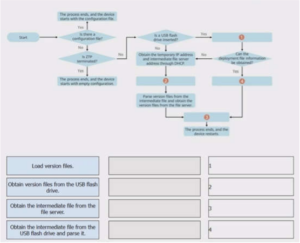
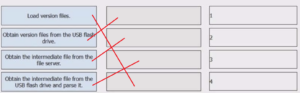
iMaster NCE-Fabric provides the ZTP-based simplified deployment function, which enables users to plan the networking topology and fabric resources, automatically onboard devices, execute device installation scripts, and deliver underlay configurations to devices in batches using a GUI. This reduces labor costs and improves deployment efficiency. In the figure, supplement the ZTP workflow.
Select and Place:
Correct Answer:
QUESTION 34
Which of the following components can analyze cross-DC traffic, evaluate the health status, and identify connectivity exceptions between applications?
A. MDC
B. SecoManager
C. MDA
D. iMaster NCE-Fabricinsight
Correct Answer: D
QUESTION 35
In the computing scenario, VMs are provisioned by the VMM connected to iMaster NCE-Fabric. The VMM manages compute resources, and iMaster NCE-Fabric manages network resources.
A. TRUE
B. FALSE
Correct Answer: A
QUESTION 36
How many rollback levels does Huawei’s iMaster NCE-Fabric support?
A. 2
B. 1
C. 4
D. 3
Correct Answer: D
QUESTION 37
Which of the following is the recommended convergence ratio for use when planning the bandwidth for server leaf nodes in a DC?
A. 3:1
B. 1:1
C. 10:1
D. 8:1
Correct Answer: B
QUESTION 38
Which of the following statements are true about routing design that employs OSPF on the underlay network of a DC?
A. Typically, the is IP address of Loopback0 is configured as the VTEP IP address and the same IP address is planned for active-active leaf nodes in the same group.
B. It is recommended that all devices be planned in Area 0.
C. This routing design is recommended when the DC has more than 300 switches.
D. The network type of spine and leaf nodes can be set to P2P in order to accelerate convergence.
Correct Answer: ABD
QUESTION 39
Which of the following nodes can forward external traffic to a DCN?
A. Service leaf
B. DCI leaf
C. Server leaf
D. Border leaf
Correct Answer: D
QUESTION 40
A DC has a complex computing service management system. The computing and management networks are isolated from each other and no cloud platform is deployed.
Which of the following scenarios in Huawei CloudFabric Solution is most suitable for this DC?
A. Computing
B. Hosting
C. Container network
D. Cloud-network integration
Correct Answer: B