H12-831_Part4
QUESTION 61
On a broadcast network, routers (including non-DIs routers) of the same level on a network segment can establish neighbor relationships. In the implementation of BFD for IS-IS, however, BFD sessions are established only between a DIS and non-DIS routers, not between non-DIS routers.
A. TRUE
B. FALSE
Correct Answer: B
QUESTION 62
On a stable network that requires fast route convergence, you can change the value of the interval at which OSPF LSAs are updated to 0 so that topology or route changes can be immediately advertised on the network through LSAs, which speeds up route convergence.
A. TRUE
B. FALSE
Correct Answer: A
QUESTION 63
The set-overload command is configured in the process of an IS-IS router. By default, how long after being restarted does the router exit the overload state?
A. 1200s
B. 900s
C. 600s
D. 500s
Correct Answer: C
QUESTION 64
On the OSPF network shown in the figure, the cost values of links are marked. OSPF IP FRR is enabled on R1, and the maximum load-balancing 1 command is configured in the OSPF process. Which of the following is the backup outbound interface from R1 to 10.0.3.3/32?
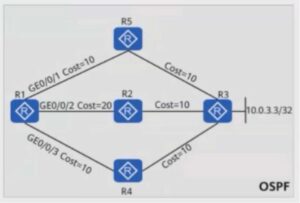
A. GE0/0/2
B. There is no backup outbound interface.
C. GE0/0/1
D. GE0/0/3
Correct Answer: C
QUESTION 65
On the OSPF network shown in the figure, area 1 is a stub area, area 2 is a totally NSSA, and area 3 is an NSSA. R5 imports an external route 10.0.5.5/32. Given this, which of the following routers do not have the route 10.0.5.5/32 in their routing tables?
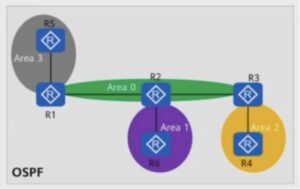
A. R6
B. R3
C. R2
D. R4
Correct Answer: ABC
QUESTION 66
On the OSPF network shown in the figure, area 1 is a stub area, area 2 is a totally stub area, and area 3 is an NSSA. Which of the following LSAs does not exist in areas 1, 2, and 3?
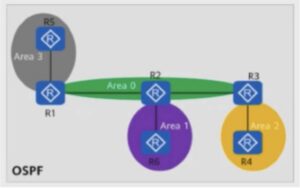
A. Type 2
B. Type 3
C. Type 1
D. Type 4
Correct Answer: D
QUESTION 67
On the OSPF network shown in the figure, areas 1, 2, and 3 are common areas. The IP address of Loopback0 on R5 is 10.0.5.5/32, and OSPF is enabled on the interface using the network command. ACL 2000 (with the matching rule shown in the figure) is configured on all routers. If the filter 2000 export command is run in area 0 (where R1, R2, and R3 reside), which of the following routers do not have the route 10.0.5.5/32 in their routing tables?
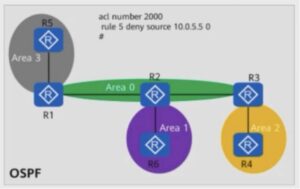
A. R2
B. R3
C. R4
D. R6
Correct Answer: CD
QUESTION 68
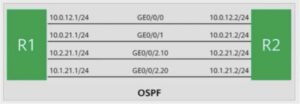
On the OSPF network shown in the figure, R1 and R2 are connected through four links. OSPF is enabled on Loopback0 of R2, and the maximum load-balancing 3 command is run in the OSPF process of R1. Which of the following are the outbound interfaces from R1 to Loopback0 of R2?
A. GE0/0/2.20
B. GE0/0/1
C. GE0/0/2.10
D. GE0/0/0
Correct Answer: ABC
QUESTION 69
When there are multiple equal-cost routes to the same destination, BGP can perform load balancing among these routes to load balance traffic. However, load balancing cannot be performed between IBGP and EBGP routes to the same destination on the public network.
A. TRUE
B. FALSE
Correct Answer: A
QUESTION 70
To reduce the possibility of attacks on BGP, use MD5 authentication between BGP peers. The MD5 algorithm is easy to configure and generates a single password that can only be changed manually.
A. TRUE
B. FALSE
Correct Answer: A
QUESTION 71
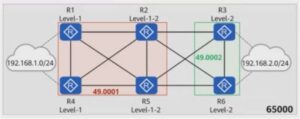
On the network shown in the figure, IS-IS runs on R1, R2, R4, and R5, and the area ID is 49.0001. IS-IS runs on R3 and R6, and the area ID is 49.0002. The import-route isis level-2 into level-1 command is configured on R2. In AS 65000, R1, R3, R4, and R6 each establish IBGP peer relationships with R2 and R5. R2 and R5 are RRs, and R1, R4, R3, and R6 are clients. The IBGP peer relationships are established using Loopback0. The IP address of Loopback0 on each router is 10.0.X.X/32, and the router ID is 10.0.x.X, where X is the number of the router. R1 and R4 import the external route 192.168.1.0/24 to BGP through the import-route command, and R3 and R6 import the external route 192.168.2.0/24 to BGP through the import-route command. Which of the following statements are true?
A. The routing table of R4 contains two equal-cost default routes.
B. The route 192.168.2.0/24 in the routing table of R4 has two next hops.
C. The routing table of R1 contains two equal-cost default routes.
D. The routing table of R1 contains the route 192.168.2.0/24.
Correct Answer: ACD
QUESTION 72
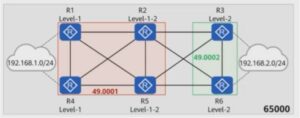
On the network shown in the figure, IS-IS runs on R1, R2, R4, and R5, and the area ID is 49.0001. IS-IS runs on R3 and R6, and the area ID is 49.0002. In AS 65000, R1, R3, R4, and R6 each establish IBGP peer relationships with R2 and R5. R2 and R5 are RRs, and Ri, R4, R3, and R6 are clients. The IBGP peer relationships are established using Loopback0. The IP address of Loopback0 on each router is 10.0.X.X/32, and the router ID is 10.0.X.X, where X is the number of the router R1 and R4 import the external route 192.168.1.0/24 to BGP through the import-route command, and R3 and R6 import the external route 192.168.2.0/24 to BGP through the import-route command. Which of the following statements are true?
A. For 192.168.1.0/24, R6 preferentially selects the BGP route with the Originator_ ID attribute 10.0.1.1.
B. For 192.168.1.0/24, R5 preferentially selects the route received from R1.
C. For 192.168.1.0/24, R3 preferentially selects the BGP route with the Originator_ID attribute 10.0.2.2.
D. For 192.168.1.0/24, R2 preferentially selects the BGP route with the Originator_ID attribute 10.0.1.1.
Correct Answer: ABD
QUESTION 73
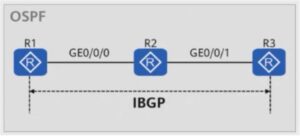
On the network shown in the figure, OSPF runs on R1, R2, and R3, and OSPF BFD is enabled. R1 and R3 use loopback interfaces to establish an IBGP peer relationship. If GE0/0/1 of R2 is shut down, which of the following is the longest period after which the BGP peer relationship of R1 will change from Up to Down?
A. 40s
B. 180s
C. 60s
D. 3s
Correct Answer: B
QUESTION 74
The figure shows the Router-LSA generated by a router. Which of the following statements are true based on the LSA?
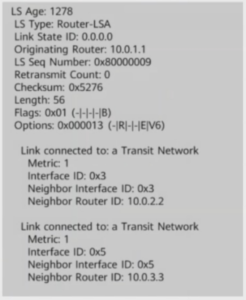
A. The router is an ASBR.
B. The router is an ABR.
C. At least one interface on the router belongs to a stub area.
D. At least one interface on the router belongs to area 0.
Correct Answer: BC
QUESTION 75
On the OSPFV3 network shown in the figure, OSPFV3 is enabled on the interfaces connecting R1, R2, and R3. The router ID of each router is 10.0.X.X, where X is the number of the router. If you check detailed information about an LSA on R3, the command output shows that the LSA is generated by R2 and describes the IPv6 prefix address associated with the Router-LSA.
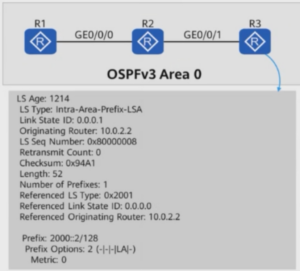
A. TRUE
B. FALSE
Correct Answer: A
QUESTION 76
Which of the following statements are true about OSPFv3?
A. OSPFv3 supports multiple processes on a link.
B. Information about the flooding scope is added to OSPFv3 LSAS.
C. OSPFv3 router LSAs and network LSAs do not contain IP addresses.
D. On broadcast, NBMA, and P2MP networks, OSPFV3 neighbors are identified only by router IDs, not by IP addresses.
Correct Answer: ABCD
QUESTION 77
Which of the following TLVs is added to IS-IS to support muti-topology?
A. TLV 232
B. TLV 129
C. TLV 236
D. TLV 229
Correct Answer: D
QUESTION 78
Which of the following is not added for IS-IS to support IPv6 route processing and calculation?
A. TLV 232, which is equivalent to the IP Interface Address TLV in IPv4, except that the original 32-bit IPv4 address is changed to a 128-bit IPv6 address.
B. The source IP address of IS-IS Hello packets is changed to the link-local address.
C. TLV 236, which describes network reachability by defining information such as route prefixes and metrics.
D. The NLPID value must be carried when IPv6 routes are advertised.
Correct Answer: B
QUESTION 79
On the IS-IS IPv6 network shown in the figure, multi-topology is enabled on all routers. The ipv6 default-route-advertise always level-1 command is configured in the IS-IS process of R4. Which of the following routers does not have the default route in its routing table?
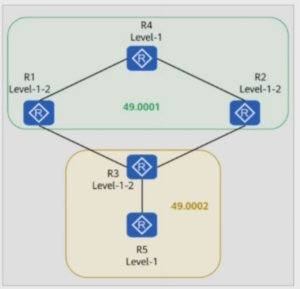
A. R5
B. R2
C. R3
D. R1
Correct Answer: A
QUESTION 80
An OSPFV3 NSSA LSA is generated by an ASBR, describes routes to a destination outside the AS, and is advertised in an NSSA.
A. TRUE
B. FALSE
Correct Answer: A