Network security has become one of the most important areas of modern IT infrastructure. As organizations move toward cloud computing, hybrid networks, remote work, and zero-trust architectures, the demand for professionals who understand enterprise security technologies continues to grow.
For network engineers and aspiring cybersecurity professionals, the CCNP Security 350-701 exam is an excellent opportunity to develop a broader understanding of Cisco security technologies and build practical skills for real-world network environments.
Officially known as Implementing and Operating Cisco Security Core Technologies (SCOR 350-701), this exam covers a wide range of security concepts, including network protection, cloud security, endpoint detection, secure network access, and security operations.
Whether you are a networking student, an entry-level engineer, or an IT professional planning to specialize in cybersecurity, this guide will help you understand the certification path, explore the latest exam objectives, and build an effective preparation strategy. You can also supplement your learning with these CCNP Security 350-701 exam preparation resources to review important concepts and test your understanding.
1. What Is the Cisco CCNP Security 350-701 Exam?
Table of Contents
ToggleThe 350-701 SCOR exam is the core examination for Cisco’s professional-level Security certification track. It evaluates a candidate’s ability to understand, implement, and operate modern security technologies across enterprise network environments.
The exam is designed around practical security requirements rather than isolated theoretical concepts. Candidates are expected to understand how different security technologies work together to protect users, devices, applications, and network infrastructure.
Some of the major technology areas include:
- Enterprise network security and firewall technologies
- Cryptography, encryption, and VPN technologies
- Cloud security and shared responsibility models
- Secure Service Edge (SSE) and Secure Access Service Edge (SASE)
- Endpoint Protection and Detection (EPP and EDR)
- Identity management and network access control
- Security monitoring, telemetry, SIEM, and XDR
- Security automation and API integration
One important point for candidates to understand is that passing the 350-701 SCOR exam alone does not award the complete CCNP Security certification. It earns the Cisco Certified Specialist – Security Core certification and satisfies the core examination requirement for CCNP Security.
To earn the full CCNP Security certification, candidates must also pass one approved concentration examination of their choice.
Candidates who want additional preparation exercises can also explore these 350-701 SCOR practice materials alongside the official Cisco learning resources.
2. Important Update: The SCOR v2.0 Exam Blueprint
Cisco introduced the major SCOR v2.0 examination update on August 27, 2026. This is an important change for anyone preparing for the 350-701 exam.
The updated blueprint reflects how enterprise security environments have evolved. Traditional network protection remains important, but modern security architectures increasingly rely on cloud-delivered protection, identity-aware access, artificial intelligence security, and integrated security operations.
Compared with older SCOR v1.1 preparation materials, the v2.0 blueprint places greater emphasis on several modern technologies:
- AI and LLM Security: Understanding threats such as prompt injection, system prompt leakage, and weaknesses in AI model supply chains.
- Secure Service Edge: Understanding cloud-delivered security architectures and Cisco Secure Access.
- Cloud Workload Protection: Learning about microsegmentation, Cisco Secure Workload, Multicloud Defense, and eBPF.
- Security Automation: Understanding Infrastructure as Code, DevSecOps, APIs, and Python-based automation.
- Advanced Security Operations: Using Splunk, Cisco XDR, telemetry, and AI/ML-based security analytics.
For candidates who have already started studying, the most important recommendation is to check the latest official exam blueprint before purchasing preparation materials. Older study notes may still be useful for foundational concepts, but they should not be treated as a complete preparation resource for SCOR v2.0.
Official reference: Cisco 350-701 SCOR v2.0 Exam Blueprint (PDF).
3. CCNP Security 350-701 Exam Information
Before starting your preparation, it is useful to understand the basic examination requirements and certification structure.
| Exam Information | Details |
|---|---|
| Exam Number | 350-701 SCOR |
| Official Exam Name | Implementing and Operating Cisco Security Core Technologies |
| Exam Version | v2.0 |
| Exam Duration | 120 minutes |
| Exam Fee | US$400 |
| Available Languages | English and Japanese |
| Prerequisites | None formally required |
| Exam Result | Pass or Fail |
| Result Availability | Online, generally within 48 hours |
| Certification Validity | 3 years |
| Certification Earned | Cisco Certified Specialist – Security Core |
Although Cisco does not require formal prerequisites, candidates will benefit significantly from having a solid understanding of networking fundamentals, particularly TCP/IP, routing, switching, VLANs, access control lists, and basic network troubleshooting.
For the latest registration information, always refer to the official Cisco SCOR examination page.
4. How to Earn the CCNP Security Certification
Cisco uses a two-exam structure for its professional-level certifications. This approach allows candidates to demonstrate broad technical knowledge while choosing a specialization that matches their career interests.
The CCNP Security certification requires:
- Pass the core examination: 350-701 SCOR.
- Pass one approved Security concentration examination.
Current concentration options include:
- 300-710 SNCF: Securing Networks with Cisco Firewalls.
- 300-715 SISE: Implementing and Configuring Cisco Identity Services Engine.
- 300-740 SSCA: Designing and Implementing Secure Cloud Access for Users and Endpoints.
- 300-745 SDSI: Designing Cisco Security Infrastructure.
Each concentration exam focuses on a different technical area. For example, engineers interested in firewall deployment may prefer SNCF, while professionals working with identity-based access control may find SISE more relevant.
This flexible structure makes CCNP Security useful for professionals with different technical backgrounds and career goals.
Learn more: Cisco CCNP Security Certification Overview.
5. Complete CCNP Security Exam Topic Breakdown
Understanding the official exam objectives is one of the most important steps in preparing for the 350-701 SCOR exam. Candidates should also review each major CCNP Security Exam Topic and use practice-oriented learning resources to reinforce their understanding of the technologies covered by the blueprint.
According to the current SCOR v2.0 blueprint, the examination contains six major knowledge domains. The following table shows their respective weightings.
| Exam Domain | Weight |
|---|---|
| 1. Security Concepts | 20% |
| 2. Network Security | 25% |
| 3. Cloud Security | 15% |
| 4. Secure Service Edge | 10% |
| 5. Endpoint Protection and Detection | 15% |
| 6. Network Access, Visibility, and Enforcement | 15% |
Let’s take a closer look at each domain and the technical knowledge candidates should develop.
5.1 Security Concepts – 20%
Security Concepts establishes the theoretical foundation for the rest of the examination. Candidates should understand common cyber threats, security vulnerabilities, cryptographic technologies, VPN architectures, and modern security frameworks.
Important subjects include:
- Common attacks against on-premises, hybrid, and cloud environments.
- Malware, phishing, DDoS, man-in-the-middle attacks, and credential compromise.
- Common application vulnerabilities, including SQL injection and cross-site scripting.
- OWASP Top 10, Common Vulnerabilities and Exposures (CVE), and Common Vulnerability Scoring System (CVSS).
- AI and LLM security vulnerabilities, including prompt injection and supply chain risks.
- Cryptography, hashing, symmetric and asymmetric encryption, PKI, TLS, QUIC, and IPsec.
- Post-quantum cryptography fundamentals.
- Site-to-site VPN and remote access VPN architectures.
- Zero Trust Architecture and defense-in-depth strategies.
- Python scripts and APIs used to interact with security appliances.
For beginners, it is particularly important to understand the difference between encryption and hashing, how digital certificates establish trust, and why organizations use different VPN technologies for different connectivity requirements.
5.2 Network Security – 25%
Network Security is the largest domain in the SCOR v2.0 blueprint, accounting for 25% of the examination.
This section focuses on protecting enterprise network infrastructure, controlling traffic, deploying firewalls, and maintaining secure management access.
Key technologies include:
- Next-generation firewall and intrusion prevention technologies.
- Cisco Secure Firewall Threat Defense (FTD).
- Network segmentation using VLANs and Security Group Tags (SGTs).
- Layer 2 security, port security, DHCP snooping, and Dynamic ARP Inspection.
- Protection against MAC flooding, ARP spoofing, VLAN hopping, and rogue DHCP servers.
- Infrastructure device hardening and CIS benchmarks.
- AAA authentication using TACACS+ and RADIUS.
- Secure management protocols such as SNMPv3, NETCONF, RESTCONF, and secure syslog.
- Access control policies, application visibility and control (AVC), URL filtering, and malware protection.
- Site-to-site VPN and remote access VPN configuration and troubleshooting.
A good way to understand this domain is to imagine a corporate network with multiple departments, remote offices, and internet-facing applications. You need to determine how traffic should be controlled, how unauthorized devices should be prevented from connecting, and how administrators can securely manage network equipment.
Practical experience with firewall policies, network segmentation, and AAA troubleshooting can make these concepts much easier to understand.
5.3 Cloud Security – 15%
Cloud computing has changed the way organizations deploy applications and manage infrastructure. Security engineers must now understand how to protect resources distributed across public, private, and hybrid cloud environments.
This domain covers:
- Cloud Shared Responsibility Models.
- SaaS, PaaS, and IaaS service models.
- Public, private, hybrid, and community cloud deployment models.
- Cloud Access Security Brokers (CASB).
- Cloud network, application, and data security.
- Cisco Multicloud Defense and Cisco Secure Workload.
- Cloud logging and monitoring using Splunk.
- Application and workload security, including eBPF.
- DevSecOps, Infrastructure as Code, CI/CD pipelines, and container security.
One particularly important concept is the Shared Responsibility Model. Cloud service providers and customers have different security responsibilities depending on the service model being used.
For example, an organization using IaaS is generally responsible for more of its operating system, application, and workload security than an organization using a fully managed SaaS application.
Understanding these differences is essential when designing security controls for cloud environments.
5.4 Secure Service Edge – 10%
Secure Service Edge (SSE) is an increasingly important component of modern enterprise security architecture.
Traditional network security models often rely on centralized firewalls and perimeter-based access controls. However, remote employees, cloud applications, and distributed infrastructure have made these approaches more difficult to manage.
SSE addresses this challenge by delivering security capabilities through cloud-based services.
Important examination topics include:
- Secure Service Edge (SSE) architecture.
- Secure Access Service Edge (SASE) architecture.
- Cisco Secure Access Secure Internet Access.
- Cisco Secure Access Secure Private Access.
- Data Loss Prevention (DLP).
- AI guardrails for secure internet access.
- Interpreting Cisco Secure Access investigation scores and indicators.
Students should understand the differences between traditional perimeter security, SSE, and SASE. They should also understand how identity, application context, and security policies work together to provide secure access to internet and private applications.
5.5 Endpoint Protection and Detection – 15%
Network firewalls alone cannot provide complete enterprise protection. Endpoints such as laptops, desktops, and mobile devices are frequently targeted by malware, ransomware, phishing, and credential theft attacks.
This domain focuses on endpoint security technologies and threat detection capabilities.
Key subjects include:
- Endpoint Protection Platforms (EPP).
- Endpoint Detection and Response (EDR).
- Mobile Device Management (MDM).
- Endpoint posture assessment and compliance.
- Cisco Secure Client.
- Cisco Secure Malware Analytics.
- Cisco Secure Endpoint configuration and malware detection.
- Interpreting endpoint security alerts and detection events.
- Cisco Security Email Threat Defense.
It is important to understand the differences between EPP and EDR. EPP focuses primarily on preventing endpoint threats, while EDR provides additional capabilities for detecting, investigating, and responding to suspicious activities.
Candidates should also understand how endpoint security events can be integrated into a broader security monitoring and incident response process.
5.6 Network Access, Visibility, and Enforcement – 15%
The final domain focuses on identity-based security, network access control, security monitoring, and enforcement.
Modern enterprise networks must verify not only who is connecting, but also whether the connecting device is trusted and compliant with organizational security policies.
Important topics include:
- Identity management and secure network access.
- Guest access, endpoint profiling, posture assessment, and BYOD.
- Network Access Control (NAC).
- 802.1X and MAC Authentication Bypass (MAB).
- Cisco Identity Services Engine (ISE).
- RADIUS and Change of Authorization (CoA).
- Network data exfiltration techniques.
- Security telemetry and network visibility.
- SIEM, SOAR, and XDR technologies.
- Splunk and Cisco XDR.
- Cisco Duo, Multi-Factor Authentication (MFA), Single Sign-On (SSO), and Device Trust.
- Security information and event management automation.
Cisco ISE is particularly important because it provides centralized identity-based network access control. Candidates should understand how 802.1X authentication works, how MAB differs from 802.1X, and how authorization policies determine the access granted to different devices.
Understanding the relationship between network access control and security monitoring is also essential.
6. How to Choose a 350-701 SCOR Study Guide
Choosing the right preparation materials can make a significant difference in your learning experience. However, not every study guide available online is aligned with the latest examination objectives.
For the current 350-701 SCOR exam, I recommend combining official Cisco documentation, structured learning materials, technical references, and hands-on exercises.
6.1 Start with the Official Cisco Exam Blueprint
The official exam blueprint should always be your primary reference.
It identifies the knowledge areas, technical objectives, and approximate weighting of each examination domain. Use it as a checklist throughout your preparation.
Download the current document here:
350-701 SCOR v2.0 Official Exam Topics.
After reviewing the official blueprint, you can use this 350-701 SCOR Study Guide and practice resource as an additional way to review exam-related concepts, reinforce your understanding, and identify areas that may require further study.
6.2 Use the Cisco Press Official Cert Guide
The CCNP and CCIE Security Core SCOR 350-701 Official Cert Guide, Second Edition, written by Omar Santos, is a useful structured reference for building a solid understanding of Cisco security technologies.
The book includes technical explanations, knowledge assessments, practice questions, and study planning resources.
However, it was published in November 2023, before the SCOR v2.0 major blueprint update. Therefore, candidates should use it as a foundational study resource and cross-check its coverage against the current 2026 examination objectives.
Book information: Cisco Press Official Cert Guide, Second Edition.
6.3 Follow Cisco’s Official SCOR Training
Cisco provides an official training course called Implementing and Operating Cisco Security Core Technologies (SCOR).
The course is designed to prepare candidates for the 350-701 examination and includes practical learning objectives covering security architecture, firewall configuration, cloud security, endpoint protection, secure access, and security operations.
It is a particularly useful option for learners who prefer structured instruction rather than studying entirely from books.
Official course: Cisco SCOR Training Course.
6.4 Supplement Your Preparation with Technical References
Some SCOR topics involve technologies and security concepts that are not exclusive to Cisco. Reading authoritative technical references can help you understand the underlying principles.
Useful resources include:
- OWASP Top 10 – Common web application security risks.
- NIST SP 800-145 – The definition and fundamental models of cloud computing.
- CVE Program – Publicly disclosed cybersecurity vulnerabilities.
- FIRST CVSS v4.0 – Vulnerability severity assessment.
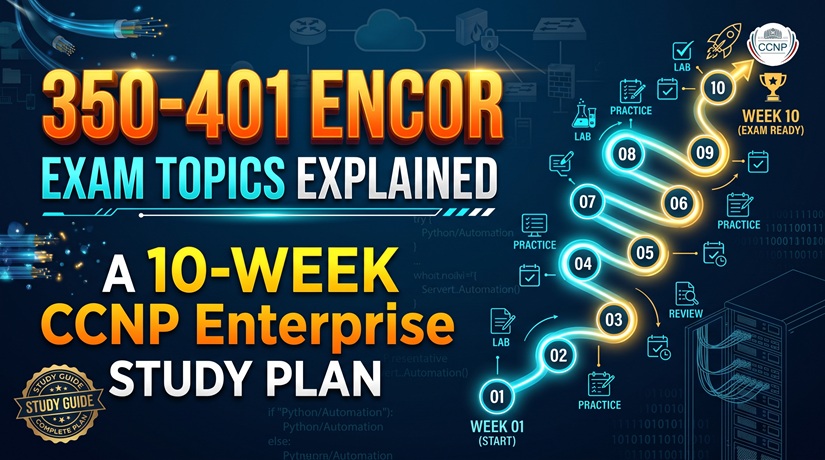
7. A Practical 10-Week CCNP Security Exam Preparation Plan
If you already have basic networking knowledge, a structured 10-week preparation plan can help you cover the major examination objectives without spending too much time on any single topic.
The following is a suggested schedule, not an official Cisco requirement. You can adjust it depending on your existing experience and available study time.
| Week | Study Focus | Recommended Activities |
|---|---|---|
| 1 | Networking and Security Fundamentals | Review TCP/IP, routing, switching, VLANs, ACLs, and basic security concepts. |
| 2 | Security Concepts | Study threats, vulnerabilities, cryptography, PKI, VPNs, and Zero Trust. |
| 3 | Network Security | Learn firewall architectures, intrusion prevention, segmentation, and infrastructure security. |
| 4 | Network Security Configuration | Practice FTD policies, VPN configuration, AAA, and troubleshooting. |
| 5 | Cloud Security | Study cloud models, shared responsibility, CASB, workload security, and DevSecOps. |
| 6 | Secure Service Edge | Understand SSE, SASE, Secure Access, DLP, and AI security controls. |
| 7 | Endpoint Protection and Detection | Study EPP, EDR, endpoint posture, malware analytics, and email security. |
| 8 | Network Access and Identity | Practice ISE concepts, 802.1X, MAB, RADIUS, CoA, and Duo. |
| 9 | Visibility and Automation | Review Splunk, XDR, security telemetry, APIs, and basic Python scripts. |
| 10 | Final Review and Practice | Complete practice tests, revisit weak areas, and review the entire v2.0 blueprint. |
During the final preparation stage, working through additional 350-701 SCOR practice questions can help you assess your understanding of different technical areas and identify topics that need another review.
One important recommendation: do not spend all your preparation time memorizing definitions. Try to understand how each technology is deployed, why it is needed, and how it interacts with other security components.
8. Why Hands-On Labs Matter
Reading technical documentation is important, but practical exercises help transform theoretical knowledge into usable engineering skills.
For candidates preparing for CCNP Security 350-701, the following lab activities are worth considering:
Network Infrastructure Security
- Create VLAN-based network segmentation.
- Configure port security and access control policies.
- Understand DHCP snooping and Dynamic ARP Inspection.
- Explore secure device management and AAA authentication.
Firewall and VPN Technologies
- Explore Cisco Secure Firewall Threat Defense architecture.
- Create and verify firewall access control policies.
- Understand intrusion prevention and malware protection policies.
- Configure site-to-site and remote access VPN scenarios.
- Practice troubleshooting failed VPN connections.
Identity and Access Control
- Understand the 802.1X authentication process.
- Compare 802.1X and MAB authentication.
- Explore Cisco ISE authentication and authorization policies.
- Understand RADIUS and CoA operations.
- Explore MFA and device trust concepts.
Security Monitoring and Automation
- Review security logs and investigate suspicious activities.
- Understand how SIEM and XDR platforms collect security information.
- Explore Splunk search and security event analysis.
- Practice interpreting Python scripts that communicate with security appliance APIs.
You do not need access to every commercial Cisco security product to begin learning. Start with the networking equipment and lab resources available to you, then use Cisco training environments or authorized demonstrations when you need to explore specific enterprise security platforms.
9. Is the CCNP Security Certification Worth It?
For networking professionals who want to move into cybersecurity, the CCNP Security certification can be a valuable step in their professional development.
Modern organizations need engineers who understand more than basic network connectivity. They need professionals who can protect network infrastructure, manage security policies, control user access, investigate threats, and maintain secure communication across hybrid environments.
Preparing for the 350-701 SCOR exam helps candidates develop knowledge in several important areas of enterprise security.
These skills are relevant to positions such as:
- Network Security Engineer
- Cybersecurity Engineer
- Network Security Administrator
- Firewall Engineer
- Security Operations Engineer
- Security Solutions Engineer
- IT Infrastructure Security Specialist
The certification can help demonstrate structured knowledge of Cisco security technologies to employers. However, passing an examination does not automatically guarantee employment or replace practical engineering experience.
For beginners, the best approach is to combine certification preparation with real networking experience, troubleshooting exercises, and hands-on security projects.
10. Frequently Asked Questions (FAQ)
Q1. Is the CCNP Security 350-701 exam difficult?
The exam can be challenging, especially for candidates who have limited experience with enterprise security technologies. It covers several different technical areas, including firewalls, VPNs, cloud security, endpoint protection, identity management, and security operations. A structured study plan and practical exercises can make preparation more manageable.
Q2. Do I need CCNA before taking the 350-701 SCOR exam?
No. Cisco does not require CCNA or any other formal prerequisite for the 350-701 SCOR exam. However, a solid understanding of networking fundamentals is strongly recommended.
Q3. Does passing 350-701 SCOR automatically give me CCNP Security?
No. Passing the core exam earns the Cisco Certified Specialist – Security Core certification. You must also pass one approved Security concentration exam to earn the full CCNP Security certification.
Q4. How long should I study for the 350-701 exam?
Preparation time depends on your networking background and familiarity with security technologies. Candidates with professional networking experience may need less time than beginners. A structured 8-to-12-week preparation period is a reasonable starting point for many learners, provided they study consistently and practice the relevant technologies.
Q5. Are older SCOR study guides still useful?
Yes, older study materials can still help explain fundamental concepts such as cryptography, VPNs, firewalls, and network security. However, candidates should use the SCOR v2.0 blueprint as their primary reference and supplement older materials with newer topics such as SSE, AI/LLM security, eBPF, and updated Cisco Secure Access technologies.
Q6. What is the best way to prepare for the SCOR v2.0 exam?
A balanced approach is recommended: begin with the official Cisco exam blueprint, use a structured study guide, follow Cisco training resources, practice relevant security technologies, and regularly evaluate your knowledge using legitimate practice tests. You can also explore these 350-701 SCOR exam preparation materials as supplementary learning resources.
11. Official References and Further Reading
The following resources provide additional information about the CCNP Security certification, the 350-701 SCOR exam, and the underlying security technologies.
- Cisco 350-701 SCOR Official Exam Page – Examination details and registration information.
- Cisco CCNP Security Certification – Certification requirements and concentration options.
- 350-701 SCOR v2.0 Exam Blueprint – The official examination objectives and domain weightings.
- Cisco SCOR Official Training – Structured training and technical learning objectives.
- Cisco Security Certification Updates: Your Questions Answered – Information about the 2026 certification changes.
- CCNP and CCIE Security Core SCOR 350-701 Official Cert Guide – Cisco Press study reference.
- NIST SP 800-145: The NIST Definition of Cloud Computing – Cloud computing concepts and service models.
- OWASP Top 10 – Common web application security risks.
- CVE Program – Public cybersecurity vulnerability information.
- FIRST CVSS v4.0 – Vulnerability scoring and severity assessment.
Final Thoughts
The CCNP Security 350-701 SCOR exam provides a structured way to develop a broad understanding of enterprise security technologies. Its updated v2.0 blueprint reflects the direction of modern cybersecurity, where network protection, cloud security, endpoint defense, identity management, and security operations are increasingly interconnected.
For beginners, the journey may seem challenging at first. However, by building a strong networking foundation, following the official examination objectives, and practicing real-world security scenarios, you can gradually develop the knowledge and confidence needed for professional-level security work.
Remember that the goal is not simply to pass an examination. It is to understand how enterprise security systems work, how they protect business infrastructure, and how to troubleshoot them when things go wrong.
If you are ready to take the next step, review the CCNP Security 350-701 study and practice resources and build a preparation routine that combines technical knowledge, hands-on experience, and regular self-assessment.
Start with the official SCOR v2.0 blueprint, build your knowledge step by step, and turn your study time into practical engineering skills.