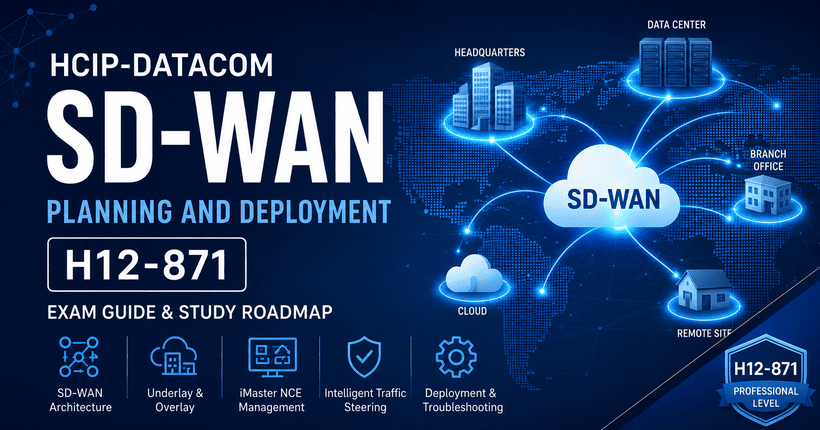
Wide area networks are changing quickly. Traditional enterprise WANs built mainly around private circuits and manually configured routers are increasingly being supplemented—or replaced—by software-defined networking technologies. For network engineers, this means that understanding routing protocols is no longer enough. Engineers are also expected to understand centralized management, overlay networks, automated deployment, application-aware traffic steering, and WAN service policies.
The HCIP-Datacom-SD-WAN Planning and Deployment certification, associated with the H12-871 exam, focuses on these skills within Huawei’s Datacom technology ecosystem. It is intended for engineers who want to move beyond basic routing and switching and develop practical knowledge of planning, deploying, and operating enterprise SD-WAN networks.
This guide introduces the H12-871 certification direction, explains the technologies you should understand, and provides a practical study approach for candidates preparing for the exam.
What Is the HCIP-Datacom-SD-WAN Planning and Deployment Certification?
Table of Contents
ToggleHCIP stands for Huawei Certified ICT Professional. Within Huawei’s Datacom certification framework, HCIP represents a professional-level qualification aimed at engineers who need deeper technical knowledge and practical networking skills.
HCIP-Datacom-SD-WAN Planning and Deployment is a specialized Datacom direction focusing on software-defined wide area networking. Instead of concentrating only on individual router configuration, it considers the WAN as a complete system consisting of physical links, logical overlay networks, controllers, edge devices, routing policies, application policies, and operational tools.
| Item | Details |
|---|---|
| Certification Direction | HCIP-Datacom-SD-WAN Planning and Deployment |
| Exam Code | H12-871 |
| Certification Level | HCIP – Professional |
| Technology Area | Datacom / SD-WAN |
| Main Focus | SD-WAN planning, deployment, service configuration, optimization, and troubleshooting |
| Suitable Candidates | Network engineers, WAN engineers, implementation engineers, technical support engineers, students, and Datacom professionals |
Candidates who are actively preparing for the certification can also review the H12-871 HCIP-Datacom-SD-WAN exam preparation page alongside their official Huawei training materials and hands-on practice.
Exam policies and certification requirements may change over time, so candidates should always confirm the latest registration and exam information through Huawei’s official certification platform before scheduling an exam.
Why SD-WAN Skills Matter
Traditional WAN design often relies heavily on static architectures. A company may have MPLS circuits connecting branches to headquarters, Internet links for general access, and separate configurations for different branch routers. As the number of sites increases, operating such a network becomes increasingly difficult.
SD-WAN changes this model by introducing centralized orchestration and policy-driven networking.
An enterprise may have several WAN transport options available at the same branch, including:
- MPLS private lines
- Business Internet connections
- Broadband Internet
- LTE or 5G links
- Leased lines
- Other enterprise WAN services
Instead of treating every connection independently, an SD-WAN solution can build a logical WAN across these different transport networks and make forwarding decisions according to business requirements.
For example, voice traffic may require low delay and low packet loss, while software updates are more concerned with bandwidth than latency. An SD-WAN policy can treat these applications differently instead of forcing all traffic to follow the same path.
This combination of networking, automation, application awareness, and centralized policy is why SD-WAN knowledge has become increasingly useful for modern enterprise network engineers.
H12-871 Is More Than a Routing Exam
If you already understand technologies such as OSPF, BGP, VPNs, and QoS, you have a useful foundation for H12-871. However, SD-WAN introduces another layer of thinking.
In a conventional router-focused environment, an engineer may ask:
Which routing protocol should I configure on this interface?
In an SD-WAN project, the questions are broader:
- How should branch sites connect to the WAN?
- Which transport networks should each site use?
- How should sites be grouped into virtual networks?
- Which overlay topology is appropriate?
- How will CPE devices be deployed automatically?
- Which applications require guaranteed service levels?
- What should happen when link quality deteriorates?
- How should Internet access be designed?
- How should failures be monitored and diagnosed?
This difference is important when preparing for the Huawei H12-871 exam. Memorizing isolated commands is less useful than understanding how the individual technologies work together to deliver an end-to-end SD-WAN service.
Core Technologies to Study for the H12-871 Exam
1. Huawei SD-WAN Architecture
A good starting point is understanding the overall SD-WAN architecture and the responsibilities of each component.
At a conceptual level, an enterprise SD-WAN can be viewed as several cooperating layers:
- Underlay network – provides physical WAN connectivity.
- Overlay network – creates logical connectivity between enterprise sites.
- Management and control system – centrally orchestrates devices, topology, routes, and policies.
- Service policy layer – determines how different applications and services use the WAN.
Keeping these layers separate in your mind makes many later topics easier to understand.
2. Underlay Network Planning
The underlay is the physical IP network that provides reachability between SD-WAN devices and supporting systems.
A branch might connect using one MPLS circuit and one Internet circuit, while another branch may use dual Internet connections plus a 5G backup link. From the SD-WAN perspective, these are transport resources over which logical connectivity can be constructed.
Important underlay concepts include:
- WAN interface planning
- IP address planning
- Static and dynamic routing
- Transport network selection
- Multiple WAN links
- Link redundancy
- NAT considerations
- Connectivity between CPEs and the management/control system
One common mistake when studying SD-WAN is to focus almost entirely on the overlay. In practice, a broken underlay means that the overlay cannot operate correctly. Troubleshooting therefore often begins by verifying basic IP reachability.
3. Overlay Networks
The overlay is one of the most important concepts in SD-WAN.
Rather than making enterprise connectivity directly dependent on the topology of the service provider network, logical tunnels are created between SD-WAN sites. This allows an enterprise to build its own logical topology over different types of WAN transport.
You should understand concepts such as:
- Overlay tunnels
- Virtual networks (VNs)
- VPN-based service isolation
- Branch-to-branch communication
- Branch-to-headquarters communication
- Hub-and-spoke topology
- Full-mesh or more flexible topology models
- Route distribution between sites
For example, finance traffic and general office traffic can be assigned to different virtual networks even though they use the same physical WAN links.
This separation between the physical transport network and the logical enterprise network is one of the fundamental ideas behind SD-WAN.
4. SD-WAN EVPN and Route Reflectors
Huawei SD-WAN solutions use technologies such as BGP EVPN to distribute routing and reachability information for overlay services.
A Route Reflector (RR) plays an important role in controlling route distribution between SD-WAN sites. Rather than requiring every branch to maintain a full routing relationship with every other branch, route information can be centrally coordinated according to the planned network topology.
For H12-871 preparation, make sure you understand:
- The purpose of an RR
- Edge site and RR site concepts
- How routes are distributed between sites
- How overlay topology influences route advertisement
- How logical tunnels and routes work together
- The relationship between EVPN and SD-WAN service networks
You do not need to treat EVPN as a collection of isolated protocol fields. Try to understand why it is being used: scalable distribution of service reachability across the SD-WAN overlay.
5. iMaster NCE and Centralized Management
Centralized management and orchestration are major differences between SD-WAN and manually operated WAN environments.
Huawei SD-WAN deployments use the iMaster NCE platform family to provide centralized network management, orchestration, policy delivery, and operational visibility. Depending on the solution generation and software version, specific product naming and menu structures may differ, so understanding the function is more important than memorizing one graphical interface.
You should understand how a controller or management system participates in:
- Site creation
- Device onboarding
- WAN link configuration
- Overlay orchestration
- Virtual network creation
- Topology configuration
- Policy delivery
- Application experience monitoring
- Alarm and network status monitoring
In traditional networking, an engineer may configure 100 branch routers individually. In SD-WAN, the objective is to define reusable policies and allow the management platform to orchestrate those configurations across many sites.
6. Zero-Touch Provisioning
Zero-Touch Provisioning (ZTP) is another important SD-WAN concept.
Large organizations may need to deploy hundreds or thousands of branch CPE devices. Sending a senior network engineer to manually configure every router is expensive and inefficient.
With ZTP, a branch device can be installed with minimal local configuration and then automatically establish communication with the management system, obtain the required information, and receive its intended network configuration.
When studying ZTP, understand the complete workflow rather than only remembering configuration steps:
- A CPE is physically installed.
- The device obtains basic WAN connectivity.
- The device reaches the required management or registration services.
- The device identity and site information are validated.
- Configuration and service policies are delivered.
- The branch becomes part of the SD-WAN network.
The exact onboarding mechanism may vary by solution and deployment scenario, but the operational objective remains the same: reducing manual configuration at remote sites.
7. Site and Topology Planning
Real SD-WAN deployments rarely consist of identical branches. A network may contain headquarters, regional centers, data centers, large branches, small branches, cloud environments, and Internet breakout sites.
You therefore need to understand how different sites should be organized.
Topology planning may involve:
- Hub-and-spoke connectivity
- Branch-to-branch connectivity
- Regional hubs
- Multiple headquarters
- Redundant gateways
- Data center connectivity
- Centralized Internet access
- Local Internet access
The technically simplest topology is not always the best business design. The correct design depends on traffic flows, redundancy requirements, security policies, available bandwidth, and application behavior.
8. Intelligent Traffic Steering
Intelligent traffic steering is one of the most useful SD-WAN topics to understand because it demonstrates the difference between traditional route selection and application-aware WAN control.
A traditional routing protocol generally selects a path using routing metrics. SD-WAN can consider both network conditions and application requirements.
Typical link-quality indicators include:
- Latency
- Packet loss
- Jitter
- Available bandwidth or bandwidth utilization
- Link availability
Suppose a branch has both MPLS and Internet connectivity. Voice traffic normally uses MPLS because of its predictable quality. If the MPLS link becomes congested and no longer meets the application’s SLA requirement, SD-WAN can move the voice traffic to another path that provides better real-time performance.
The important concept is not simply “failover.” Intelligent traffic steering can make forwarding decisions based on application requirements and measured path quality.
9. Application Identification and SLA Policies
Modern WAN optimization is increasingly application-aware.
Different applications behave very differently:
- Voice is sensitive to delay, jitter, and packet loss.
- Video conferencing needs consistent bandwidth and low delay.
- Web applications may tolerate moderate latency.
- File transfers generally prioritize throughput.
- Backup traffic can often use lower-priority links.
An SD-WAN policy can classify traffic and assign different forwarding behavior according to business importance.
For the H12-871 exam, connect three concepts together:
Application identification → SLA requirement → path selection policy
If you understand that relationship clearly, many traffic-policy scenarios become much easier to analyze.
10. VPN and Service Isolation
Enterprise WANs frequently carry traffic from multiple business departments or security zones. These services may need to share WAN infrastructure without being allowed to communicate directly.
Virtual networks and VPN technologies make this possible.
You should understand why an organization might create different logical networks for:
- Corporate office users
- Finance systems
- Production networks
- Guest services
- IoT devices
- Management traffic
Logical segmentation improves security and gives administrators greater control over routing and policy behavior.
11. SD-WAN Security
SD-WAN frequently uses public Internet infrastructure as one of its transport options, making security an essential part of the design.
Overlay connectivity can therefore use technologies such as IPsec encryption to protect enterprise traffic transmitted across untrusted networks.
Depending on the solution architecture, security planning may also involve:
- Traffic segmentation
- Access control
- Internet access security
- Firewall integration
- Encrypted overlay connectivity
- Security policies between different service networks
Modern Secure SD-WAN architectures increasingly combine WAN connectivity and security functions, so network engineers benefit from understanding both areas.
12. Operations, Monitoring, and Troubleshooting
A network is not finished when deployment succeeds. It must remain observable and maintainable.
An HCIP-level engineer should be able to approach an SD-WAN fault systematically.
A useful troubleshooting order is:
- Check device and physical interface status.
- Verify underlay IP connectivity.
- Confirm that the CPE is correctly registered and managed.
- Verify control-plane relationships.
- Check overlay tunnel status.
- Verify VPN and route information.
- Check service and traffic-steering policies.
- Review application SLA and link-quality data.
- Check alarms, logs, and configuration consistency.
This layered troubleshooting approach is much more effective than immediately changing configuration.
Traditional WAN vs. SD-WAN
| Area | Traditional WAN | SD-WAN |
|---|---|---|
| Configuration | Often device-by-device | Centralized and policy-driven |
| Transport | Frequently dependent on specific WAN services | Can combine multiple transport technologies |
| Topology | Closely tied to physical network design | Logical overlay can be separated from the underlay |
| Traffic Selection | Primarily routing-metric based | Can consider applications and SLA conditions |
| Branch Deployment | Manual configuration is common | ZTP and centralized orchestration |
| Visibility | Often distributed across multiple devices/tools | Centralized monitoring and application visibility |
| Policy | Configured separately on devices | Policies can be centrally defined and delivered |
Who Should Consider the H12-871 Exam?
The H12-871 HCIP-Datacom-SD-WAN certification exam is particularly relevant for people who already have basic networking knowledge and want to specialize in enterprise WAN technologies.
Typical candidates include:
- Network engineers working with enterprise routers
- WAN deployment engineers
- Huawei Datacom engineers
- Network operations and maintenance engineers
- Technical support engineers
- Network solution engineers
- ICT students who already understand routing and switching
- Engineers moving from traditional WAN technologies to SD-WAN
Absolute beginners may find H12-871 difficult without first learning basic networking technologies. A strong understanding of IP addressing, routing, VPNs, QoS, and enterprise WAN concepts will make SD-WAN much easier to learn.
Recommended Knowledge Before Studying H12-871
Before going deeply into SD-WAN, make sure you are comfortable with the following fundamentals:
- IPv4 addressing and subnetting
- Static routing
- OSPF
- BGP fundamentals
- VPN and VRF concepts
- NAT
- QoS fundamentals
- WAN technologies
- IPsec fundamentals
- Basic enterprise network troubleshooting
You do not need to be an expert in every protocol before starting, but weak routing fundamentals tend to make overlay troubleshooting unnecessarily confusing.
How to Prepare for the H12-871 Exam
Step 1: Build a Strong SD-WAN Mental Model
Start with architecture rather than configuration commands.
Make sure you can explain the following without referring to notes:
- What is an underlay?
- What is an overlay?
- What does a CPE do?
- What is the purpose of an RR?
- What role does iMaster NCE play?
- Why are VNs required?
- Why is ZTP useful?
- How does intelligent traffic steering work?
If those concepts are clear, detailed deployment workflows become much easier to remember.
Step 2: Learn Technologies as Workflows
Avoid studying every feature as an isolated definition.
For example, when learning branch deployment, think through the complete sequence:
Plan the site → create the site → prepare WAN connectivity → onboard the CPE → establish underlay reachability → build the overlay → distribute routes → apply service policies → verify traffic.
Workflow-based learning closely resembles how engineers solve real deployment problems.
Step 3: Practice With Network Scenarios
Scenario questions are easier when you are used to asking why a design exists.
Consider an enterprise with:
- One headquarters
- Two data centers
- 50 branch offices
- MPLS and Internet at large branches
- Dual Internet at smaller branches
- Voice, ERP, video, and backup traffic
Then ask yourself:
- Which topology should be used?
- Should branches communicate directly?
- How should Internet access be provided?
- Which applications need SLA assurance?
- What happens if the primary WAN link experiences packet loss?
- Which services require separate VNs?
This type of practice develops architectural understanding rather than short-term memorization.
Step 4: Use Hands-On Labs Whenever Possible
SD-WAN is difficult to learn entirely from diagrams.
If you have access to a Huawei training environment or suitable lab platform, practice tasks such as:
- Creating sites
- Configuring WAN links
- Planning underlay connectivity
- Creating virtual networks
- Building overlay topologies
- Configuring traffic policies
- Testing path changes
- Checking tunnel status
- Reviewing routes and alarms
- Troubleshooting failed site connectivity
Seeing how the controller, CPE, routes, tunnels, and policies interact makes the theory much easier to retain.
Step 5: Combine Theory With Targeted Exam Review
After you understand the core technologies, use structured review to identify weaker topics. A good preparation cycle is to study one domain, review configuration and deployment logic, complete practice questions, and then revisit the concepts behind any incorrect answers.
You can use the HCIP-Datacom-SD-WAN H12-871 study resources as part of your revision process, while continuing to rely on official documentation and practical labs for deeper technical understanding.
Step 6: Practice Troubleshooting
Do not limit your preparation to successful configuration.
Deliberately think through failures such as:
- A CPE cannot register with the controller.
- The underlay is reachable but the overlay tunnel is down.
- A branch has routes but applications cannot communicate.
- Traffic uses the wrong WAN link.
- An SLA policy does not trigger the expected switchover.
- One VN works while another does not.
For every problem, identify whether the fault belongs to the physical network, underlay, control plane, overlay, routing, service policy, or application layer.
Common H12-871 Study Mistakes
Memorizing Without Understanding
Knowing that an RR exists is not enough. You should understand what information it handles and why the architecture needs it.
Ignoring the Underlay
SD-WAN does not eliminate IP networking. It depends on it. Many overlay problems begin as basic underlay connectivity problems.
Confusing Routing With Traffic Steering
Routing determines network reachability and path information. Intelligent traffic steering can make application-specific forwarding decisions according to link quality and SLA requirements. The two concepts are related but are not identical.
Studying Only the GUI
Software versions and interface layouts can change. Understanding the function behind a menu option is more valuable than memorizing its exact location.
Ignoring Business Requirements
SD-WAN is built around policy. A technically functional path is not necessarily the correct path for every application.
Career Value of HCIP-Datacom-SD-WAN
The value of studying for H12-871 goes beyond obtaining another networking certificate.
The technologies involved connect several important areas of enterprise networking:
- Routing
- WAN architecture
- SDN
- Network automation
- VPNs
- Application experience
- Network security
- Centralized operations
For engineers who previously worked mainly with traditional router configuration, learning SD-WAN can help bridge the gap between conventional networking and modern intent- and policy-driven network architectures.
These skills are especially relevant for roles involving enterprise branch networking, WAN transformation, multi-site connectivity, managed network services, network integration, and Datacom solution deployment.
For candidates building a Huawei networking career path, preparing for HCIP-Datacom-SD-WAN Planning and Deployment H12-871 can also help strengthen practical knowledge in modern WAN architecture and software-defined networking.
Is H12-871 Difficult?
The difficulty depends largely on your networking background.
If you already understand routing, VPNs, WAN technologies, and basic Huawei Datacom concepts, the challenge is mainly learning how those technologies are integrated into an SD-WAN architecture.
If you are completely new to routing and WAN networking, the exam can feel significantly harder because you are trying to learn both traditional networking and SD-WAN concepts at the same time.
The best approach is therefore:
Networking fundamentals first → SD-WAN architecture second → deployment workflows third → policies and optimization fourth → troubleshooting last.
Frequently Asked Questions About H12-871
What is H12-871?
H12-871 is associated with the Huawei HCIP-Datacom-SD-WAN Planning and Deployment professional certification direction. It focuses on the knowledge and skills required to understand, plan, deploy, and operate SD-WAN networks.
Is H12-871 suitable for beginners?
It is better suited to candidates who already have basic routing and switching knowledge. Beginners can still study the material, but learning IP routing, VPN, QoS, and WAN fundamentals first will make the SD-WAN topics considerably easier.
What technologies should I focus on for H12-871?
Important areas include SD-WAN architecture, underlay and overlay networking, CPE and site planning, EVPN, route reflectors, virtual networks, iMaster NCE, ZTP, traffic policies, application-aware intelligent traffic steering, SLA assurance, security, monitoring, and troubleshooting.
Do I need to understand BGP and OSPF?
Yes. SD-WAN automates many networking operations, but it does not remove the need to understand routing. Familiarity with OSPF, BGP, static routing, and VPN concepts is very helpful when studying deployment and troubleshooting scenarios.
What is the difference between the underlay and overlay in SD-WAN?
The underlay provides the physical IP connectivity using technologies such as MPLS, Internet, leased lines, or wireless WAN links. The overlay creates logical enterprise connectivity over those transport networks, allowing services and topology to be managed independently from much of the physical WAN design.
What is intelligent traffic steering?
Intelligent traffic steering allows SD-WAN devices to select paths based on application requirements and network conditions. When the quality of a preferred path no longer meets an application’s SLA requirements, traffic can be moved to a more appropriate path.
Is hands-on practice useful for H12-871?
Yes. Hands-on practice is particularly valuable because SD-WAN involves interaction between multiple components. Working with site deployment, overlays, VNs, routing, tunnels, policies, and monitoring helps candidates understand the complete system rather than memorizing individual terms.
How should I prepare for the H12-871 exam?
A balanced preparation plan should combine networking fundamentals, Huawei SD-WAN architecture, deployment workflows, hands-on labs, troubleshooting scenarios, official technical documentation, and focused H12-871 exam preparation materials. The goal should be to understand why each SD-WAN component exists and how it interacts with the rest of the solution.
Final Thoughts
The HCIP-Datacom-SD-WAN Planning and Deployment H12-871 exam represents an important step for network engineers who want to understand how enterprise WANs are evolving from device-centered configuration toward centralized, automated, and application-aware architectures.
The most effective preparation strategy is not to memorize every feature independently. Instead, learn how the entire system works together:
Underlay connectivity provides reachability. The overlay creates logical enterprise connectivity. EVPN and routing distribute service information. The management and control platform orchestrates the network. Virtual networks provide service separation. Traffic policies map applications to appropriate paths. Monitoring and troubleshooting keep the service operational.
Once those relationships make sense, SD-WAN becomes much easier to understand.
For students, H12-871 provides a structured way to move beyond basic routing and switching. For working engineers, it can help develop the skills needed to participate in real enterprise SD-WAN planning, migration, deployment, optimization, and operations projects.
If you are currently preparing for the certification, you can review the H12-871 HCIP-Datacom-SD-WAN Planning and Deployment course page for additional exam-focused study resources and use them together with official Huawei materials and practical network labs.
Note: Huawei may update certification requirements, product versions, exam objectives, and registration policies over time. Before taking the H12-871 exam, always review the latest official Huawei certification information and current exam outline.
Official References and Further Reading
For candidates preparing for the Huawei H12-871 HCIP-Datacom-SD-WAN Planning and Deployment exam, the following official Huawei and authoritative industry resources provide additional information about SD-WAN architecture, enterprise WAN interconnection, iMaster NCE-Campus, GRE, IPsec VPN, BGP, QoS, high availability, intelligent traffic steering, network security, and SD-WAN operations and maintenance.
- Huawei Career Certification – Official Portal
– Huawei’s official certification portal covering HCIA, HCIP, and HCIE certification paths, examination procedures, learning resources, certification policies, and recertification information. - Huawei HCIP-Datacom-SD-WAN Planning and Deployment Certification Reference
– An official Huawei certification reference describing the HCIP-Datacom-SD-WAN Planning and Deployment direction, including H12-871 and major knowledge areas such as GRE, IPsec VPN, QoS, HA, SD-WAN deployment, security, intelligent O&M, and network planning. - Huawei High-Quality Branch Campus Network Solution
– Huawei’s official enterprise networking resource describing SD-WAN-based branch connectivity, hybrid WAN links, intelligent traffic steering, WAN optimization, secure interconnection, and unified LAN/WAN management. - Huawei SD-WAN Technical Documentation
– Huawei’s official SD-WAN documentation center providing solution overviews, configuration guides, best practices, deployment documentation, maintenance handbooks, release notes, and troubleshooting resources. - Huawei iMaster NCE-Campus Documentation
– Official technical documentation for iMaster NCE-Campus, the management and control platform used for Huawei campus and SD-WAN solutions, including deployment, configuration, automation, monitoring, security, and O&M resources. - Huawei Secure SD-WAN Deployment Process
– An official Huawei deployment guide explaining SD-WAN planning and deployment across physical underlay networks, logical overlay networks, service policies, network interconnection, application experience optimization, and security deployment. - Huawei Secure SD-WAN Deployment Configuration Guide
– A practical Huawei reference covering iMaster NCE-Campus global configuration, transport networks, IPsec encryption, WAN links, ZTP, routing domains, site creation, and SD-WAN deployment configuration. - RFC 2784 – Generic Routing Encapsulation (GRE)
– The authoritative IETF specification for GRE, an important tunneling technology used in enterprise WAN environments and included among the technical topics relevant to H12-871 preparation. - RFC 4301 – Security Architecture for the Internet Protocol
– The IETF standard describing the architecture of IPsec, including Security Associations, policy processing, authentication, encryption, and secure IP communications. - RFC 7296 – Internet Key Exchange Protocol Version 2 (IKEv2)
– An authoritative technical reference for IKEv2, which is widely used to negotiate security parameters and establish IPsec VPN tunnels in secure WAN environments. - RFC 4271 – Border Gateway Protocol 4 (BGP-4)
– The core IETF specification for BGP-4, providing useful background for WAN routing, route advertisement, path selection, routing policy, and SD-WAN overlay networking. - RFC 2475 – An Architecture for Differentiated Services
– The IETF reference for the Differentiated Services (DiffServ) architecture, providing useful background for QoS classification, traffic treatment, and service assurance in enterprise WAN and SD-WAN networks.