
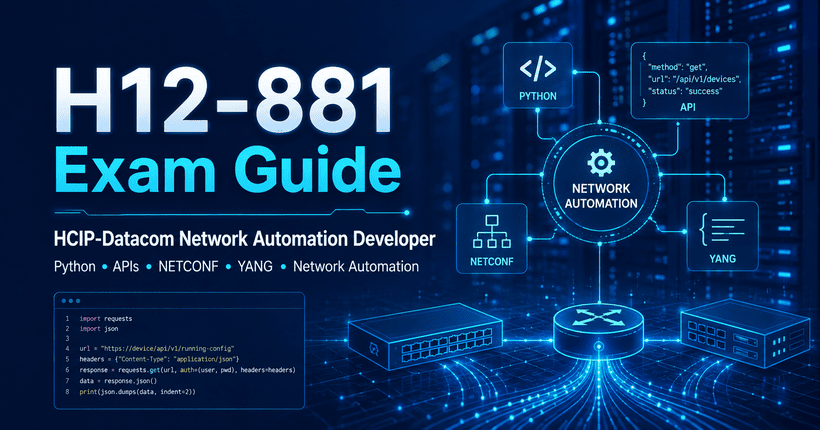
The H12-881 exam is designed for network professionals who want to move beyond traditional command-line configuration and learn how modern networks can be managed through software, APIs, programmable interfaces, and automation tools. It is associated with the HCIP-Datacom Network Automation Developer certification direction and focuses on connecting conventional network engineering with software-driven network operations.
For students and junior network engineers, this certification offers an opportunity to build skills that are becoming increasingly important in enterprise networking. Routing, switching, IP addressing, and troubleshooting remain essential, but modern engineers are also expected to understand Python, NETCONF, YANG, REST APIs, Telemetry, Git, and controller-based network management.
This H12-881 exam guide explains the certification, major technologies, practical value of network automation, recommended preparation strategy, and the skills candidates should develop before attempting the exam.
If you are actively preparing for the certification, you can also review the H12-881 exam preparation resources to reinforce the topics discussed throughout this guide.
What Is the H12-881 Exam?
H12-881 is associated with the Huawei HCIP-Datacom Network Automation Developer certification direction. It focuses on using programming, programmable network interfaces, management protocols, APIs, and controllers to automate network operations.
Traditional networking certifications often focus on questions such as how routing protocols work, how a VLAN should be configured, or which command should be used to troubleshoot an interface.
H12-881 adds another important question:
How can these networking tasks be performed automatically, consistently, and at scale?
That distinction is important because large enterprise networks can contain hundreds or thousands of network devices. Managing every router and switch manually becomes increasingly difficult as the infrastructure grows.
| Item | Details |
|---|---|
| Exam Code | H12-881 |
| Certification | HCIP-Datacom Network Automation Developer |
| Certification Level | HCIP |
| Main Direction | Network Automation and Programmability |
| Programming | Python |
| Key Technologies | Git, SSH, SFTP, SNMP, NETCONF, YANG, RESTCONF, APIs, Telemetry, OPS and iMaster NCE |
| Target Audience | Network engineers, students, automation engineers and Datacom professionals |
Candidates should always verify the latest certification policies and exam information before registering, because exam versions and administrative details may change over time.
Why Network Automation Matters
If an engineer manages only three or four network devices, logging in to each router or switch and entering commands manually may be perfectly reasonable.
The situation changes when the network contains hundreds of devices distributed across branch offices, campuses, data centers, and cloud environments.
Large networks create several operational challenges:
- Configuration changes must be repeated across many devices.
- Manual configuration can create inconsistencies.
- Human errors become more likely as the environment grows.
- Collecting operational data manually takes too much time.
- Configuration compliance becomes difficult to verify.
- Troubleshooting may require information from many devices.
- Change history must be documented and audited.
Network automation addresses these problems by turning repetitive tasks into programmable workflows.
For example, imagine an enterprise operating 300 branch routers. The network team needs to verify that every router is using the approved DNS server, NTP server, and management configuration.
Without automation, engineers might connect to each router manually and inspect the configuration.
With automation, a script can:
- Read the device inventory.
- Connect to all routers.
- Retrieve the required configuration.
- Compare the configuration with the desired standard.
- Identify non-compliant devices.
- Generate a report.
This is one of the key ideas candidates should understand when studying for the H12-881 exam.
Key H12-881 Exam Topics
Preparing for H12-881 requires more than learning a single programming language. Network automation combines several technical areas, and candidates should understand how these technologies work together.
Important topics include:
- Python programming fundamentals
- Git and version control
- SSH and SFTP
- SNMP
- NETCONF
- YANG data models
- RESTCONF
- HTTP and HTTPS
- RESTful APIs
- JSON and XML
- Telemetry
- Huawei OPS
- Huawei iMaster NCE
- Northbound APIs
- Jinja2 configuration templates
- Network service programmability
Students who want to organize these topics into a structured preparation process can use the H12-881 HCIP-Datacom study resources together with hands-on lab practice.
Python for the H12-881 Exam
Python is one of the most widely used programming languages in network automation. Its readable syntax and extensive ecosystem make it particularly suitable for network engineers who are beginning to learn programming.
The objective is not necessarily to become a professional software developer. Instead, network engineers use Python to automate infrastructure tasks that would otherwise require repetitive manual work.
Before attempting the H12-881 exam, candidates should understand basic Python concepts such as:
- Variables
- Strings and numeric data
- Lists
- Dictionaries
- Tuples
- Conditional statements
- For loops
- While loops
- Functions
- Modules
- Exception handling
- File operations
Why Python Dictionaries Matter
Python dictionaries are especially useful in network automation because APIs and network management systems frequently provide information using key-value structures.
device = {
    "hostname": "Branch-Router-01",
    "management_ip": "192.168.10.10",
    "status": "online"
}

print(device["management_ip"])
A real automation script could retrieve information about hundreds of devices and process each device programmatically.
Learn Python Through Networking Tasks
For network engineers, practical exercises are often more effective than generic programming examples.
Try writing scripts that:
- Read device addresses from a file.
- Store network inventory information.
- Parse JSON data.
- Generate configuration.
- Call REST APIs.
- Save operational information.
- Check whether a value matches an expected standard.
This approach helps connect Python directly to the skills required for network automation.
Git and Version Control for Network Engineers
Network automation introduces several software development practices into traditional infrastructure operations. One of the most important is version control.
Without version control, engineers may end up with configuration files such as:
router-config-final.txt
router-config-final-v2.txt
router-config-new.txt
router-config-final-latest.txt
Git provides a more structured way to track scripts, templates, and configuration changes.
Version control allows engineers to:
- Track exactly what changed.
- Identify who made a change.
- Restore previous versions.
- Collaborate with other engineers.
- Review changes before deployment.
- Maintain automation code systematically.
These practices are closely related to concepts such as Infrastructure as Code and Network as Code.
Instead of viewing configuration only as something stored on a router, engineers can maintain the intended network state as structured files, scripts, and templates.
SSH, SFTP, and SNMP in Network Automation
Modern automation does not mean that traditional network management technologies are no longer useful. Enterprise networks often contain a mixture of old and new management methods.
SSH
SSH provides secure remote access to network devices. Automation tools can also use SSH to execute commands and retrieve information programmatically.
This can be useful when a network device does not provide an API or when an existing workflow still depends on CLI commands.
SFTP
SFTP provides secure file transfer through SSH. It may be used to transfer configuration files, logs, software packages, or other network-related files.
SNMP
SNMP has been widely used for network monitoring and management. It can provide information such as:
- Interface status
- Traffic statistics
- Device resource utilization
- System information
- Operational health
Understanding traditional protocols remains useful because real production environments rarely migrate to a completely new management architecture overnight.
NETCONF, YANG, and RESTCONF
For many traditional network engineers, NETCONF and YANG are among the most unfamiliar H12-881 topics.
They become easier to understand when you stop thinking about configuration only as CLI commands.
What Is NETCONF?
NETCONF is a network management protocol designed to retrieve and modify device configuration through structured operations.
Traditional CLI interaction is primarily designed for humans. Engineers type commands and read text output.
Automation software benefits from structured interfaces that allow information to be processed reliably.
A simplified model looks like this:
Automation Application
        |
        v
     NETCONF
        |
        v
  Network Device
Rather than pretending to be a human using a terminal, software communicates with the device through a machine-oriented management interface.
What Is YANG?
YANG is a data modeling language used to describe configuration and operational data.
A YANG model can define information related to:
- Interfaces
- IP addresses
- Routing parameters
- Device configuration
- Operational state
- Network services
A useful way to remember the relationship is:
YANG describes the structure of network data, while NETCONF provides a way to interact with that data.
What Is RESTCONF?
RESTCONF provides another mechanism for interacting with network configuration and operational data, using concepts familiar from REST-style APIs.
Understanding these technologies is important because structured management interfaces provide a more reliable foundation for automation than parsing human-oriented CLI output.
REST APIs, HTTP, and JSON
APIs are another central concept in modern network automation.
An API allows one software system to communicate with another using defined requests and responses.
Network controllers, management platforms, monitoring systems, cloud services, and orchestration systems frequently expose RESTful APIs.
HTTP Methods Candidates Should Understand
| HTTP Method | Typical Purpose |
|---|---|
| GET | Retrieve information |
| POST | Create or submit information |
| PUT | Update or replace information |
| DELETE | Remove information |
Candidates should also understand:
- HTTP and HTTPS
- API endpoints
- Authentication
- Request headers
- Status codes
- Request parameters
- API responses
Why JSON Is Important
JSON is widely used by APIs to represent structured data.
{
  "hostname": "Core-SW-01",
  "management_ip": "10.10.1.10",
  "cpu_usage": 28,
  "status": "online"
}
Python can easily convert JSON information into data structures such as dictionaries and lists.
This allows a network automation program to retrieve information from an API, evaluate the values, and take further action.
For example, a script could retrieve CPU utilization from hundreds of devices and generate a report containing only devices that exceed a predefined threshold.
Telemetry and Modern Network Monitoring
Automation is not only about configuring network devices. It also includes collecting and analyzing operational information automatically.
Telemetry is an important technology for modern network visibility.
It can provide information about:
- Interface traffic
- Bandwidth utilization
- CPU usage
- Memory usage
- Network state
- Device health
- Operational events
Traditional monitoring frequently relies on periodic polling. Telemetry can support more continuous delivery of operational information.
This makes it possible to build automated workflows such as:
Collect Network Data
        |
        v
Analyze Network State
        |
        v
Detect a Condition
        |
        v
Perform an Action
        |
        v
Verify the Result
This closed-loop approach is an important concept in modern network operations.
Huawei OPS and Event-Driven Automation
Huawei OPS introduces another important network automation concept: event-driven operations.
Instead of requiring an engineer to continuously monitor the network and manually respond to every event, an automation mechanism can execute predefined logic after a particular condition occurs.
A simplified workflow might look like this:
Network Event
     |
     v
Automation Trigger
     |
     v
Script or Policy
     |
     v
Automated Action
     |
     v
Validation
This can improve response speed and help make routine operational procedures more consistent.
For candidates reviewing this area, it is useful to understand the difference between scheduled automation and automation triggered by a network event.
Huawei iMaster NCE and Northbound APIs
Huawei iMaster NCE is another important area in the HCIP-Datacom Network Automation Developer learning path.
The central concept is controller-based network management.
Without a controller, an automation application may need to communicate independently with every network device. As the network grows, maintaining those individual connections becomes increasingly complex.
A controller can provide an abstraction layer:
Automation Application
        |
        v
  Northbound API
        |
        v
    iMaster NCE
        |
        v
 Network Infrastructure
External applications can interact with the controller through northbound APIs, while the controller communicates with the underlying infrastructure.
Depending on the services available, API-based automation may be used to:
- Retrieve device information.
- Obtain network topology.
- Check network resources.
- Collect operational information.
- Provision network services.
- Automate configuration workflows.
- Integrate networking with external IT systems.
Candidates studying this section should be comfortable with RESTful APIs, HTTP/HTTPS, authentication, structured requests, and API responses.
For additional review of these certification areas, candidates can use the HCIP-Datacom Network Automation Developer H12-881 course as part of a broader study plan.
Jinja2 and Configuration Templates
Templates are extremely useful in network automation when many devices share a similar configuration structure.
Imagine an enterprise deploying 200 branch routers. Every device may require the same basic interface configuration, but values such as hostname, IP address, subnet mask, and site description are different.
Instead of writing 200 separate configurations manually, an engineer can create a reusable template.
hostname {{ hostname }}

interface {{ interface_name }}
 ip address {{ ip_address }} {{ subnet_mask }}
 description {{ interface_description }}
An automation script can combine the template with device-specific data.
{
  "hostname": "Branch-01",
  "interface_name": "GigabitEthernet0/0/1",
  "ip_address": "192.168.1.1",
  "subnet_mask": "255.255.255.0",
  "interface_description": "LAN Interface"
}
The automation system can then generate a complete configuration for each network device.
This approach offers several advantages:
- Configurations are more consistent.
- Deployment is faster.
- Manual typing errors are reduced.
- Templates can be reused.
- Changes can be maintained centrally.
How Network Automation Changes the Network Engineer’s Role
Network automation does not eliminate the need for strong networking knowledge.
In many situations, it makes that knowledge even more important.
If an engineer manually enters an incorrect command on one router, the mistake may affect one device.
If an automation script contains an incorrect configuration and deploys it to 500 routers, the mistake can affect 500 devices.
This is why professional automation requires more than speed.
Engineers need to consider:
- Change planning
- Error handling
- Pre-deployment testing
- Configuration validation
- Logging
- Rollback procedures
- Post-change verification
The objective of automation should be to make network operations more consistent, repeatable, auditable, and scalable.
How to Prepare for the H12-881 Exam
A structured study sequence is usually more effective than trying to learn every technology simultaneously.
Step 1: Review Networking Fundamentals
Before concentrating heavily on automation, make sure you understand:
- TCP/IP
- IPv4 addressing
- Subnetting
- Ethernet
- VLANs
- Routing
- Network interfaces
- Device management
- Basic troubleshooting
Step 2: Learn Python Fundamentals
Focus on variables, lists, dictionaries, conditions, loops, functions, modules, exceptions, and files.
Then apply those skills to simple network tasks.
Step 3: Learn JSON and XML
Practice reading structured data and extracting individual values.
Step 4: Understand HTTP and REST APIs
Learn GET, POST, PUT, DELETE, authentication, headers, status codes, and API responses.
Step 5: Study SSH, SFTP, and SNMP
Understand how traditional network management technologies can be incorporated into automated workflows.
Step 6: Study NETCONF, YANG, and RESTCONF
Focus on why structured network management is more suitable for software-driven operations than CLI-only workflows.
Step 7: Learn Telemetry and OPS
Understand automated network monitoring and event-driven operations.
Step 8: Study iMaster NCE
Learn the role of network controllers and understand how northbound APIs enable external applications to interact with network infrastructure.
Step 9: Practice Configuration Templates
Create reusable templates and generate configuration using structured variables.
Step 10: Review the Complete H12-881 Knowledge Set
After completing the individual technologies, review the entire network automation workflow and identify weak areas.
At this stage, combining labs with H12-881 exam study materials can help organize revision around the certification objectives.
A Practical 30-Day H12-881 Study Plan
| Study Period | Main Focus |
|---|---|
| Days 1–5 | Python fundamentals and networking-related Python exercises |
| Days 6–8 | Git and version control |
| Days 9–11 | SSH, SFTP and SNMP |
| Days 12–16 | NETCONF, YANG and RESTCONF |
| Days 17–19 | HTTP, REST APIs, JSON and XML |
| Days 20–22 | Telemetry and OPS |
| Days 23–25 | iMaster NCE and northbound APIs |
| Days 26–27 | Jinja2 and configuration templates |
| Days 28–30 | Review, hands-on practice and exam preparation |
This schedule should be adjusted according to your existing knowledge. A network engineer who already understands Python can spend more time on Huawei-specific technologies, while someone with little programming experience may need additional time for Python and APIs.
Hands-On H12-881 Practice Ideas
Network automation is easier to understand when theory is combined with practical exercises.
Useful beginner projects include:
- Reading device IP addresses from a text file.
- Creating a Python-based network inventory.
- Parsing JSON responses.
- Generating device configuration from variables.
- Sending REST API requests.
- Checking API status codes.
- Collecting device information automatically.
- Comparing current configuration with a desired standard.
- Logging automation results.
- Creating a configuration compliance report.
You do not need to begin with a large automation framework. Small projects are often better because they allow you to understand each component individually.
Common H12-881 Exam Preparation Mistakes
1. Studying Only Python
Python is important, but H12-881 is a network automation certification rather than a general programming certification.
Candidates also need to understand APIs, programmable network interfaces, management protocols, structured data, controllers, and Huawei automation technologies.
2. Ignoring Networking Fundamentals
Automation cannot compensate for weak networking knowledge.
An engineer needs to understand what a script is changing and how those changes affect network behavior.
3. Memorizing Without Hands-On Practice
Reading about JSON is not the same as parsing JSON. Reading about APIs is not the same as sending an API request.
Hands-on exercises make abstract concepts easier to understand.
4. Confusing NETCONF and YANG
NETCONF and YANG are related but serve different purposes. Candidates should understand their relationship rather than treating them as interchangeable terms.
5. Ignoring Error Handling
Real network automation does not always work perfectly.
Devices can be unreachable, authentication can fail, APIs can return errors, and unexpected data may be received.
A reliable automation workflow should handle failures safely.
6. Focusing Only on Passing the Exam
Certification preparation is more valuable when the knowledge can also be applied to real-world networking tasks.
Try to understand why each technology exists and how it solves an operational problem.
Career Value of HCIP-Datacom Network Automation Developer
The knowledge associated with HCIP-Datacom Network Automation Developer reflects the broader transition toward software-driven infrastructure.
Skills such as Python, Git, REST APIs, NETCONF, YANG, JSON, Telemetry, and controller-based management can be relevant to many modern network roles.
Possible career directions include:
- Network Engineer
- Network Automation Engineer
- Network Operations Engineer
- SDN Engineer
- Infrastructure Automation Engineer
- NetDevOps Engineer
- Enterprise Network Engineer
- Network Solution Engineer
- Network Management Platform Engineer
The certification itself does not guarantee a specific job or salary. Its value increases when certification knowledge is combined with strong networking fundamentals and practical automation experience.
Traditional Networking vs. Network Automation
| Traditional Networking | Network Automation |
|---|---|
| Configure devices individually | Configure devices programmatically |
| Primarily CLI-based | CLI plus APIs and programmable interfaces |
| Manual verification | Automated validation |
| Manually created configurations | Reusable configuration templates |
| Periodic manual monitoring | Telemetry and automated data collection |
| Device-by-device operations | Controller-based management |
| Manually tracked changes | Git-based version control |
Traditional networking and automation should not be viewed as competing approaches.
Strong network automation engineers usually understand traditional networking very well. Automation simply gives them additional tools for managing larger and more complex environments.
Is the H12-881 Exam Difficult?
The difficulty of the H12-881 exam depends heavily on your technical background.
If you already work with routers and switches but have never written Python, programming and API topics may initially be challenging.
If you already understand Python but have limited networking experience, NETCONF, YANG, Telemetry, network controllers, and device management concepts may require more study.
The ideal preparation approach combines both areas.
You do not need to become a professional application developer, but you should be comfortable reading scripts, understanding programming logic, processing structured data, and thinking about how software interacts with network infrastructure.
Who Should Consider the H12-881 Exam?
H12-881 may be particularly relevant for:
- Students studying computer networking.
- Junior network engineers.
- HCIA-Datacom learners moving toward HCIP topics.
- Traditional network engineers who want to learn automation.
- Network operations engineers responsible for repetitive tasks.
- Engineers interested in SDN.
- Professionals interested in NetDevOps.
- Engineers working with Huawei enterprise networks.
- Infrastructure professionals interested in API-driven networking.
If you already understand routing, switching, addressing, and basic network troubleshooting, the H12-881 Network Automation Developer preparation path can help you expand those skills into programmable networking.
H12-881 Exam Frequently Asked Questions
What is the H12-881 exam?
The H12-881 exam is associated with Huawei HCIP-Datacom Network Automation Developer and focuses on programming, network programmability, APIs, network management protocols, Telemetry, controllers, and automation technologies.
What should I study for H12-881?
Candidates should study Python, Git, SSH, SFTP, SNMP, NETCONF, YANG, RESTCONF, HTTP/HTTPS, RESTful APIs, JSON, XML, Telemetry, Huawei OPS, iMaster NCE, and configuration templating.
Is Python important for H12-881?
Yes. Python programming fundamentals are an important part of network automation. Candidates should understand basic Python syntax, data structures, functions, loops, exceptions, and how Python can be applied to networking tasks.
Do I need to know NETCONF and YANG?
Yes. NETCONF and YANG are important technologies for programmable network management and should be included in your preparation.
Do I need to understand REST APIs?
Yes. RESTful APIs, HTTP/HTTPS, authentication, JSON, API requests, and API responses are important concepts for controller-based network automation.
Is H12-881 suitable for beginners?
It is generally better suited to learners who already understand networking fundamentals. Complete beginners may benefit from first studying TCP/IP, routing, switching, VLANs, and network device configuration.
Do I need software development experience?
No. Candidates do not need to be professional software developers, but they should be willing to learn basic programming, structured data, APIs, and automation logic.
Is H12-881 useful outside Huawei environments?
The certification contains Huawei-specific technologies, but many of the underlying skills—including Python, Git, REST APIs, JSON, NETCONF, YANG, Telemetry, and automation templates—are broadly relevant to modern networking.
How should I start preparing for H12-881?
Begin with networking fundamentals and basic Python, then study JSON and APIs, followed by NETCONF, YANG, RESTCONF, Telemetry, OPS, iMaster NCE, and configuration templates.
Where can I find H12-881 preparation materials?
Candidates who want additional resources can review the H12-881 HCIP-Datacom Network Automation Developer exam resources and combine them with official learning materials and hands-on lab practice.
Final Thoughts on the H12-881 Exam
The H12-881 exam represents an important shift in the skills expected from modern network engineers.
Knowing how to configure a router or switch remains valuable, but large-scale enterprise infrastructure increasingly relies on APIs, controllers, structured data, automation scripts, Telemetry, and programmable network interfaces.
The best way to prepare for the HCIP-Datacom Network Automation Developer certification is therefore not to memorize isolated technical definitions.
Instead, try to understand the complete network automation process:
- Identify the network task.
- Determine which devices or controllers are involved.
- Select the appropriate programmable interface or protocol.
- Retrieve the required information.
- Process structured data.
- Generate or apply the required configuration.
- Handle errors safely.
- Verify the result.
- Record the outcome.
Once you understand this workflow, Python, Git, NETCONF, YANG, RESTCONF, APIs, Telemetry, OPS, Jinja2, and iMaster NCE no longer appear to be unrelated exam topics. They become different parts of the same automation architecture.
For candidates who are ready to continue their preparation, the H12-881 exam preparation course can be used alongside lab exercises and official documentation to review important knowledge areas and strengthen exam readiness.
For students and engineers who want to move from traditional device-by-device administration toward programmable networking, the H12-881 HCIP-Datacom Network Automation Developer exam offers a structured way to begin developing the automation skills increasingly used in modern enterprise networks.
Official References and Further Reading
For candidates preparing for the Huawei H12-881 HCIP-Datacom-Network Automation Developer exam, the following official Huawei and authoritative industry resources provide additional information about network programmability, Python, NETCONF, YANG, RESTCONF, Telemetry, APIs, iMaster NCE, and modern network automation technologies.
- Huawei Career Certification – Official Portal
– Huawei’s official certification portal covering HCIA, HCIP, and HCIE certification paths, examination information, learning resources, certification policies, and recertification requirements. - Huawei HCIP-Datacom-Network Automation Developer Certification Reference
– An official Huawei certification reference describing the H12-881 Network Automation Developer direction and its major knowledge areas, including programming, device programmability, and iMaster NCE open capabilities. - Huawei – What Is YANG?
– Huawei’s technical introduction to YANG data modeling, including configuration data, operational state data, RPCs, notifications, NETCONF, RESTCONF, and model-driven network management. - Huawei NETCONF Configuration Guide
– Official Huawei documentation covering NETCONF configuration, YANG models, NETCONF client/server operations, subscriptions, YANG Push, and automated network device management. - Huawei iMaster NCE-Campus Documentation
– Huawei’s official documentation center for iMaster NCE-Campus, including northbound APIs, service programmability, network automation, monitoring, configuration, deployment, and operations. - Huawei iMaster NCE-Campus Northbound APIs
– Official documentation showing how RESTful northbound APIs can be used to query and manage network resources, providing useful practical context for controller-based network automation. - Huawei Event Versus Action (EVA) and Network Programmability
– Huawei’s introduction to automated network operations using Python or JSON scripts together with Telemetry, NETCONF, RESTCONF, YANG data, and programmable event-driven actions. - RFC 6241 – Network Configuration Protocol (NETCONF)
– The authoritative IETF specification for NETCONF, defining mechanisms to install, manipulate, and delete network device configurations through structured remote management operations. - RFC 7950 – The YANG 1.1 Data Modeling Language
– The IETF standard defining YANG 1.1, the data modeling language widely used with NETCONF and RESTCONF for model-driven network automation. - RFC 8040 – RESTCONF Protocol
– The authoritative IETF specification for RESTCONF, which provides an HTTP-based interface for accessing and manipulating YANG-defined network configuration and operational data. - RFC 8639 – Subscription to YANG Notifications
– An IETF standard describing subscription mechanisms for YANG-based notifications, providing useful background for model-driven telemetry and event-based network automation. - Python 3 Official Documentation
– The official Python language documentation covering syntax, data structures, functions, modules, exception handling, file operations, object-oriented programming, and other programming concepts useful for network automation.