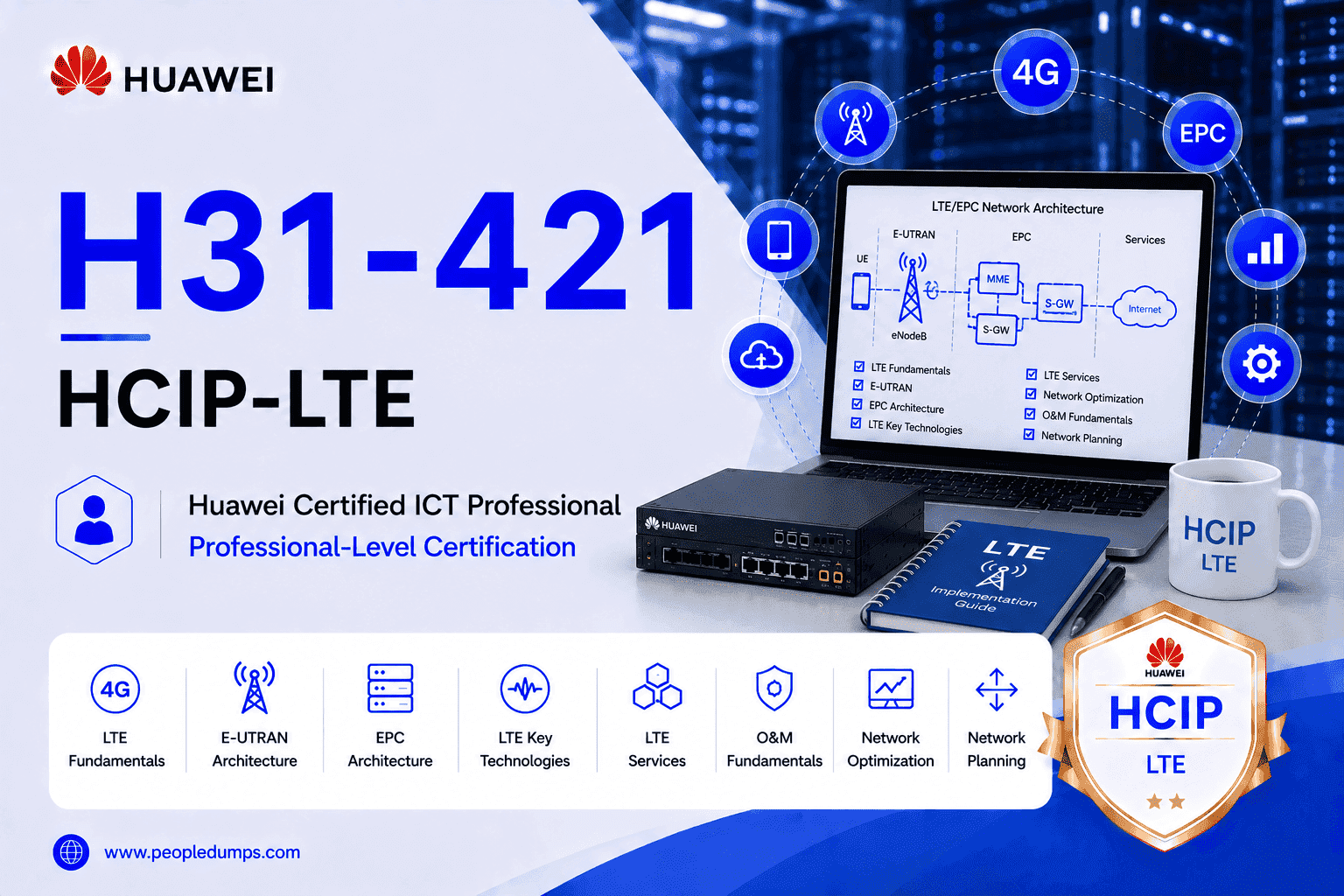

The H31-421 HCIP-LTE exam is the professional-level Huawei certification for LTE mobile networks. It covers how an LTE network is built — from the radio access network that talks to your phone, through the evolved packet core that routes and manages traffic, to the services that run on top.
This H31-421 HCIP-LTE exam guide explains what the exam covers, who it is for, and how to prepare. You can also use our H31-421 HCIP-LTE course and practice questions to test yourself as you study.
1. What Is the H31-421 HCIP-LTE Certification?
HCIP stands for Huawei Certified ICT Professional. The LTE track focuses on fourth-generation mobile networks: the technology that carries most of the world's mobile data. The exam tests whether you understand LTE architecture, protocols, and services well enough to plan, deploy, and troubleshoot an LTE network.
The exam is technical and structured around the network itself. You need to know what each network element does, how the elements communicate, how a phone attaches to the network, and how voice and data services are delivered. Many questions describe a procedure — attach, handover, bearer setup — and ask what happens at each step or where it can fail.
For engineers in mobile communications, HCIP-LTE is a practical credential that matches daily work in planning, optimization, and operations.
2. Who Should Take the H31-421 Exam?
HCIP-LTE suits engineers who work with mobile networks:
- Radio network engineers who plan, deploy, and optimize LTE base stations.
- Core network engineers who work with the evolved packet core and its elements.
- Telecom operations staff who monitor and troubleshoot LTE networks.
- Engineers moving from earlier mobile technologies who need a structured understanding of LTE.
Basic knowledge of mobile communications and IP networking is essential. If you understand what a base station does and how IP networks route traffic, you have the foundation the LTE topics build on.
3. H31-421 Exam Topics: What to Study
The exam follows the path of a data session through the LTE network. The main areas are:
3.1 LTE Network Architecture
Learn the two main parts of the network and the elements inside them:
- E-UTRAN (radio access network): the eNodeB, the base station that provides the radio interface to user devices and connects to the core network.
- EPC (evolved packet core): the all-IP core that carries user data and signalling. Its key elements include the MME (mobility management), the SGW (serving gateway), the PGW (packet data network gateway), and the HSS (subscriber database).
- Interfaces: how the eNodeB connects to the core and to neighbouring base stations, and what information flows over each interface.
For each element, learn its function and its neighbours. A useful exercise is to draw the network and trace a packet from a phone to the internet, naming every element it passes through.
3.2 Mobility Management and Session Control
The MME manages mobility and session control. Study the procedures it handles:
- Attach: how a device joins the network, is authenticated, and gets an IP address.
- Bearer setup: how data bearers are established, and the difference between default and dedicated bearers.
- Handover: how a device moves between base stations without dropping its session.
- Tracking area updates: how the network keeps track of idle devices.
For each procedure, learn the sequence of steps and the messages involved. Exam questions often ask what happens next, or which element is responsible for a particular step.
3.3 Air Interface and Protocols
The air interface is what makes LTE fast. Study the essentials:
- OFDMA and SC-FDMA: the multiple-access techniques used on the downlink and uplink.
- Protocol stack: the layers that carry user data and signalling over the air, and what each layer does.
- Channels: the physical, transport, and logical channels, and how they map to each other.
- Scheduling and QoS: how the base station shares radio resources between users and prioritizes different services.
3.4 LTE Services and Features
The exam also covers the services that run on the network:
- Voice over LTE (VoLTE): how voice calls are carried as IP packets.
- Data services: how internet access and other data services are delivered through the packet core.
- Interworking: how LTE connects with earlier mobile technologies and with other networks.
4. How to Prepare for H31-421: A Four-Week Study Plan
| Week | Study Focus | Practical Activities |
|---|---|---|
| Week 1 | Architecture | Study E-UTRAN and EPC elements; draw the network and trace a packet from phone to internet |
| Week 2 | Mobility and procedures | Study attach, bearer setup, and handover; write out each procedure step by step |
| Week 3 | Air interface and services | Study OFDMA, protocol layers, channels, and VoLTE |
| Week 4 | Review and practice | Work through practice questions, log mistakes by topic, and re-study weak areas |
Diagrams are your best study tool for this exam. Draw the architecture from memory until you can do it without notes, then add the procedures on top: attach, handover, bearer setup. If you can walk through a procedure on your own diagram, you understand it well enough for the exam.
5. How to Use H31-421 Practice Questions
Practice questions are most useful as a diagnostic tool. After each set, sort your mistakes by area — architecture, mobility, air interface, or services — and re-study the weakest area before moving on. Pay attention to questions about element responsibilities: the exam often asks which element performs a particular function, so knowing each element's job precisely matters.
Our H31-421 HCIP-LTE question bank includes 60 practice questions across 3 parts, so you can work through them in order, shuffled, or as a timed exam simulation, and review your wrong answers separately.
Try These Sample HCIP-LTE Practice Questions
The following original practice questions illustrate the kind of reasoning the exam rewards. They are original learning questions, not actual Huawei examination questions.
Question 1: Mobility Management
In an LTE network, which network element manages mobility and session control?
- A. MME
- B. eNodeB
- C. SGW
- D. HSS
Correct Answer: A
Explanation: The Mobility Management Entity (MME) handles mobility management, authentication, and session control in the evolved packet core. The eNodeB provides the radio interface, the SGW forwards user data, and the HSS stores subscriber information.
Question 2: eNodeB Function
What does the eNodeB provide in an LTE network?
- A. The radio access interface for user devices
- B. The subscriber billing system
- C. The core network database
- D. The internet gateway
Correct Answer: A
Explanation: The eNodeB is the LTE base station. It provides the radio interface that user devices connect to, and it connects to the core network. Billing, subscriber data, and internet gateway functions belong to other elements.
When choosing practice materials, prefer resources that explain both correct and incorrect answers, follow the current exam topics, and are updated when Huawei revises the syllabus.
6. Frequently Asked Questions About H31-421
Do I need to know earlier mobile technologies first?
Some background in 2G and 3G concepts helps — the exam sometimes refers to how LTE differs from earlier systems — but the focus is LTE itself. A basic understanding of mobile network concepts is enough to start.
What is the hardest part of the exam?
Most candidates find the procedures hardest: attach, handover, and bearer setup involve several elements and messages in a specific order. Drawing the procedures step by step is the most effective way to learn them.
How much protocol detail do I need?
You need to know what each protocol layer does and how the layers fit together, rather than memorizing message formats. Focus on functions and sequences: who sends what to whom, and in what order.
How should I use practice tests?
Use them to find weak areas, especially element responsibilities and procedure steps. After each session, write down every topic you got wrong and re-study it before your next session. A shrinking list of weak topics is a better sign of readiness than a single high score.
7. Final Thoughts: Learn the Network, Then the Procedures
LTE is a system of elements working together, and the exam tests whether you can follow the work through that system. Learn the architecture first until you can draw it from memory, then learn the procedures that run on it. Study one area at a time, and use practice questions to keep finding the gaps.
To keep preparing, explore our H31-421 HCIP-LTE course and work through the question bank in order, shuffled, or as a timed simulation. Good luck with your preparation.