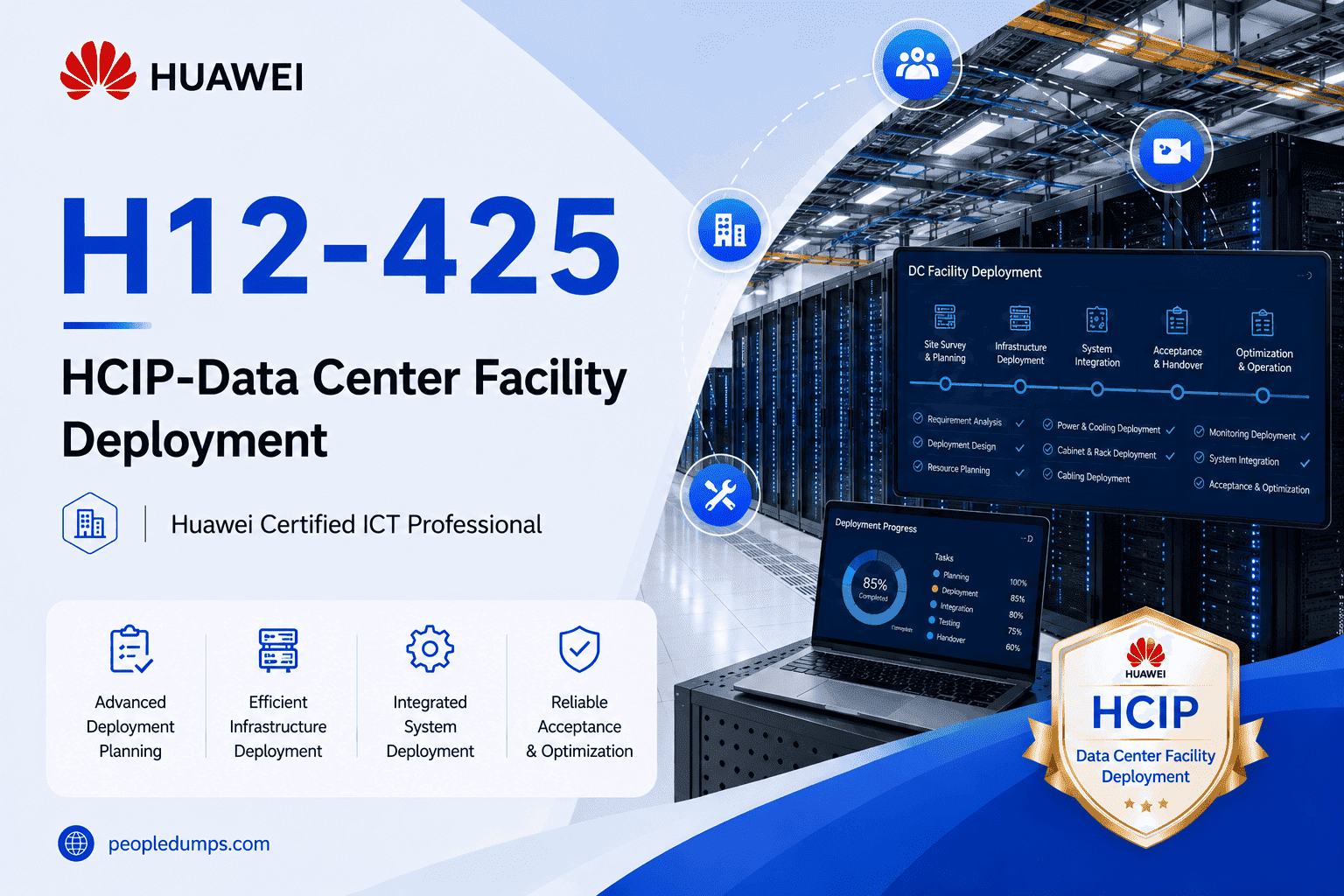

The H12-425 HCIP-Data Center Facility Deployment exam is the professional-level Huawei certification for data center infrastructure. It covers the physical side of the data center — the power, cooling, cabling, and monitoring systems that keep servers running — and how to deploy them in a real project.
This H12-425 exam guide explains what the certification covers, who it is for, and how to prepare. You can also use our H12-425 HCIP-Data Center Facility Deployment course and practice questions to test yourself as you study.
1. What Is the H12-425 HCIP-Data Center Facility Certification?
Most data center certifications focus on servers, networks, or software. HCIP-Data Center Facility Deployment focuses on what those systems stand on: the facility itself. The exam tests whether you understand how a data center is powered, cooled, cabled, and monitored, and how to deploy that infrastructure so it works reliably from the first day.
The exam is aimed at engineers who work on data center construction and deployment projects. Passing it shows that you can read a facility design, understand the requirements behind it, and carry out deployment work that meets those requirements — including the handover and acceptance steps that close a project.
This is a practical certification. The questions often describe a deployment situation — a power layout, a cooling arrangement, a cabling plan — and ask what should be done, what is wrong, or what to check next.
2. Who Should Take the H12-425 Exam?
HCIP-Data Center Facility Deployment suits people who work on the physical side of data centers:
- Data center engineers who deploy and maintain power, cooling, and cabling systems.
- Deployment and commissioning engineers who install data center infrastructure on customer sites.
- Network and infrastructure engineers who want to understand the facility their equipment depends on.
- Project engineers involved in data center construction, acceptance, and handover.
Basic knowledge of data center concepts — what a rack, a UPS, and a cooling unit do — is a useful starting point. The exam builds from those basics into deployment details, so hands-on familiarity with a data center environment helps more than pure theory.
3. H12-425 Exam Topics: What to Study
The exam covers the main facility systems and the deployment process that brings them together. The main areas are:
3.1 Power Supply and Distribution
Power is the most critical facility system. Study how it is delivered and protected:
- Power architecture: how utility power flows through transformers, switchgear, and distribution units to the racks.
- UPS systems: how uninterruptible power supplies bridge short outages and give generators time to start.
- Redundancy: why redundant power paths matter, and how a single failure is prevented from taking down the load.
- Power distribution in the rack: how power is delivered to servers and how capacity is planned per rack.
For each component, learn what it protects against and what happens when it fails. A useful exercise is to trace the power path for one rack from the utility feed to the server, naming every device in between.
3.2 Cooling and Airflow
Servers produce heat, and cooling removes it. Study the principles and the common layouts:
- Cooling principles: how air cooling works and why airflow direction matters.
- Hot-aisle and cold-aisle layout: arranging racks so cold supply air and hot exhaust air do not mix, which improves cooling efficiency.
- Cooling equipment: precision air conditioners and their role in controlling temperature and humidity.
- Temperature and humidity control: why both matter for equipment reliability, not just temperature alone.
3.3 Cabling and Layout
Cabling connects the facility together. Study the planning and installation of:
- Power cabling: routing and labelling so circuits can be identified and maintained safely.
- Network cabling: copper and fiber runs between racks, and how cable management affects airflow.
- Cable routing: overhead trays and under-floor paths, and the separation of power and data cables.
3.4 Monitoring, Management, and Deployment
The exam also covers how a facility is run and how a deployment project is completed:
- Monitoring systems: watching power, temperature, humidity, and equipment status, and raising alarms when limits are crossed.
- Deployment process: site survey, installation, testing, commissioning, and acceptance.
- Handover: documentation, labelling, and the checks that confirm the facility is ready for operation.
4. How to Prepare for H12-425: A Four-Week Study Plan
| Week | Study Focus | Practical Activities |
|---|---|---|
| Week 1 | Data center basics and power | Study power architecture, UPS, and redundancy; trace the power path for a single rack |
| Week 2 | Cooling and airflow | Study cooling principles and hot-aisle/cold-aisle layout; sketch a small data hall floor plan |
| Week 3 | Cabling and monitoring | Study cable routing and monitoring systems; review alarm and response procedures |
| Week 4 | Deployment and review | Study the deployment and acceptance process; work through practice questions and re-study weak areas |
If you can visit a data center, do it: seeing a UPS room, a cooling unit, and a cable tray makes the concepts concrete in a way diagrams cannot. If a visit is not possible, study photos and floor plans and practise describing what each element does.
5. How to Use H12-425 Practice Questions
Practice questions are most useful as a diagnostic tool. After each set, sort your mistakes by area — power, cooling, cabling, monitoring, or deployment process — and re-study the weakest area before moving on. Pay attention to scenario questions: the exam often asks what to do next in a deployment situation, so practise thinking in sequences rather than isolated facts.
Our H12-425 HCIP-Data Center Facility Deployment question bank includes 99 practice questions across 5 parts, so you can work through them in order, shuffled, or as a timed exam simulation, and review your wrong answers separately.
Try These Sample Data Center Facility Practice Questions
The following original practice questions illustrate the kind of reasoning the exam rewards. They are original learning questions, not actual Huawei examination questions.
Question 1: Redundant Power
Why is redundant power important in a data center?
- A. It keeps systems running if one power source fails
- B. It reduces the need for cooling
- C. It increases network speed
- D. It replaces the UPS
Correct Answer: A
Explanation: Redundant power paths mean a single failure — a failed UPS, a tripped breaker, a lost feed — does not take down the load. Cooling, network speed, and UPS backup are separate concerns; redundancy is about surviving failures.
Question 2: Hot-Aisle and Cold-Aisle Layout
What does a hot-aisle and cold-aisle layout help manage?
- A. Airflow and cooling efficiency
- B. Network addressing
- C. Cable labelling
- D. Fire suppression
Correct Answer: A
Explanation: Arranging racks in alternating hot and cold aisles keeps cold supply air and hot exhaust air from mixing, so cooling equipment works more efficiently and servers receive air at the intended temperature.
When choosing practice materials, prefer resources that explain both correct and incorrect answers, follow the current exam topics, and are updated when Huawei revises the syllabus.
6. Frequently Asked Questions About H12-425
Do I need a networking background for this exam?
Networking knowledge is helpful but not the focus. The exam is about the facility: power, cooling, cabling, and deployment. A basic understanding of what servers and network devices do is enough to follow the material.
Is hands-on data center experience required?
It is not formally required, but it helps a great deal. Candidates who have seen a data center — or at least studied detailed floor plans and photos — find the deployment questions much easier than those who have only read descriptions.
What is the hardest part of the exam?
Most candidates find the breadth challenging: power, cooling, cabling, monitoring, and the deployment process are each substantial topics. Study one system at a time, test yourself, and do not move on until the weak areas are small.
How should I use practice tests?
Use them to find weak areas, not to predict your score. After each session, write down every topic you got wrong and re-study it before your next session. A shrinking list of weak topics is a better sign of readiness than a single high score.
7. Final Thoughts: The Facility Makes the Data Center Work
Servers and networks get the attention, but none of them runs without power, cooling, and cabling. HCIP-Data Center Facility Deployment is a practical certification for engineers who make sure the physical foundation is right. Study each system until you can trace it end to end, practise with deployment scenarios, and use practice questions to keep finding the gaps.
To keep preparing, explore our H12-425 HCIP-Data Center Facility Deployment course and work through the question bank in order, shuffled, or as a timed simulation. Good luck with your preparation.