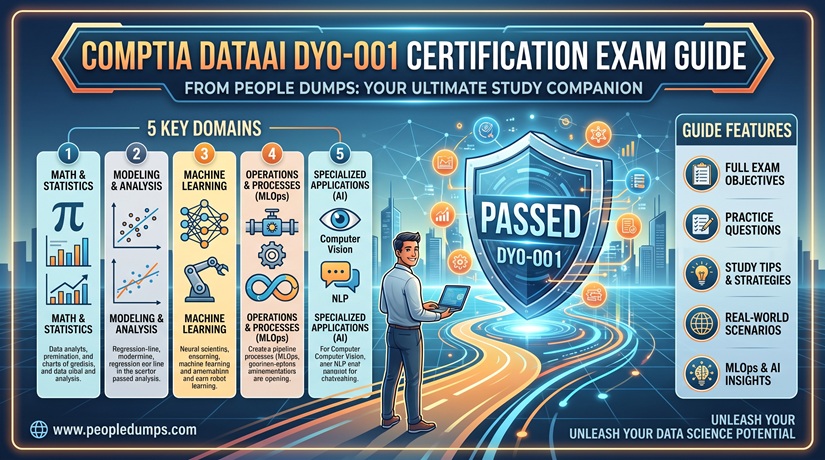
CompTIA DataAI DY0-001 is an expert-level certification designed for experienced professionals who work where data science, machine learning, artificial intelligence, and production data operations meet. Unlike entry-level analytics certifications that concentrate primarily on reporting, visualization, and basic data manipulation, DataAI expects candidates to understand how advanced analytical models are selected, evaluated, deployed, monitored, and connected to real business requirements.
The certification was previously known as CompTIA DataX. CompTIA rebranded it as DataAI in early 2026 to better reflect how closely modern data science is now connected with artificial intelligence. The exam continues to use the DY0-001 exam code.
If you are a student or are just beginning your IT, networking, or data career, this is important to understand: DataAI is not really intended to be your first certification. However, studying its objectives can give you an excellent roadmap for understanding what advanced data scientists and machine learning professionals are expected to know.
What Is the CompTIA DataAI Certification?
Table of Contents
ToggleCompTIA DataAI validates advanced knowledge across the complete data science lifecycle. A successful candidate should be able to move beyond simply training a model and demonstrate an understanding of the mathematics behind the model, the quality of the data feeding it, the business problem being solved, the infrastructure used to deploy it, and the processes required to keep it reliable in production.
This broad approach is one of the most interesting characteristics of the certification. DataAI is vendor-neutral, so the exam is not centered on a single cloud provider, proprietary AI platform, or machine learning service.
Instead, candidates are expected to understand concepts that remain relevant whether an organization is working in AWS, Microsoft Azure, Google Cloud, an on-premises environment, or a hybrid architecture.
According to CompTIA’s published DY0-001 objectives, successful candidates should be able to:
- Understand and implement data science operations and processes.
- Apply mathematical and statistical methods appropriately.
- Understand data processing, cleaning, statistical modeling, linear algebra, and calculus concepts.
- Apply machine learning models and understand deep learning concepts.
- Select appropriate analysis and modeling techniques.
- Evaluate results and justify model recommendations.
- Understand industry trends and specialized applications of data science.
CompTIA DataAI DY0-001 Exam Details
Before building a study plan, candidates should understand the structure of the DY0-001 certification exam.
| Exam Detail | CompTIA DataAI DY0-001 |
|---|---|
| Exam Code | DY0-001 |
| Certification | CompTIA DataAI |
| Maximum Number of Questions | 90 |
| Question Types | Multiple-choice and performance-based questions |
| Exam Length | 165 minutes |
| Passing Method | Pass/Fail only; no scaled score |
| Recommended Experience | Minimum of five years of hands-on experience as a data scientist |
| Level | Expert |
The five-year experience recommendation should not be ignored. The exam assumes that candidates can connect theoretical concepts with real-world decision-making rather than simply recognize definitions.
Another unusual feature is the scoring method. CompTIA lists DY0-001 as pass/fail only with no scaled score. Candidates therefore should not build their preparation around trying to reach a specific numeric passing score. A better strategy is to develop balanced competence across all five exam domains.
CompTIA DataAI DY0-001 Exam Domains
The CompTIA DataAI DY0-001 exam contains five major domains.
| Domain | Percentage |
|---|---|
| 1.0 Mathematics and Statistics | 17% |
| 2.0 Modeling, Analysis, and Outcomes | 24% |
| 3.0 Machine Learning | 24% |
| 4.0 Operations and Processes | 22% |
| 5.0 Specialized Applications of Data Science | 13% |
The weighting tells us something important about the exam. Modeling and machine learning together account for nearly half of the examination, while operations and processes represent another significant portion. DataAI therefore tests both building models and operating data science systems in the real world.
Domain 1: Mathematics and Statistics — 17%
Strong mathematical foundations separate advanced data science from simply using a machine learning library. DataAI expects candidates to understand why analytical methods work and when they should be applied.
Topics include statistical concepts such as:
- Hypothesis testing
- t-tests
- Chi-squared testing
- Analysis of variance (ANOVA)
- Confidence intervals
- p-values
- Type I and Type II errors
- Correlation
- Regression performance metrics
- Confusion matrices
- Accuracy, precision, recall, and F1 score
- ROC/AUC
Candidates should not memorize metrics without understanding their implications. For example, accuracy can be misleading when dealing with heavily imbalanced classification data. Depending on the business problem, recall, precision, F1 score, or another measurement may provide a more meaningful representation of model performance.
Probability and Statistical Modeling
You should also understand common probability distributions and modeling concepts such as normal, uniform, Poisson, binomial, and t distributions.
Other important areas include:
- Bayes’ rule
- Monte Carlo simulation
- Bootstrapping
- Expected value
- Skewness and kurtosis
- Missing-data mechanisms
- Sampling and stratification
Linear Algebra and Calculus
DataAI does not expect candidates to become pure mathematicians, but concepts such as vectors, matrices, eigenvalues, matrix operations, distance metrics, partial derivatives, logarithms, and the chain rule are important because they appear throughout machine learning.
Understanding these concepts makes technologies such as neural networks, dimensionality reduction, embeddings, and optimization much easier to reason about.
Domain 2: Modeling, Analysis, and Outcomes — 24%
This domain connects mathematical knowledge with practical data science.
One of the first skills candidates need is exploratory data analysis, or EDA. Before choosing an algorithm, a data scientist must understand the characteristics and limitations of the available data.
Relevant visualization and exploration methods include:
- Histograms
- Scatter plots
- Box plots
- Heat maps
- Correlation plots
- Line plots
- Violin plots
- Density plots
- Q-Q plots
Candidates must also recognize different feature types, including categorical, continuous, discrete, ordinal, nominal, and binary variables.
Data Quality and Feature Engineering
Real-world data is rarely clean. DataAI therefore includes issues such as sparse data, multicollinearity, non-linearity, seasonality, outliers, non-stationarity, and insufficient features.
Feature engineering and transformation techniques are another important area. Examples include:
- One-hot encoding
- Label encoding
- Normalization
- Standardization
- Binning
- Scaling
- Data augmentation
- Synthetic data
Model Selection Is a Business Decision
A technically impressive model is not automatically the best model.
Imagine that one model improves predictive accuracy by only a small amount but requires significantly more GPU resources, takes much longer to train, and increases inference latency. Another model may be slightly less accurate but dramatically cheaper and easier to operate.
The right answer depends on the requirements.
This is why DataAI includes model design constraints such as:
- Time
- Infrastructure resources
- Hardware
- Cost
- Training performance
- Inference performance
- Business requirements
Being able to explain why a model should be selected is just as important as knowing how the model works.
Domain 3: Machine Learning — 24%
Machine learning is one of the largest domains in the DY0-001 exam.
Candidates should understand foundational concepts such as:
- Bias versus variance
- Overfitting and underfitting
- Feature selection
- Regularization
- Cross-validation
- Class imbalance
- Hyperparameter tuning
- Ensemble models
- Data leakage
- Model drift
- Model explainability
Supervised Machine Learning
Important supervised-learning methods include regression and classification algorithms such as:
- Linear regression
- Logistic regression
- Ridge regression
- LASSO
- Elastic Net
- Naive Bayes
- Decision trees
- Random forests
- Gradient boosting
- XGBoost
- Bagging
You should understand the strengths, limitations, assumptions, and appropriate use cases of these models rather than treating them as interchangeable tools.
Unsupervised Machine Learning
DataAI also covers unsupervised techniques, including:
- k-means clustering
- Hierarchical clustering
- DBSCAN
- Principal Component Analysis (PCA)
- t-SNE
- UMAP
- Singular Value Decomposition (SVD)
For clustering, candidates should understand how techniques such as the silhouette score or elbow method can help evaluate results.
Deep Learning and Modern AI
Deep learning is another major part of the machine learning objectives.
Candidates should understand neural-network components such as:
- Artificial neurons
- Multilayer perceptrons
- Activation functions
- Input, hidden, pooling, and output layers
- Backpropagation
- Dropout
- Batch normalization
- Early stopping
- Optimization algorithms
The objectives reference architectures and approaches including:
- Convolutional Neural Networks (CNNs)
- Recurrent Neural Networks (RNNs)
- Long Short-Term Memory networks (LSTMs)
- Generative Adversarial Networks (GANs)
- Autoencoders
- Transformers
- Zero-shot learning
- One-shot learning
- Few-shot learning
CompTIA also includes widely used deep learning frameworks such as PyTorch and TensorFlow/Keras in the objectives.
This does not mean the exam is simply testing framework syntax. You should understand what the frameworks are used for and how their underlying machine learning concepts behave.
Domain 4: Operations and Processes — 22%
This may be one of the most valuable parts of DataAI because many real AI projects fail not during experimentation, but when organizations attempt to move them into production.
Data scientists increasingly need knowledge traditionally associated with software engineering, cloud infrastructure, DevOps, and data engineering.
Data Ingestion and Storage
Candidates should understand common data formats and ingestion architectures, including:
- CSV
- JSON
- Parquet
- Structured data
- Semi-structured data
- Unstructured data
- Batch processing
- Streaming
- Data pipelines
- Orchestration and automation
- Data lineage
Data Wrangling
Data preparation remains one of the most important parts of the data science lifecycle.
DY0-001 includes techniques involving:
- Data joins
- Merging datasets
- Deduplication
- Date and time standardization
- Regular expressions
- Missing values
- Imputation
- Outlier management
- Ground-truth labeling
DevOps and MLOps
Understanding MLOps is particularly important for DataAI candidates.
A machine learning model that works perfectly inside a notebook is not useful to an organization until it can be reliably integrated into production systems.
The objectives include concepts such as:
- Version control
- Continuous integration and continuous deployment (CI/CD)
- Model deployment
- Container orchestration
- Virtualization
- Model performance monitoring
- Model validation
- A/B testing
- API-based model services
Candidates should also be able to compare deployment environments including cloud, hybrid, clusters, containers, edge computing, and on-premises infrastructure.
This domain can be especially interesting for IT infrastructure or networking professionals because it connects data science with the technologies used to operate scalable systems.
Domain 5: Specialized Applications of Data Science — 13%
The final domain introduces advanced applications where data science and AI are used to solve specialized problems.
Natural Language Processing
NLP topics include:
- Tokenization
- Bag-of-words models
- Word embeddings
- n-grams
- TF-IDF
- Stemming
- Lemmatization
- Part-of-speech tagging
- Topic modeling
- Named-entity recognition
- Sentiment analysis
- Text generation
- Text summarization
- Speech recognition
- Natural language understanding
- Natural language generation
- Large language models
Modern generative AI makes this part of the certification especially relevant. However, candidates should remember that technologies such as large language models are built on concepts that go far beyond writing prompts. Embeddings, transformers, tokenization, model evaluation, data quality, and deployment all remain essential.
Computer Vision
The DataAI objectives also include computer vision technologies such as:
- Optical Character Recognition (OCR)
- Object detection
- Object and semantic segmentation
- Tracking
- Sensor fusion
- Image data augmentation
Optimization
Candidates may also encounter concepts involving constrained and unconstrained optimization, scheduling, resource allocation, linear and non-linear solvers, and multi-armed bandit problems.
Why Is the CompTIA DataAI Certification Valuable?
The main value of DataAI is not that it teaches one particular AI product. Its strength comes from combining several disciplines that are frequently separated in other certification programs.
A DataAI candidate is expected to understand the relationship between:
- Statistics
- Data quality
- Machine learning
- Deep learning
- Data engineering
- MLOps
- Infrastructure
- Business requirements
- Model interpretation
This makes the CompTIA DataAI certification relevant to professionals who want to demonstrate broad, vendor-neutral data science expertise.
Potential roles associated with these skills may include:
- Senior Data Scientist
- Machine Learning Engineer
- AI Engineer
- Advanced Analytics Specialist
- Quantitative Analyst
- Data Science Lead
- ML Platform Engineer
- Data and AI Consultant
A certification alone will not turn someone into a senior data scientist. Portfolio projects, programming skills, mathematical understanding, and real-world experience still matter enormously. However, DataAI can provide a structured framework for validating knowledge across a very wide technical area.
CompTIA DataAI vs. Data+: Which One Should You Take?
Students sometimes assume DataAI is simply the next version of CompTIA Data+. That is not the case.
Data+ is much more accessible to professionals beginning their journey into data analytics. It focuses on concepts such as analyzing data, data governance, visualization, and communicating results.
DataAI sits much further along the career path.
| Area | CompTIA Data+ | CompTIA DataAI |
|---|---|---|
| Primary Level | Early-career / foundational | Expert |
| Main Focus | Data analytics | Advanced data science and AI |
| Advanced Statistics | Limited | Major focus |
| Machine Learning | Introductory | Advanced |
| Deep Learning | Limited | Yes |
| MLOps | Limited | Important exam area |
| Recommended Experience | Early-career experience | Five years of data science experience |
If you are completely new to data science, beginning with Data+, statistics, SQL, Python, and practical machine learning projects will usually make more sense than immediately attempting DY0-001.
CompTIA DataAI vs. DataSys+
CompTIA DataSys+ focuses primarily on the administration, security, maintenance, and management of database systems.
DataAI focuses on extracting knowledge from data and developing advanced analytical and machine learning solutions.
A simple way to remember the difference is:
- DataSys+: How do we reliably manage the systems storing and serving our data?
- DataAI: How do we transform data into statistical models, machine learning systems, predictions, and AI-driven outcomes?
The certifications therefore complement each other, but they target very different professional responsibilities.
How Difficult Is the DY0-001 Exam?
For an experienced data scientist, the challenge is likely to come from the breadth of the exam.
Someone who works primarily with deep learning may need to review classical statistics, causal inference, and traditional regression. A statistician may need additional preparation in containerization and MLOps. A machine learning engineer may be comfortable with deployment but need to strengthen exploratory analysis and statistical hypothesis testing.
For beginners, the difficulty is substantially greater because many exam topics depend on knowledge normally developed through years of study and practical experimentation.
This is why the best preparation strategy begins by identifying gaps rather than simply reading an exam guide from beginning to end.
Recommended CompTIA DataAI DY0-001 Study Strategy
1. Start With the Official Exam Objectives
Download the current DY0-001 objectives and use them as your master checklist.
Do not rely solely on a video course or book. Training materials inevitably emphasize certain areas more heavily than others, while the official objectives define what CompTIA expects candidates to understand.
2. Strengthen Statistics Before Memorizing Algorithms
Make sure you can explain concepts such as:
- When precision matters more than recall
- Why data leakage produces misleading results
- How cross-validation works
- What a p-value actually represents
- Why multicollinearity can be problematic
- When normalization or standardization is appropriate
- How class imbalance affects evaluation
If you cannot explain these ideas without referring to notes, more foundational study is probably necessary.
3. Build Models Yourself
Even though DY0-001 is not primarily a programming examination, practical experimentation makes the concepts far easier to understand.
Use Python or R to build small projects involving:
- Linear regression
- Logistic regression
- Decision trees
- Random forests
- Gradient boosting
- Clustering
- PCA
- Basic neural networks
For every project, compare several models instead of stopping when the first one works.
4. Practice Model Evaluation
Learn to select metrics based on business requirements.
For example, detecting a fraudulent transaction and recommending a movie are both classification-related problems, but the business consequences of false positives and false negatives are very different.
Scenario-based thinking is therefore much more valuable than memorizing formulas.
5. Learn Production MLOps
Practice moving beyond Jupyter notebooks.
Understand concepts such as:
- Packaging models
- Exposing inference through APIs
- Containers
- CI/CD pipelines
- Model versioning
- Experiment tracking
- Monitoring
- Data drift
- Concept drift
This is an area where candidates with traditional data-analysis backgrounds may need additional preparation.
6. Study NLP, Computer Vision, and Modern AI Concepts
You do not necessarily need to become an expert in every specialized AI discipline, but you should understand the core technologies and know when they are appropriate.
Pay particular attention to transformers, embeddings, NLP pipelines, computer vision tasks, and deep learning architectures.
7. Practice Performance-Based Thinking
Because DY0-001 includes performance-based questions, preparation should include more than remembering terminology.
When reviewing a scenario, ask yourself:
- What business outcome is required?
- What type of data is available?
- What limitations exist?
- Which modeling technique fits the problem?
- Which metric should be used?
- What operational risks exist?
- How will the model be deployed and monitored?
This type of reasoning closely resembles real data science work.
If you are preparing specifically for the certification, reviewing a structured DY0-001 exam preparation resource alongside the official objectives can also help you organize the large number of topics into a more manageable study plan.
A Practical Learning Path for Beginners
If you are a student, network engineer, system administrator, or IT beginner interested in AI, you do not need to abandon DataAI simply because CompTIA recommends five years of experience.
Instead, treat it as a long-term roadmap.
A sensible progression could look like this:
- Learn basic statistics and probability.
- Learn SQL.
- Develop practical Python skills.
- Study NumPy and pandas.
- Learn data visualization.
- Study foundational machine learning.
- Build several complete data projects.
- Learn Git and basic software development practices.
- Study cloud computing and container technologies.
- Learn MLOps concepts.
- Study deep learning and modern AI.
- Finally, use the DY0-001 objectives to identify expert-level gaps.
This approach may take much longer than simply preparing for an exam, but it produces skills that are much more valuable professionally.
Common Mistakes to Avoid When Preparing for DataAI
Memorizing Algorithms Without Understanding Them
Knowing that Random Forest uses multiple decision trees is not enough. You should understand why ensemble methods can improve generalization and how they compare with other approaches.
Ignoring Mathematics
Modern frameworks make it possible to train models with only a few lines of code, but DataAI expects candidates to understand the concepts behind those models.
Ignoring Data Preparation
A sophisticated model trained on poor-quality data will still produce poor results. Data cleaning, feature engineering, missing values, outliers, and data leakage deserve serious attention.
Studying Only Machine Learning
Machine learning is important, but Operations and Processes represent 22% of the examination. MLOps, pipelines, model monitoring, APIs, deployment, and version control cannot be ignored.
Using Unauthorized Exam Dumps
CompTIA explicitly warns candidates against unauthorized third-party materials that claim to contain actual examination questions.
Use official objectives, legitimate practice questions, labs, books, documentation, and your own hands-on projects instead. Besides avoiding exam-policy issues, learning the concepts properly is far more useful once you actually have to solve these problems at work.
Is CompTIA DataAI DY0-001 Worth It?
For the right candidate, yes.
DataAI can be valuable for experienced professionals who want a vendor-neutral certification covering advanced statistics, machine learning, data science operations, deep learning, NLP, computer vision, and production deployment.
It is particularly interesting for professionals whose responsibilities cross traditional boundaries between data science, AI engineering, data engineering, and MLOps.
However, beginners should view the certification differently. Earning DY0-001 without sufficient practical experience is unlikely to replace the need for a strong portfolio, programming ability, mathematical foundations, and real project work.
If your goal is to prepare systematically for the exam, a dedicated CompTIA DataAI DY0-001 study resource can be used together with official CompTIA documentation, hands-on labs, and personal projects to identify weak areas and structure your revision.
The certification is most valuable when it validates experience rather than attempts to substitute for it.
Frequently Asked Questions About CompTIA DataAI DY0-001
What is the CompTIA DataAI exam code?
The current CompTIA DataAI certification exam code is DY0-001.
Is CompTIA DataAI the same as DataX?
CompTIA DataAI is the new name for the certification previously known as CompTIA DataX. CompTIA rebranded DataX as DataAI in 2026 to better reflect the increasing integration of data science and artificial intelligence.
How many questions are on the DY0-001 exam?
The official CompTIA objectives specify a maximum of 90 questions.
How long is the CompTIA DataAI exam?
Candidates have 165 minutes to complete the DY0-001 examination.
What types of questions appear on DY0-001?
The exam includes multiple-choice questions and performance-based questions (PBQs).
What is the passing score for CompTIA DataAI?
CompTIA lists DataAI as pass/fail only with no scaled score.
How much experience does CompTIA recommend?
CompTIA recommends a minimum of five years of hands-on experience as a data scientist.
Does the exam cover machine learning?
Yes. Machine Learning represents 24% of the examination and includes supervised learning, unsupervised learning, ensemble methods, deep learning, model evaluation, feature selection, model explainability, and related concepts.
Does CompTIA DataAI cover generative AI?
The objectives include technologies closely connected with modern generative AI, including transformers, large language models, embeddings, text generation, NLP, deep learning, and several neural-network architectures.
Is DataAI suitable for beginners?
It is not designed as a beginner certification. Students can certainly use the objectives as a learning roadmap, but candidates preparing to sit the exam should be comfortable with advanced statistics, machine learning, data science workflows, and production operations.
Final Thoughts
CompTIA DataAI DY0-001 represents a very different type of CompTIA certification. Instead of focusing on a narrow technology stack, it brings together mathematics, statistics, data analysis, machine learning, deep learning, MLOps, data engineering concepts, and specialized AI applications.
That breadth is both its greatest strength and its biggest challenge.
Experienced candidates should begin with the official objectives and identify the areas that fall outside their normal day-to-day responsibilities. Students and early-career professionals should use those same objectives as a map showing the skills they will need to develop as they progress toward advanced data science and AI roles.
Most importantly, do not prepare for DataAI by memorizing isolated definitions. Build models, analyze real datasets, compare algorithms, investigate model failures, deploy applications, and learn how technical decisions affect business outcomes.
For candidates planning to take the certification, the DY0-001 CompTIA DataAI certification exam page can serve as an additional preparation reference alongside the official exam objectives and other authoritative resources.
Those skills will help you on the DY0-001 exam, but they will matter even more after the exam is over.