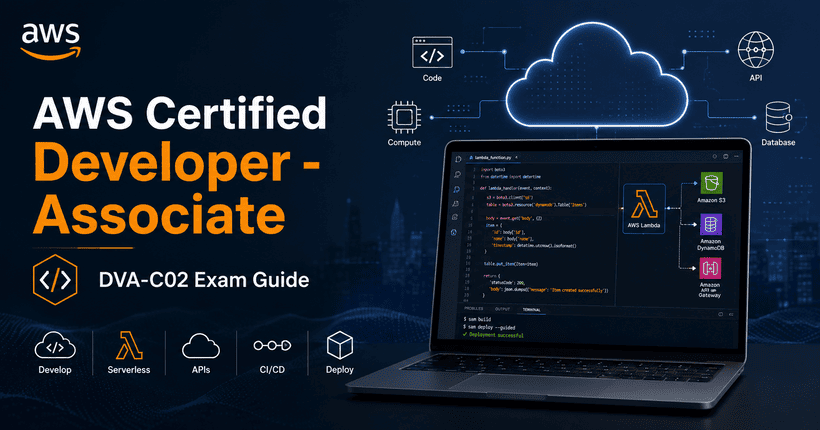
The AWS Certified Developer – Associate certification is one of the most practical credentials in the AWS certification portfolio for people who build, deploy, secure, and troubleshoot applications in the cloud. The current exam, DVA-C02, goes beyond memorizing AWS service names. It tests whether you understand how AWS services work together in realistic application development scenarios.
If you are a student, junior developer, cloud engineer, DevOps beginner, technical project professional, or someone planning to move into AWS application development, the AWS Certified Developer Associate DVA-C02 certification can provide a structured way to build both cloud knowledge and application development skills.
The exam covers serverless development, application integration, databases, identity and access management, encryption, CI/CD, infrastructure deployment, monitoring, troubleshooting, and application optimization. Recent updates to the exam guide also reflect newer development practices, including Amazon Q Developer, event-driven architectures, application resilience, structured logging, and AI-assisted development concepts.
This guide explains what the DVA-C02 exam covers, which AWS services deserve the most attention, how the certification can support your career, and how to build an effective study plan without trying to memorize the entire AWS platform.
What Is the AWS Certified Developer – Associate Certification?
The AWS Certified Developer – Associate certification validates the ability to develop, test, deploy, secure, optimize, and troubleshoot applications running on Amazon Web Services.
Although the word “Developer” appears in the certification name, DVA-C02 is not simply a programming exam. AWS does not expect candidates to spend the exam writing large applications from scratch. Instead, many questions present a development or operational scenario and ask you to identify the AWS service, configuration, security model, deployment method, or troubleshooting approach that best solves the problem.
For example, you may need to determine how an AWS Lambda function should access a DynamoDB table securely, how messages should be processed reliably through Amazon SQS, how application secrets should be stored, or how a new application version should be deployed with minimal risk.
That makes DVA-C02 particularly useful for learners who want to understand the connection between software development and cloud architecture.
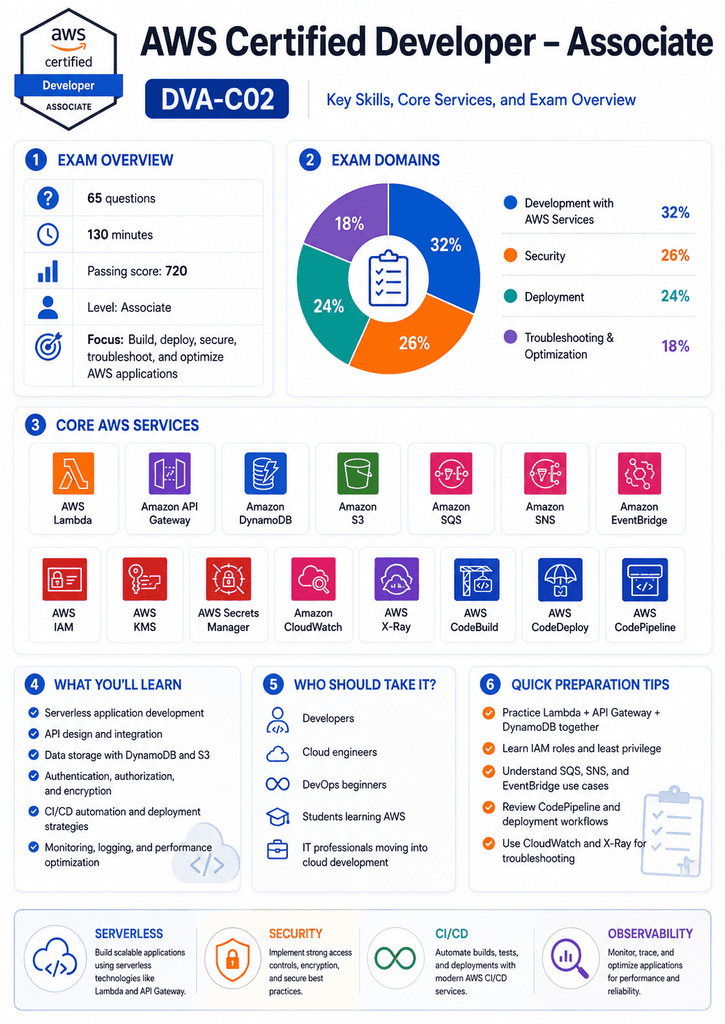
DVA-C02 Exam Overview
Before starting your preparation, it is helpful to understand the basic structure of the exam. Candidates who want additional preparation resources can also review this DVA-C02 AWS Certified Developer Associate course while building their study plan.
| Certification | AWS Certified Developer – Associate |
| Exam Code | DVA-C02 |
| Level | Associate |
| Exam Duration | 130 minutes |
| Number of Questions | 65 questions |
| Question Types | Multiple choice and multiple response |
| Scored Questions | 50 |
| Unscored Questions | 15 |
| Score Range | 100-1,000 |
| Minimum Passing Score | 720 |
| Exam Fee | USD $150, subject to regional pricing and applicable taxes |
| Testing Options | Pearson VUE testing center or online proctored exam |
AWS recommends that the target candidate have approximately one or more years of hands-on experience developing and maintaining applications using AWS services. This is a recommendation rather than a requirement, so beginners can still prepare successfully if they build enough practical experience during their studies.
Current DVA-C02 Exam Domains
The DVA-C02 exam is divided into four scored content domains. Understanding their weighting is important because it helps you decide where to spend your preparation time.
| Domain | Exam Weight |
|---|---|
| Domain 1: Development with AWS Services | 32% |
| Domain 2: Security | 26% |
| Domain 3: Deployment | 24% |
| Domain 4: Troubleshooting and Optimization | 18% |
The percentages immediately reveal something important: development is the largest section, but security and deployment together account for half of the scored exam. A candidate who studies only Lambda and DynamoDB while ignoring IAM, encryption, CI/CD, monitoring, and deployment strategies will probably find DVA-C02 much harder than expected.
Domain 1: Development with AWS Services – 32%
This is the largest DVA-C02 domain and the foundation of the certification. You should understand how to develop cloud applications using AWS services rather than simply knowing what each service does.
AWS Lambda
AWS Lambda is one of the most important services for the AWS Developer Associate exam. You should be comfortable with function configuration, event sources, permissions, environment variables, concurrency, error handling, retries, versions, aliases, and integrations with other AWS services.
You should also understand how Lambda fits into event-driven architectures. A function may be triggered by services such as API Gateway, Amazon S3, Amazon EventBridge, Amazon SQS, or other AWS services. Each integration can have different retry behavior, failure handling, and scaling characteristics.
Rather than memorizing isolated facts, practice following an event through an architecture:
- What service produces the event?
- How does the event reach Lambda?
- Which IAM permissions are required?
- What happens if the function fails?
- Where are logs and metrics available?
- How can failed events be processed later?
Amazon API Gateway
API Gateway frequently appears alongside Lambda because the combination is widely used to create serverless APIs.
Important concepts include request and response handling, authentication, authorization, API stages, throttling, caching, error responses, integrations, and deployment.
You should be able to recognize scenarios where API Gateway acts as the public API layer while Lambda implements application logic behind it.
Amazon DynamoDB
Amazon DynamoDB deserves significant study time. DVA-C02 questions often focus on how an application accesses and models data rather than basic database definitions.
Make sure you understand:
- Partition keys and sort keys
- Primary key design
- Query versus Scan
- Global secondary indexes
- Local secondary indexes
- Conditional writes
- Optimistic locking concepts
- Read and write capacity concepts
- On-demand capacity
- DynamoDB Streams
- Time to Live (TTL)
- Transactions
- Consistency models
A good DVA-C02 candidate should be able to look at an access pattern and choose an appropriate DynamoDB design instead of treating DynamoDB like a traditional relational database.
Application Integration
Modern AWS applications frequently use loosely coupled and event-driven components. For this reason, you should know how several AWS application integration services differ.
Amazon SQS
Understand standard queues, FIFO queues, visibility timeout, long polling, message retention, dead-letter queues, message processing, and duplicate handling.
Amazon SNS
Understand publish/subscribe architectures, multiple subscribers, notifications, message filtering, and how SNS can work together with SQS.
Amazon EventBridge
EventBridge has become increasingly relevant for event-driven AWS applications. You should understand event buses, rules, event patterns, targets, and how events can connect independent application components.
AWS Step Functions
Step Functions can coordinate distributed workflows and serverless applications. Learn when workflow orchestration is preferable to writing complex coordination logic directly in application code.
Application Architecture Patterns
DVA-C02 increasingly expects developers to understand architectural behavior rather than individual services in isolation.
Know the differences between:
- Synchronous and asynchronous communication
- Stateful and stateless applications
- Tightly coupled and loosely coupled systems
- Monolithic and microservices architectures
- Orchestration and choreography
- Request-response and event-driven patterns
Also understand common resilience techniques such as retry logic, exponential backoff, error handling, idempotency, circuit breaker concepts, and designing applications to tolerate temporary service failures.
Domain 2: Security – 26%
Security represents more than a quarter of the scored DVA-C02 exam. For many developers, this is the domain that requires the biggest change in thinking.
The exam expects you to understand how applications should securely access AWS resources without embedding permanent credentials directly in source code.
AWS Identity and Access Management
AWS IAM is essential knowledge.
You should understand:
- IAM users
- IAM groups
- IAM roles
- Identity-based policies
- Resource-based policies
- Temporary credentials
- Least-privilege permissions
- Role assumption
- Cross-account access concepts
A recurring exam principle is simple: when an AWS service needs access to another AWS service, prefer an appropriate IAM role and temporary credentials instead of hard-coded access keys.
AWS Security Token Service
AWS STS provides temporary security credentials and is closely related to IAM roles. Understand how applications can assume roles and why temporary credentials are generally preferable to long-lived credentials.
Amazon Cognito
Amazon Cognito can provide identity capabilities for web and mobile applications. Candidates should understand its role in authentication and application access rather than confusing Cognito with IAM users used for AWS administration.
AWS KMS and Encryption
You should understand both encryption at rest and encryption in transit, as well as the role of AWS Key Management Service (AWS KMS).
Study:
- AWS KMS keys
- Encryption and decryption permissions
- Key policies
- Key rotation concepts
- Server-side encryption
- Client-side encryption concepts
- Cross-account encryption considerations
AWS Secrets Manager
Database passwords, API credentials, tokens, and other sensitive values should not be stored directly inside application source code.
AWS Secrets Manager is an important service for securely storing and retrieving secrets. Understand when it is preferable to hard-coded configuration and how IAM permissions control which applications can retrieve particular secrets.
Secure Application Development
The current DVA-C02 scope also puts more emphasis on application-level security. Developers should understand fine-grained authorization, handling sensitive information, securing communications between microservices, data sanitization, and avoiding accidental exposure of sensitive information through application logs.
Domain 3: Deployment – 24%
The deployment domain tests whether you understand how applications move from development into AWS environments safely and repeatedly.
This includes application artifacts, automated testing, infrastructure configuration, CI/CD services, and release strategies. When reviewing this section, using a structured DVA-C02 exam preparation resource can help you identify weak areas across deployment and automation topics.
AWS CodeBuild
AWS CodeBuild is a managed build service. Understand its role in compiling source code, running tests, and producing deployable artifacts as part of a CI/CD workflow.
AWS CodeDeploy
AWS CodeDeploy automates application deployments. Candidates should understand deployment configurations and strategies, including scenarios involving:
- Rolling deployments
- Canary deployments
- Blue/green deployments
You should know why a particular deployment strategy might be selected when an organization wants to reduce release risk or provide a controlled rollback path.
AWS CodePipeline
AWS CodePipeline connects stages of the software delivery process into an automated pipeline.
A typical pipeline might include:
- Source changes
- Build
- Automated testing
- Artifact generation
- Deployment
- Validation
The exam may present a broken or incomplete CI/CD workflow and ask which AWS service or configuration should be changed.
Infrastructure as Code
Developers should also understand the value of defining AWS infrastructure as code.
Services and tools worth understanding include:
- AWS CloudFormation
- AWS Cloud Development Kit (AWS CDK)
- AWS Serverless Application Model concepts
You do not need to memorize every possible CloudFormation property, but you should understand why infrastructure as code improves repeatability, version control, environment consistency, and automation.
AWS AppConfig
Application configuration is another area worth reviewing. AWS AppConfig can help separate application configuration from application code and can support controlled configuration changes across environments.
This matters because modern deployment practices are not only about deploying new binaries or functions. Configuration changes can also affect application behavior and should be managed carefully.
Testing AWS Applications
The current DVA-C02 exam scope includes stronger emphasis on application testing.
Be familiar with concepts such as:
- Unit testing
- Integration testing
- Mocking external dependencies
- Testing event-driven applications
- Automating tests in CI/CD pipelines
- Testing before production deployment
The objective is not to turn the certification into a software testing exam. Instead, AWS wants developers to recognize where testing belongs in a modern cloud delivery workflow.
Domain 4: Troubleshooting and Optimization – 18%
The final domain focuses on what happens after an application starts running.
Production systems fail in ways that are rarely obvious. Good AWS developers need to identify the source of a problem using logs, metrics, traces, configuration information, and service behavior.
Amazon CloudWatch
Amazon CloudWatch should be one of the first services you think about when a DVA-C02 scenario involves monitoring or troubleshooting.
Understand:
- CloudWatch metrics
- CloudWatch Logs
- Log groups and log streams
- Metric filters
- Alarms
- Application monitoring
- Structured logging
You should be comfortable determining whether metrics, logs, or traces provide the most useful information for a particular troubleshooting scenario.
AWS X-Ray
AWS X-Ray helps developers trace requests through distributed applications and microservices.
This is particularly useful when an application request travels through several components and you need to determine which service introduces latency or errors.
Application Performance Optimization
Optimization questions can involve several approaches depending on the bottleneck.
You may need to consider:
- Application-level caching
- Database access optimization
- Reducing unnecessary API calls
- Resource configuration
- Concurrency
- Efficient event processing
- Retry behavior
- Analyzing logs for bottlenecks
Do not automatically choose a larger compute resource whenever performance is poor. DVA-C02 often rewards the solution that addresses the underlying architectural or application problem.
Important AWS Services for DVA-C02
The AWS Certified Developer Associate exam covers a broad collection of services, but some deserve more attention because they appear naturally across multiple exam domains.
| AWS Service | What You Should Understand |
|---|---|
| AWS Lambda | Serverless functions, permissions, triggers, concurrency, errors, retries, versions and integrations |
| Amazon API Gateway | APIs, integrations, authorization, stages, throttling and caching |
| Amazon DynamoDB | Keys, indexes, capacity, queries, transactions, streams and access patterns |
| Amazon S3 | Object storage, permissions, encryption, events and application integration |
| Amazon SQS | Queues, visibility timeout, long polling, FIFO, DLQs and asynchronous processing |
| Amazon SNS | Publish/subscribe messaging, subscribers and fanout patterns |
| Amazon EventBridge | Event buses, event rules, targets and event-driven architectures |
| AWS Step Functions | Workflow orchestration and coordination of distributed components |
| AWS IAM | Policies, roles, temporary credentials and least privilege |
| AWS KMS | Encryption keys, permissions, policies and application encryption |
| AWS Secrets Manager | Secure application secrets and credential retrieval |
| Amazon Cognito | Application authentication and user identity |
| AWS CodeBuild | Build and test automation |
| AWS CodeDeploy | Automated deployments and deployment strategies |
| AWS CodePipeline | CI/CD workflow automation |
| AWS CloudFormation | Infrastructure as code and repeatable environments |
| AWS CDK | Defining AWS infrastructure through programming languages |
| Amazon CloudWatch | Metrics, alarms, logs and application monitoring |
| AWS X-Ray | Distributed tracing and performance troubleshooting |
| Amazon Q Developer | AI-assisted software development and development productivity |
Amazon Q Developer and Emerging AI Topics
One important difference between older DVA-C02 study materials and the current exam guide is the growing role of AI-assisted software development.
Amazon Q Developer is now within the DVA-C02 exam scope. Current AWS guidance also identifies emerging topics related to using AI-assisted development tools for activities such as code generation, code review, intelligent completion, refactoring, testing, optimization, and security analysis.
Security remains important when AI is introduced into a development workflow. Developers should recognize risks involving sensitive data, access permissions, model inputs and outputs, AI agent interactions, and confidential information accidentally appearing in application logs.
These topics should not replace your study of Lambda, DynamoDB, IAM, CI/CD, and observability. Instead, consider them an extension of the modern AWS developer skill set.
How Difficult Is the DVA-C02 Exam?
DVA-C02 is usually manageable for candidates with practical AWS experience, but it can be surprisingly difficult for learners who rely entirely on memorization.
The challenge comes from the way questions combine several technologies.
Instead of asking:
“What is Amazon SQS?”
a question is more likely to describe an application in which messages are processed asynchronously, some messages repeatedly fail, and the development team needs to prevent those failed messages from blocking normal processing.
You then need to identify the appropriate architecture or configuration.
This difference is important. Successful preparation means learning both what a service does and when it should be used.
Do You Need Programming Experience for DVA-C02?
Basic programming knowledge is strongly recommended.
You do not need to be an expert software engineer, but you should understand common development concepts such as:
- Functions and methods
- APIs
- JSON
- Environment variables
- Exception handling
- Authentication and authorization
- Application configuration
- Software testing
- Logging
- Version control
- CI/CD
Experience with Python, JavaScript, TypeScript, Java, C#, Go, or another common language can make the AWS examples easier to understand.
The important point is not which programming language you use. The exam focuses more heavily on your ability to build applications correctly on AWS.
Recommended Hands-On Labs for DVA-C02
If possible, do not prepare for this certification using videos and practice questions alone. A few small AWS projects can make many exam concepts much easier to remember.
Lab 1: Build a Serverless REST API
- Create a Lambda function.
- Expose it through Amazon API Gateway.
- Store application data in DynamoDB.
- Use an IAM role instead of hard-coded credentials.
- Review logs in CloudWatch.
Lab 2: Build an Asynchronous Processing Workflow
- Send messages to Amazon SQS.
- Process messages with Lambda.
- Create a dead-letter queue.
- Experiment with visibility timeout and retry behavior.
Lab 3: Create an Event-Driven Application
- Publish an event.
- Create an EventBridge rule.
- Send matched events to a target.
- Observe how producers and consumers remain loosely coupled.
Lab 4: Secure an Application Secret
- Store a secret in AWS Secrets Manager.
- Create an appropriate IAM role.
- Allow an application to retrieve only the required secret.
- Compare this with storing credentials directly in source code.
Lab 5: Create a Basic CI/CD Pipeline
- Prepare application source code.
- Configure a build process.
- Run automated tests.
- Generate an artifact.
- Deploy the application through a pipeline.
Lab 6: Troubleshoot a Distributed Application
- Generate application logs.
- Review metrics in CloudWatch.
- Configure an alarm.
- Use tracing to follow application requests.
- Identify a simulated performance bottleneck.
These labs do more than prepare you for questions. They teach you how AWS services behave when something actually goes wrong, which is exactly where practical cloud knowledge becomes valuable.
An 8-Week DVA-C02 Study Plan
A structured schedule can make preparation significantly easier. You can also combine the following plan with dedicated AWS Developer Associate DVA-C02 study materials to reinforce the topics you find most difficult.
Week 1: AWS Developer Foundations
Review AWS fundamentals, IAM, AWS SDK concepts, the AWS CLI, regions, availability concepts, application architecture, and the shared responsibility model.
Week 2: Lambda and API Development
Focus heavily on Lambda, API Gateway, event sources, permissions, error handling, versions, aliases, concurrency, and common serverless patterns.
Week 3: Databases and Storage
Study DynamoDB in depth. Add Amazon S3, Amazon RDS, Aurora, ElastiCache, and the differences between common AWS data storage options.
Week 4: Messaging and Event-Driven Applications
Study SQS, SNS, EventBridge, Step Functions, asynchronous processing, retries, failure handling, and loosely coupled architecture.
Week 5: Security
Focus on IAM roles, policies, AWS STS, Cognito, KMS, Secrets Manager, encryption, authorization, least privilege, and handling sensitive data.
Week 6: Deployment and CI/CD
Study CodeBuild, CodeDeploy, CodePipeline, CloudFormation, AWS CDK, configuration management, deployment strategies, testing, and release automation.
Week 7: Monitoring and Troubleshooting
Review CloudWatch, X-Ray, structured logging, application monitoring, performance optimization, error analysis, and distributed application troubleshooting.
Week 8: Practice and Review
Complete timed practice exams, identify weak domains, revisit hands-on labs, and review explanations for every incorrect answer.
During the final week, avoid trying to learn dozens of new services. Strengthening your understanding of the major DVA-C02 services is usually more valuable than collecting more isolated facts.
How to Approach DVA-C02 Scenario Questions
A useful technique is to identify the main requirement before looking at the answer choices.
Ask yourself what the scenario is really asking for:
- Security?
- Performance?
- Reliability?
- Loose coupling?
- Lower operational overhead?
- Automated deployment?
- Monitoring?
- Temporary credentials?
- Failure recovery?
Then eliminate answers that solve a different problem.
For example, if the requirement says application credentials must not be stored permanently in source code, the main issue is credential management. Increasing Lambda memory or adding a CloudWatch dashboard does not address that requirement, even if those services appear elsewhere in the architecture.
Common DVA-C02 Exam Mistakes
1. Memorizing Service Definitions
Knowing that SQS is a queue service is not enough. Learn visibility timeout, dead-letter queues, polling, FIFO behavior, retry considerations, and how SQS interacts with Lambda.
2. Ignoring IAM
Developers sometimes spend most of their preparation on application services and leave IAM until the end. This is risky because permissions appear throughout the exam.
3. Hard-Coding Credentials
When a scenario involves AWS-hosted workloads, look for solutions based on IAM roles and temporary credentials whenever appropriate.
4. Confusing SNS, SQS, and EventBridge
These services overlap in some architectures but solve different messaging and event-routing problems. Learn the architecture patterns rather than memorizing a one-line definition.
5. Ignoring Failure Behavior
Know what happens when a function fails, a message cannot be processed, a deployment fails, or an API dependency becomes temporarily unavailable.
6. Neglecting Testing and Deployment
Almost a quarter of the scored exam relates to deployment. CI/CD, testing, deployment strategies, and infrastructure automation deserve serious preparation.
7. Studying Only Old DVA-C02 Materials
The exam guide has evolved. Current preparation should also include EventBridge, application resilience patterns, Amazon Q Developer, application configuration, modern testing practices, structured logging, and updated optimization concepts.
Why Is the AWS Developer Associate Certification Valuable?
The value of the certification is not simply the badge itself. Its strongest benefit is the collection of practical cloud development skills that candidates develop while preparing for the exam.
It Builds Practical AWS Development Knowledge
You learn how application code interacts with AWS compute, storage, database, messaging, identity, security, monitoring, and deployment services.
It Introduces Modern Cloud Architecture
Concepts such as serverless computing, event-driven architecture, microservices, asynchronous messaging, infrastructure as code, and CI/CD are useful far beyond the certification exam.
It Can Support Developer and Cloud Career Paths
DVA-C02 is relevant to roles such as:
- Cloud Developer
- Software Developer
- Backend Developer
- Serverless Developer
- Cloud Engineer
- DevOps Engineer
- Application Engineer
- Platform Engineer
- Technical Consultant
It Provides a Foundation for More Advanced AWS Learning
After developing solid application-level AWS knowledge, candidates may choose to continue into architecture, DevOps, security, or other advanced cloud topics.
DVA-C02 vs. AWS Solutions Architect Associate
The AWS Certified Developer – Associate and AWS Certified Solutions Architect – Associate certifications overlap, but their emphasis is different.
| Area | DVA-C02 Developer Associate | Solutions Architect Associate |
|---|---|---|
| Primary Focus | Developing and operating applications | Designing AWS architectures |
| Programming Perspective | Higher | Lower |
| Lambda and APIs | Deep focus | Architectural focus |
| CI/CD | Important | Less central |
| Application Troubleshooting | Important | Less developer-focused |
| Architecture Design | Application-level | Broader infrastructure-level |
If your main interest is writing applications, building APIs, working with serverless services, or automating software delivery, DVA-C02 is usually the more directly relevant certification.
If your work focuses more heavily on designing complete AWS environments and selecting infrastructure solutions, the Solutions Architect path may be a better starting point.
Who Should Take the DVA-C02 Exam?
The AWS Certified Developer Associate exam is worth considering if you are:
- A software developer moving applications to AWS
- A student learning cloud development
- A junior AWS or cloud engineer
- A DevOps professional who works with application teams
- A backend developer building APIs and distributed systems
- A technical project professional who wants deeper knowledge of AWS software delivery
- An AWS practitioner planning to specialize in development
Absolute beginners can prepare for DVA-C02, but they should expect to spend more time on hands-on practice. Someone who has never used IAM, Lambda, APIs, databases, or application logs will probably find the exam difficult if preparation consists only of reading notes.
Final DVA-C02 Preparation Tips
As exam day approaches, prioritize understanding over memorization.
- Know why one AWS service is more appropriate than another.
- Practice Lambda, DynamoDB, SQS, API Gateway, IAM, and CloudWatch hands-on.
- Understand temporary credentials and IAM roles.
- Review encryption and secrets management.
- Understand retries, dead-letter queues, and failure handling.
- Know common CI/CD stages and deployment strategies.
- Practice reading CloudWatch logs and application traces.
- Understand event-driven and loosely coupled architectures.
- Review Amazon Q Developer and current development practices.
- Read every practice-question explanation, including explanations for answers you selected correctly.
If you want to organize your final review around the main exam objectives, the DVA-C02 AWS Certified Developer Associate exam preparation page can be used alongside your AWS hands-on practice and official documentation.
The goal is to reach the point where you can look at an AWS development scenario and reason through the architecture instead of searching your memory for a matching sentence from a study guide.
Frequently Asked Questions About AWS DVA-C02
What is the DVA-C02 exam?
DVA-C02 is the exam code for the AWS Certified Developer – Associate certification. It validates skills related to developing, securing, deploying, troubleshooting, and optimizing applications on AWS.
How many questions are on the DVA-C02 exam?
The exam contains 65 questions. The current AWS exam guide identifies 50 scored questions and 15 unscored questions.
How long is the AWS Developer Associate exam?
Candidates receive 130 minutes to complete the DVA-C02 exam.
What score do you need to pass DVA-C02?
The reported score ranges from 100 to 1,000, and the current minimum passing score is 720.
Is AWS Lambda important for DVA-C02?
Yes. Lambda is one of the most important services to understand for the exam, particularly when combined with API Gateway, DynamoDB, SQS, EventBridge, IAM, CloudWatch, and other application services.
Is DynamoDB important for the AWS Developer Associate exam?
Yes. Candidates should understand DynamoDB keys, indexes, queries, consistency, capacity modes, streams, transactions, TTL, and data-access patterns.
Does DVA-C02 include Amazon Q Developer?
Yes. Amazon Q Developer is included in the current DVA-C02 exam scope, and AWS also identifies AI-assisted development as an emerging area relevant to the Developer Associate role.
Can beginners pass AWS DVA-C02?
Yes, but beginners should combine structured study with hands-on AWS practice. Learning the services only through definitions is unlikely to provide enough preparation for scenario-based exam questions.
How long should I study for DVA-C02?
The preparation period depends heavily on previous AWS and software development experience. A structured plan of several weeks is reasonable for many learners, while complete beginners may need additional time to build programming and AWS fundamentals.
Is DVA-C02 worth earning?
For developers and cloud professionals who work with AWS applications, DVA-C02 can be valuable because the preparation covers practical skills including serverless development, APIs, databases, security, event-driven systems, CI/CD, monitoring, and troubleshooting.
Conclusion
The AWS Certified Developer – Associate DVA-C02 exam is a strong certification choice for anyone who wants to understand how modern applications are actually built and operated on AWS.
The exam is not limited to writing code. It brings together application development, serverless architecture, databases, messaging, security, CI/CD, observability, troubleshooting, and performance optimization. That broad scope is exactly what makes the certification useful.
For the best results, concentrate first on the core AWS developer services: Lambda, API Gateway, DynamoDB, S3, SQS, SNS, EventBridge, IAM, KMS, Secrets Manager, CodeBuild, CodeDeploy, CodePipeline, CloudWatch, and X-Ray. Then connect those services through practical architectures and hands-on labs.
If you can explain not only what each AWS service does but also why you would choose it, how you would secure it, how you would deploy it, and how you would troubleshoot it, you are approaching the level of understanding that the DVA-C02 exam is designed to validate.
For candidates who want a more focused review before the exam, visit the AWS DVA-C02 certification course page for additional DVA-C02 preparation resources.
Exam objectives and AWS services can change over time. Candidates should review the latest official AWS Certified Developer – Associate exam guide before scheduling the DVA-C02 exam.