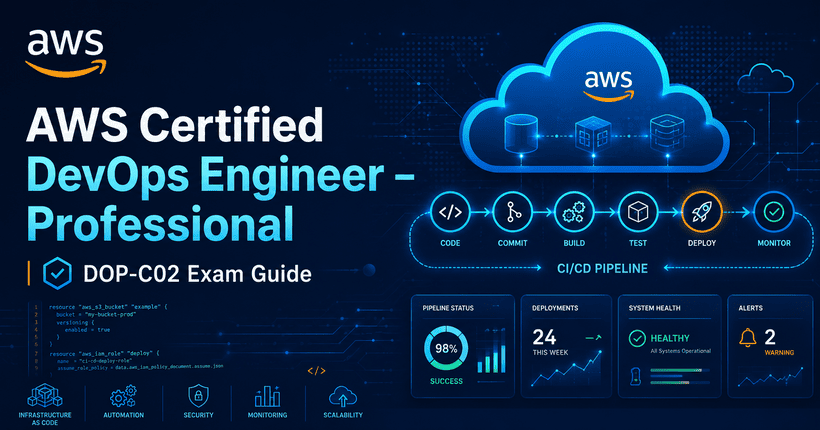
The AWS Certified DevOps Engineer – Professional DOP-C02 is one of the most advanced certifications in the AWS certification portfolio. It is designed for professionals who already understand AWS infrastructure and want to demonstrate that they can automate deployments, operate distributed systems, respond to incidents, and maintain secure and reliable cloud environments at scale.
For engineers, developers, cloud administrators, students, and even project professionals who work closely with technical teams, the certification provides a useful framework for understanding how modern cloud applications move from source code to production. More importantly, the AWS Certified DevOps Engineer Professional DOP-C02 exam focuses on real operational decisions rather than simple memorization of AWS service definitions.
This guide explains the DOP-C02 exam structure, major domains, important AWS technologies, certification value, preparation strategy, and the practical skills candidates should develop before exam day.
What Is the AWS Certified DevOps Engineer – Professional Certification?
Table of Contents
ToggleThe AWS Certified DevOps Engineer – Professional certification validates advanced technical skills in provisioning, operating, managing, monitoring, and securing distributed applications on AWS.
DevOps is often described as a combination of development and operations, but the practical meaning is broader. A mature DevOps environment connects software development, infrastructure automation, testing, release management, monitoring, security, incident response, and continuous improvement.
The DOP-C02 exam therefore asks candidates to think about the complete application lifecycle.
You may need to determine how to:
- Build a secure CI/CD pipeline.
- Deploy applications across multiple AWS accounts.
- Automate infrastructure provisioning.
- Perform blue/green or canary deployments.
- Monitor applications and infrastructure.
- Automatically respond to operational events.
- Recover services after a failure.
- Manage IAM permissions at scale.
- Protect secrets and sensitive information.
- Implement governance across multiple AWS accounts and Regions.
This is what makes the certification different from an introductory AWS exam. Candidates are expected to understand not only what an AWS service does, but also when it should be used and how it interacts with other services.
DOP-C02 Exam Overview
| Exam Item | Details |
|---|---|
| Certification | AWS Certified DevOps Engineer – Professional |
| Exam Code | DOP-C02 |
| Level | Professional |
| Exam Duration | 180 minutes |
| Number of Questions | 75 questions |
| Question Types | Multiple choice and multiple response |
| Scored Questions | 65 |
| Unscored Questions | 10 |
| Passing Score | 750 on a scale of 100–1,000 |
| Exam Cost | USD 300, subject to local pricing and applicable taxes |
| Testing Options | Pearson VUE testing center or online proctored exam |
AWS does not identify which questions are unscored, so candidates should approach every question as though it contributes to the final result.
Another important point is that DOP-C02 uses a compensatory scoring model. You do not have to achieve a separate passing score in every domain. Your overall performance determines whether you pass.
Who Should Take the DOP-C02 Exam?
AWS recommends that candidates have significant practical experience before attempting the Professional-level DevOps certification. The ideal candidate normally has at least two years of experience provisioning, operating, and managing AWS environments, together with familiarity with software development lifecycle practices and scripting or programming.
The exam is particularly relevant for:
- DevOps engineers
- Cloud engineers
- Site reliability engineers
- Platform engineers
- Cloud operations engineers
- Infrastructure engineers
- Software engineers responsible for deployment pipelines
- AWS administrators moving toward automation roles
- Technical architects involved in operational design
Students can also study for DOP-C02, but they should not rely only on books or practice questions. Professional-level scenarios make much more sense after you have actually created pipelines, broken deployments, investigated CloudWatch logs, written CloudFormation templates, configured IAM roles, and restored applications after simulated failures.
Do You Need Another AWS Certification First?
There is no mandatory Associate-level certification that must be completed before attempting the AWS Certified DevOps Engineer – Professional exam.
However, candidates who already understand the material associated with certifications such as AWS Certified Developer – Associate or AWS Certified Solutions Architect – Associate generally have a much easier starting point.
DOP-C02 assumes that basic AWS concepts are already familiar. You should be comfortable with topics such as IAM, EC2, VPCs, security groups, load balancing, Auto Scaling, S3, databases, Lambda, containers, and basic monitoring before beginning serious Professional-level preparation.
DOP-C02 Exam Domains and Weightings
The DOP-C02 exam is divided into six major domains, each covering an important part of professional AWS DevOps operations.
| Domain | Weight |
|---|---|
| Domain 1: SDLC Automation | 22% |
| Domain 2: Configuration Management and Infrastructure as Code | 17% |
| Domain 3: Resilient Cloud Solutions | 15% |
| Domain 4: Monitoring and Logging | 15% |
| Domain 5: Incident and Event Response | 14% |
| Domain 6: Security and Compliance | 17% |
Although SDLC Automation has the largest weighting, candidates should avoid preparing for the exam by studying percentages alone. The domains are heavily connected. A single scenario can involve deployment automation, IAM, CloudWatch, EventBridge, Lambda, and rollback logic at the same time.
Domain 1: SDLC Automation – 22%
SDLC Automation is the largest DOP-C02 domain and covers the automation of application delivery throughout the software development lifecycle.
You should understand how continuous integration and continuous delivery pipelines are designed and how applications move safely from development to production.
Important Topics
- Continuous integration and continuous delivery
- Pipeline design
- Automated testing
- Artifact management
- Deployment automation
- Release strategies
- Rollback mechanisms
- Cross-account deployments
- Container deployment workflows
- Serverless deployments
AWS Services to Understand
Services commonly associated with these scenarios include:
- AWS CodePipeline
- AWS CodeBuild
- AWS CodeDeploy
- AWS CodeArtifact
- Amazon ECR
- AWS Lambda
- Amazon ECS
- Amazon EKS
- AWS CloudFormation
- AWS Secrets Manager
- AWS Systems Manager Parameter Store
A typical exam question may describe a company that currently performs manual deployments and wants to reduce downtime. Several answers may technically deploy the application, but the best answer could require an automated pipeline combined with blue/green deployment, health checks, testing, and automatic rollback.
Understand Deployment Strategies
Professional-level candidates should know the practical differences between deployment strategies such as:
- All-at-once deployment: Fast, but potentially disruptive.
- Rolling deployment: Updates resources gradually.
- Blue/green deployment: Maintains separate old and new environments, reducing deployment risk.
- Canary deployment: Sends a small percentage of traffic to the new version before wider release.
- Linear deployment: Gradually increases traffic to a new application version.
The correct strategy depends on requirements such as downtime, deployment speed, rollback capability, cost, and risk tolerance.
Domain 2: Configuration Management and Infrastructure as Code – 17%
Infrastructure as Code, or IaC, is one of the foundations of modern AWS DevOps environments.
Instead of manually creating infrastructure through the AWS Management Console, organizations define infrastructure through templates and automation. This makes environments easier to reproduce, review, test, version, and audit.
Key Areas
- Reusable infrastructure templates
- Configuration management
- AWS account automation
- Multi-account environments
- Multi-Region deployments
- Automated resource provisioning
- Stack management
- Configuration drift
- Automated operational tasks
AWS CloudFormation is especially important. Candidates should understand stacks, stack sets, change sets, nested stacks, parameters, outputs, dependencies, rollback behavior, and drift detection.
You should also understand how services such as AWS Organizations, AWS Control Tower, IAM, AWS Systems Manager, and AWS CloudFormation can work together to manage large environments.
Why IaC Matters Beyond the Exam
Infrastructure as Code solves a common operational problem: configuration inconsistency.
If development, testing, and production environments are manually configured, small differences can create difficult troubleshooting situations. With IaC, infrastructure changes can follow the same review and automation process used for application code.
For project managers and students learning cloud operations, this is an important concept. DevOps is not simply faster deployment. It is about creating repeatable and measurable processes that reduce operational risk.
Domain 3: Resilient Cloud Solutions – 15%
A production application must continue operating when resources fail, traffic suddenly increases, or an entire Availability Zone becomes unavailable.
This domain evaluates whether you can implement AWS environments that are highly available, scalable, and recoverable.
Topics to Study
- High availability
- Horizontal scaling
- Elastic architectures
- Multi-AZ design
- Automated recovery
- Backup and restore
- Disaster recovery
- RTO and RPO requirements
- Load balancing
- Auto Scaling
You should clearly understand two common business continuity measurements:
- Recovery Time Objective (RTO): How quickly a service must be restored.
- Recovery Point Objective (RPO): How much data loss the business can tolerate.
Different RTO and RPO requirements lead to different technical architectures and costs.
A company that can tolerate several hours of downtime may use backup-and-restore strategies. A business-critical transaction platform may require continuously available infrastructure across multiple Availability Zones or even additional Regions.
Domain 4: Monitoring and Logging – 15%
Automation is useful only when engineers can determine whether the system is actually healthy.
Monitoring and observability therefore play a major role in the AWS DevOps Engineer Professional exam.
Important Services and Concepts
- Amazon CloudWatch
- CloudWatch Logs
- CloudWatch alarms
- CloudWatch metrics
- AWS CloudTrail
- AWS X-Ray
- Amazon EventBridge
- Amazon SNS
- Log aggregation
- Metric filters
- Dashboards
- Distributed tracing
Do not confuse monitoring services with auditing services.
For example, Amazon CloudWatch is commonly used for metrics, logs, dashboards, and alarms, while AWS CloudTrail records API activity and is essential for auditing who performed an AWS action.
A strong DOP-C02 candidate should be able to look at a requirement and decide which telemetry source provides the information needed to investigate the problem.
Think in Terms of Actionable Monitoring
Collecting logs is not enough.
A mature DevOps system should be capable of detecting a condition, generating an event, notifying the appropriate team, and in some situations automatically correcting the problem.
A common workflow might look like:
CloudWatch Alarm → EventBridge → Lambda or Systems Manager Automation → Remediation Action
This event-driven approach appears repeatedly in real AWS operations and is an important pattern for the exam.
Domain 5: Incident and Event Response – 14%
Failures happen even in well-designed systems. The real question is how quickly and safely the organization can respond.
This domain focuses on event processing, automated response, remediation, and troubleshooting.
Key Topics
- Event-driven automation
- Operational notifications
- Automated remediation
- Configuration changes triggered by events
- Troubleshooting applications
- Troubleshooting infrastructure
- Failure analysis
- Rollback and recovery
Services such as EventBridge, CloudWatch, Lambda, Amazon SNS, Amazon SQS, AWS Systems Manager, AWS Config, and CloudTrail frequently appear in incident-response architectures.
Professional-level questions often include several technically possible answers. Pay attention to wording such as:
- Automatically
- Least operational overhead
- Near real time
- At scale
- Without manual intervention
- Most secure
These phrases usually help reveal the architecture AWS expects.
Domain 6: Security and Compliance – 17%
Security is integrated throughout AWS DevOps rather than treated as a separate final step.
The DOP-C02 exam expects candidates to understand how security controls can be automated across pipelines, accounts, workloads, and infrastructure.
Important Topics
- IAM roles and policies
- Least privilege
- Cross-account access
- Secrets management
- Encryption
- Automated compliance
- Security monitoring
- Audit logging
- Configuration compliance
- Automated remediation
Services Worth Reviewing
- AWS IAM
- AWS Organizations
- AWS KMS
- AWS Secrets Manager
- AWS Config
- AWS CloudTrail
- Amazon GuardDuty
- AWS Security Hub
- Amazon Inspector
- AWS Systems Manager
- Amazon EventBridge
Pay particular attention to the principle of least privilege. When several answers solve the same functional requirement, the option that avoids unnecessary permissions is often preferable.
Important AWS Services for DOP-C02
You do not need to memorize every AWS product. However, you should understand how major services fit together when preparing for the AWS DevOps Engineer Professional certification.
| Technology Area | Important AWS Services |
|---|---|
| CI/CD | CodePipeline, CodeBuild, CodeDeploy, CodeArtifact |
| Infrastructure as Code | CloudFormation, CloudFormation StackSets |
| Containers | Amazon ECS, Amazon EKS, Amazon ECR |
| Serverless | AWS Lambda, API Gateway, Step Functions |
| Monitoring | CloudWatch, X-Ray |
| Auditing | CloudTrail, AWS Config |
| Event Automation | EventBridge, SNS, SQS, Lambda |
| Operations | AWS Systems Manager |
| Governance | AWS Organizations, AWS Control Tower |
| Security | IAM, KMS, Secrets Manager, GuardDuty, Security Hub |
| Scalability | Elastic Load Balancing, EC2 Auto Scaling |
Why Is the AWS DevOps Professional Certification Valuable?
The value of the certification comes from the type of knowledge it validates.
Many engineers know how to launch an EC2 instance or create an S3 bucket. DOP-C02 goes much further. It examines how a company can repeatedly deploy, monitor, secure, and recover workloads in a controlled manner.
These capabilities are directly relevant to production cloud environments.
1. It Demonstrates Advanced AWS Knowledge
The Professional designation signals that the holder has moved beyond basic AWS administration and understands how multiple AWS services work together in complex operational architectures.
2. It Builds Practical DevOps Thinking
Studying for DOP-C02 encourages candidates to think about automation first.
Instead of asking, “How can an administrator fix this problem?”, the exam frequently pushes you toward a better question:
“How can the system detect, prevent, or automatically remediate this problem?”
3. It Is Relevant to Multiple Cloud Roles
The knowledge applies not only to people with “DevOps Engineer” in their job title. Platform engineers, SREs, cloud engineers, software developers, architects, and operations professionals all use many of the same concepts.
4. It Connects Technology With Business Requirements
Professional AWS architecture is rarely about selecting the most powerful service. It is about balancing reliability, security, cost, operational complexity, and delivery speed.
This perspective is particularly valuable for people involved in technical project management because it helps connect infrastructure decisions with risk, availability, delivery schedules, and operational objectives.
How Difficult Is the DOP-C02 Exam?
DOP-C02 is challenging because questions are often long, scenario-based, and deliberately include several plausible answers.
The main difficulty is not memorizing AWS service names.
You must identify:
- The actual business requirement.
- The technical constraint.
- The operational constraint.
- The security requirement.
- The level of automation expected.
- Which answer introduces unnecessary complexity.
For example, two solutions may both work technically, but one may require administrators to maintain custom servers while another uses managed AWS services and automation. If the question asks for the solution with the least operational overhead, that difference matters.
Hands-On Skills You Should Practice
A strong preparation plan should include hands-on AWS work.
Build a CI/CD Pipeline
Create a basic application and automate its build and deployment process. Add automated testing and experiment with failed builds and rollback behavior.
Create Infrastructure With CloudFormation
Build a reusable template containing networking, compute, IAM roles, security groups, and application resources.
Practice updating stacks, using change sets, investigating failures, and detecting configuration drift.
Configure Monitoring
Create custom CloudWatch alarms and dashboards. Send logs to CloudWatch Logs and build metric filters from application logs.
Create Event-Driven Remediation
Use EventBridge to detect an operational event and invoke Lambda or Systems Manager Automation to perform remediation.
Practice IAM
Create roles for applications and deployment pipelines. Practice cross-account role assumption and reduce permissions according to least-privilege principles.
Simulate Failures
Stop instances, introduce application errors, break permissions, and create failed deployments. Then use logs, metrics, CloudTrail records, and service events to identify what happened.
Troubleshooting systems you intentionally break is often more educational than following a perfect tutorial.
A Practical DOP-C02 Study Plan
The amount of preparation time required depends heavily on your existing AWS experience. Someone working with AWS every day may need mainly exam-focused review, while a student may require several months of hands-on practice.
If you want a structured starting point, reviewing a dedicated DOP-C02 preparation course alongside AWS documentation and hands-on labs can help you organize the six exam domains more efficiently.
Weeks 1–2: Review Core AWS Architecture
- IAM
- EC2
- Auto Scaling
- Elastic Load Balancing
- S3
- VPC fundamentals
- Lambda
- ECS and EKS basics
Weeks 3–4: Focus on CI/CD
- CodePipeline
- CodeBuild
- CodeDeploy
- Deployment strategies
- Artifact management
- Pipeline security
- Cross-account deployment
Weeks 5–6: Study IaC and Operations
- CloudFormation
- StackSets
- AWS Systems Manager
- AWS Organizations
- AWS Control Tower concepts
- Multi-account automation
Weeks 7–8: Monitoring and Incident Response
- CloudWatch
- CloudTrail
- EventBridge
- SNS and SQS
- X-Ray
- Automated remediation
Weeks 9–10: Security and Resilience
- IAM policy design
- KMS
- Secrets Manager
- AWS Config
- GuardDuty
- Security Hub
- High availability
- RTO and RPO
- Backup and disaster recovery
Final Weeks: Practice Scenario Questions
At this stage, stop spending most of your time reading service descriptions. Practice solving scenarios instead.
For every incorrect answer, determine:
- Why your selected answer was wrong.
- Why the correct answer is better.
- Which requirement in the question changed the decision.
- Which AWS service limitation or feature you misunderstood.
This review process is far more valuable than memorizing answer letters.
DOP-C02 Exam Strategy
Read the Requirement Before the Architecture
Long questions contain many technical details, but only a few determine the correct answer.
Look for phrases such as:
- Minimize downtime
- Least operational overhead
- Automatically recover
- Without manual intervention
- Across multiple AWS accounts
- Near-real-time response
- Meet RTO and RPO requirements
- Use least privilege
Eliminate Manual Solutions
Because this is a DevOps exam, answers that require repeated manual administration are often weaker than automated alternatives when automation is possible.
Prefer Managed Services When Appropriate
If two architectures meet the requirements, the solution with fewer self-managed components may provide better reliability and lower operational overhead.
Watch for Security Problems
An answer can be technically functional and still be wrong because it grants excessive IAM permissions, exposes credentials, or creates unnecessary public access.
Do Not Leave Questions Unanswered
There is no penalty for guessing, while unanswered questions are treated as incorrect. If necessary, eliminate obviously incorrect options and make the best remaining choice.
Common Mistakes During DOP-C02 Preparation
Memorizing Services Without Understanding Architectures
Knowing the definition of EventBridge is not enough. You should know when EventBridge is more appropriate than CloudWatch alarms, SNS, SQS, or direct Lambda invocation.
Ignoring Infrastructure as Code
CloudFormation and automated infrastructure management are central to Professional-level DevOps work. Candidates who have only used the AWS console often struggle in this area.
Underestimating IAM
IAM appears throughout deployment automation, account management, monitoring, security, and cross-account operations.
Skipping Hands-On Practice
Configuration errors teach valuable lessons. When you have personally investigated a failed CloudFormation stack or deployment, exam scenarios become easier to interpret.
Studying Every AWS Service Equally
Use the official DOP-C02 exam guide to prioritize relevant services and technologies. Trying to memorize the entire AWS service catalog is neither efficient nor necessary.
Is DOP-C02 Worth It for Students?
Yes, but students should approach the certification as a long-term technical goal rather than simply another exam.
If you are still learning AWS fundamentals, an Associate-level certification may provide a smoother progression. You can then build projects involving infrastructure automation, CI/CD, logging, monitoring, and container or serverless deployment before moving to DOP-C02.
The knowledge gained during this process is often more valuable than the certificate alone.
A student who can explain how a pipeline performs testing, deploys to multiple environments, monitors application health, automatically rolls back a bad release, and records every administrative action has developed a strong foundation for real cloud engineering work.
How DOP-C02 Relates to Real DevOps Work
One reason the AWS Certified DevOps Engineer Professional certification remains useful is that its major domains closely match real production responsibilities.
A typical DevOps engineer may spend one day improving a deployment pipeline, another investigating an application incident, and another creating reusable infrastructure templates.
The same engineer may also need to review IAM permissions, improve observability, automate security checks, analyze failed releases, or develop disaster recovery procedures.
DOP-C02 brings these responsibilities into a single certification framework.
Frequently Asked Questions About DOP-C02
Is AWS Certified DevOps Engineer – Professional a difficult certification?
Yes. It is a Professional-level AWS certification and requires a broad understanding of AWS operations, CI/CD, automation, monitoring, resilience, security, and Infrastructure as Code. The scenario-based questions also require candidates to compare multiple valid-looking architectures.
Do I need an AWS Associate certification before DOP-C02?
No. AWS does not require an Associate-level certification before taking DOP-C02. However, Associate-level knowledge is extremely useful because the Professional exam assumes familiarity with core AWS services.
How many questions are on the DOP-C02 exam?
The exam contains 75 questions. According to the official exam guide, 65 questions affect your score and 10 are unscored questions used by AWS for evaluation purposes.
What is the passing score for DOP-C02?
The minimum passing score is 750 on a scaled range of 100 to 1,000.
How long is the DOP-C02 exam?
The AWS Certified DevOps Engineer – Professional exam lasts 180 minutes.
Does DOP-C02 require programming?
You are not expected to be a full-stack application developer, but scripting and automation knowledge are important. Candidates should be comfortable reading configuration files, infrastructure templates, policies, scripts, and automation logic.
How long is the AWS Certified DevOps Engineer – Professional certification valid?
AWS certifications are valid for three years. Candidates should review AWS recertification requirements before their certification expires.
What should I study most for DOP-C02?
Start with CI/CD, CloudFormation and Infrastructure as Code, CloudWatch, Systems Manager, EventBridge, IAM, multi-account automation, deployment strategies, automated remediation, resilience, and security controls. Then connect these services through hands-on architectures rather than studying each service independently.
Final Thoughts
The AWS Certified DevOps Engineer – Professional DOP-C02 certification is not primarily about memorizing AWS products. It is an exam about operating cloud environments correctly and making sound architectural decisions under real operational constraints.
The strongest candidates learn to think in terms of repeatability, automation, resilience, observability, security, and controlled change.
When preparing, spend less time asking, “What does this AWS service do?” and more time asking:
- How does this service reduce manual work?
- How does it behave when something fails?
- How can it be monitored?
- How can access be secured?
- How can the configuration be reproduced?
- How can the application be safely rolled back?
- How does the solution work across accounts or Regions?
If you can answer those questions confidently across CI/CD, Infrastructure as Code, monitoring, incident response, resilience, and security, you are developing exactly the kind of thinking that the DOP-C02 exam is designed to evaluate.
Use the official AWS exam guide as your syllabus, combine it with hands-on labs and scenario-based practice, and focus on understanding why one AWS architecture is better than another. Candidates who want additional structured preparation can also review the DOP-C02 AWS Certified DevOps Engineer Professional course as part of their broader study plan.