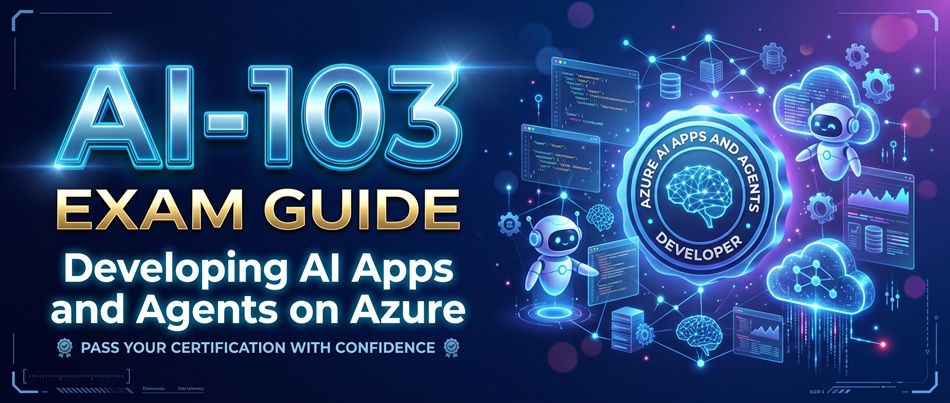
That distinction is central to Microsoft’s AI-103: Developing AI Apps and Agents on Azure exam.
AI-103 focuses on the engineering work behind modern AI applications: selecting models, connecting them to enterprise knowledge, building agents that use tools, implementing multimodal capabilities, and operating those systems responsibly in Microsoft Azure.
For students and developers entering cloud AI, the certification offers a structured way to develop practical skills. For professionals already working with Azure, it provides an opportunity to demonstrate knowledge of Microsoft’s evolving AI development platform.
This guide explains what the AI-103 exam covers, how valuable the certification may be, which technologies deserve your attention, and how to prepare through hands-on projects rather than memorization alone.
What Is the Microsoft AI-103 Exam?
Table of Contents
ToggleAI-103 is a Microsoft certification exam designed for developers and AI engineers who build, manage, and deploy AI applications and agents on Azure.
Passing the exam earns the following credential:
Microsoft Certified: Azure AI Apps and Agents Developer Associate
Microsoft classifies this certification as intermediate level. Its audience includes professionals who understand basic programming concepts and want to build practical AI-powered software using Python, Microsoft Foundry, and Azure services.
Unlike an introductory AI certification, AI-103 expects candidates to understand how the components of an AI system fit together.
For example, you should be able to explain not only what a large language model does, but also how to connect that model to business documents, implement controlled tool access, evaluate the quality of its responses, and monitor the application after deployment.
AI-103 vs. AI-102: What Changed?
Microsoft retired the AI-102 exam, Designing and Implementing a Microsoft Azure AI Solution, on June 30, 2026. AI-103 represents the newer certification path for developers working with Azure AI applications and agents.
The distinction is more substantial than an exam-number change.
AI-102 included Azure AI services, natural language processing, computer vision, and generative AI. AI-103 continues to cover important parts of that foundation but places greater emphasis on Microsoft Foundry, agentic workflows, retrieval-augmented generation, tool integration, and production AI engineering.
In practical terms, candidates need to think beyond invoking a single AI API. They must understand how to design an application in which models, data, retrieval systems, tools, security controls, and monitoring work together.
AI-103 Exam Details: What You Need to Know
Before starting your preparation, it helps to understand the basic exam requirements.
| Exam Detail | Information |
|---|---|
| Exam code | AI-103 |
| Official exam name | Developing AI Apps and Agents on Azure |
| Certification | Azure AI Apps and Agents Developer Associate |
| Level | Intermediate / Associate |
| Exam duration | 120 minutes |
| Passing score | 700 or higher on Microsoft’s scaled scoring system |
| Primary programming language | Python |
| Core platform | Microsoft Azure and Microsoft Foundry |
| Exam delivery | Proctored exam through Microsoft-authorized delivery options |
| Exam price | Varies by country or region |
| Certification validity | One year, with eligible free online renewal |
The official certification page provides scheduling information and available exam languages. Prices and scheduling options should be checked for your location before booking.
Microsoft also recommends practical experience with Python, general AI concepts, generative AI, and Azure services.
Although no separate prerequisite certification is listed, AI-103 is not intended to be an introductory programming examination.
Is the AI-103 Certification Worth It in 2026?
A certification is useful when it represents skills that matter outside the exam room. The AI-103 certification exam has a particularly practical focus because organizations increasingly need developers who can turn AI capabilities into functioning applications.
There are several reasons to consider this certification.
1. It Connects AI Knowledge with Software Engineering
Understanding prompts and language models is a starting point. Shipping an AI application involves considerably more work.
Developers must make decisions about authentication, data access, model deployment, API integration, monitoring, performance, and operational costs.
AI-103 brings those concerns into a single learning path, helping candidates understand AI systems as software products rather than isolated experiments.
2. It Covers Modern AI Agent Development
AI agents are increasingly used to coordinate workflows that involve multiple steps, external services, and changing information.
An agent might retrieve a company policy, verify a user’s request, call an approved application API, and summarize the result.
Building such a system requires more than generating natural-language responses. It requires tool definitions, authorization, state management, error handling, and safeguards.
These are important areas of the AI-103 curriculum.
3. It Provides a Recognizable Technical Credential
Microsoft certifications are recognized within the Azure ecosystem and provide a standardized way to communicate technical knowledge.
AI-103 may be relevant to roles such as:
- Azure AI Developer
- AI Application Developer
- Generative AI Engineer
- AI Agent Developer
- Cloud Application Developer
- AI Solutions Engineer
However, a certification does not guarantee employment, promotion, or a particular salary. Employers may also expect strong programming fundamentals, practical project experience, and an understanding of security and system design.
4. It Gives Students a Clear Learning Structure
For students, the biggest challenge is often deciding what to learn first.
AI development spans model APIs, search systems, cloud infrastructure, machine learning, application frameworks, and security. Studying everything at once is inefficient.
The AI-103 exam objectives provide a useful framework for organizing that learning into manageable technical areas.
AI-103 Exam Objectives and Skills Measured
According to the Microsoft Learn study guide, the AI-103 exam objectives effective April 16, 2026, are divided into five domains.
| Skill Domain | Exam Weight |
|---|---|
| Plan and manage an Azure AI solution | 25–30% |
| Implement generative AI and agentic solutions | 30–35% |
| Implement computer vision solutions | 10–15% |
| Implement text analysis solutions | 10–15% |
| Implement information extraction solutions | 10–15% |
The first two domains together represent approximately 55–65% of the exam. That makes application architecture, Microsoft Foundry, generative AI, and agents especially important preparation areas.
Let’s look at each domain more closely.
Domain 1: Plan and Manage an Azure AI Solution (25–30%)
This domain tests your ability to make appropriate architectural and operational decisions for Azure AI applications.
Key areas include:
- Selecting suitable AI models and Foundry services for specific workloads.
- Designing infrastructure for AI applications and agent-based systems.
- Configuring model and agent deployments.
- Understanding quotas, scaling, rate limits, and cost management.
- Monitoring application behavior and retrieval quality.
- Implementing managed identities, role-based access control, and private networking.
- Applying responsible AI controls, evaluations, and audit mechanisms.
Imagine that a university wants to launch an AI assistant for students. The technical decision is not simply which language model to deploy.
You would also need to determine which data sources the application can access, how students authenticate, where logs are stored, how content is filtered, and how expensive the solution will be to operate.
Those choices are part of planning an Azure AI solution.
Domain 2: Implement Generative AI and Agentic Solutions (30–35%)
This is the largest individual domain in AI-103.
It covers building applications with generative models, connecting those models to external knowledge, and developing agents that can interact with tools and services.
Important topics include:
- Deploying and consuming large and small language models.
- Building generative AI applications with Microsoft Foundry SDKs.
- Implementing retrieval-augmented generation (RAG).
- Designing tool-enabled workflows and multistep reasoning pipelines.
- Developing agents with functions, APIs, search, and memory.
- Coordinating multiple agents in orchestrated workflows.
- Evaluating output quality, relevance, safety, and groundedness.
- Implementing tracing, monitoring, and error analysis.
One particularly important distinction is the difference between an AI chatbot and an AI agent.
A conventional chatbot primarily generates responses to user messages. An agent can also select and use authorized tools to complete a task.
For example, a chatbot might explain how to check an order status. An appropriately authorized agent could call an order-management API, retrieve the current status, and report the result.
That additional capability introduces new engineering requirements. The application must validate inputs, restrict tool permissions, handle failures, and determine which actions require human approval.
An agent should not automatically receive unrestricted access to the systems it can interact with.
Domain 3: Implement Computer Vision Solutions (10–15%)
Computer vision is no longer limited to identifying objects or extracting text from images.
The AI-103 objectives also cover image generation, video generation, editing workflows, and multimodal understanding.
Relevant concepts include:
- Generating and editing images using AI models.
- Implementing video-generation and editing workflows.
- Analyzing visual information with multimodal models.
- Generating image descriptions and accessibility-focused alt text.
- Extracting visual characteristics through Content Understanding.
- Applying safety controls to visual inputs and generated content.
- Recognizing indirect prompt-injection risks embedded in images.
A useful study exercise is to compare three tasks: describing an image, extracting structured information from a document image, and generating a new image from a prompt.
Each task has different output requirements, evaluation criteria, and model-selection considerations.
Domain 4: Implement Text Analysis Solutions (10–15%)
Text analysis concerns applications that interpret, transform, summarize, translate, or extract information from language.
This domain also includes speech-related capabilities.
You should understand:
- Entity and information extraction.
- Sentiment and tone analysis.
- Text summarization and structured JSON output.
- Machine translation and language-model translation workflows.
- Speech-to-text and text-to-speech integration.
- Speech translation and multimodal audio reasoning.
- Customization for domain-specific language tasks.
For example, a customer-support application might transcribe a telephone conversation, identify the customer’s main concern, generate a summary, and produce structured information for a ticketing system.
Understanding how those capabilities connect is more valuable than memorizing individual service names.
Domain 5: Implement Information Extraction Solutions (10–15%)
Information extraction is the process of converting unstructured content into information an application can search, analyze, and use.
The AI-103 exam includes:
- Ingesting and indexing documents and multimodal content.
- Implementing vector, keyword, hybrid, and semantic search.
- Designing data preparation and retrieval pipelines.
- Using optical character recognition (OCR) and layout analysis.
- Extracting structured fields from complex documents.
- Using Azure Content Understanding to prepare grounded information for downstream AI applications.
This domain is closely related to RAG because reliable retrieval depends on well-prepared, searchable source content.
A poorly indexed knowledge base can undermine an otherwise capable language model.
Key Azure AI Technologies Every AI-103 Candidate Should Understand
The exam covers a broad set of services, but several concepts deserve particular attention because they connect multiple skill domains.
Microsoft Foundry: The Foundation for AI Applications and Agents
Microsoft Foundry provides a platform for developing, deploying, evaluating, and managing AI applications and agents.
It brings together model access, development workflows, agent capabilities, evaluation, monitoring, and governance.
For AI-103 preparation, learn how Foundry resources and projects fit into an application architecture. You should also understand model deployments, SDK integration, and the lifecycle of an AI application.
A helpful exercise is to create a Foundry project, deploy an appropriate model, test it, and connect a simple Python application to that deployment.
Pay attention to the difference between a resource, a project, a model, and a deployment. Those terms represent different parts of the system.
Retrieval-Augmented Generation (RAG)
RAG is one of the most useful architectural patterns in modern enterprise AI.
A language model cannot be assumed to know a company’s latest policies, a university’s current course requirements, or the contents of a private document repository.
RAG addresses this problem by retrieving relevant information from an external source and supplying it to the model as context for generating an answer.
A typical RAG workflow looks like this:
User Question
     |
     v
Retrieve Relevant Documents
     |
     v
Rank and Select Context
     |
     v
Send Context to Language Model
     |
     v
Generate Grounded Answer
     |
     v
Return Answer with Source References
Azure AI Search is particularly relevant here because it supports several retrieval approaches.
Vector search helps identify content with similar meaning. Keyword search can be effective when exact terms, identifiers, or names matter. Hybrid search combines both approaches, while semantic ranking can improve the relevance of the returned results.
For AI-103, understanding when to choose these techniques is more important than knowing only their definitions.
Also remember that RAG does not guarantee factual correctness. Retrieval quality, source freshness, access control, prompt design, and evaluation still matter.
Microsoft Foundry Agent Service
Foundry Agent Service provides managed capabilities for building, deploying, and operating AI agents.
Agents can combine instructions and models with tools, search capabilities, and external application functions.
For example, an IT support agent might:
- Interpret a user’s technical question.
- Search an approved troubleshooting knowledge base.
- Call a read-only system-status API.
- Generate a response based on the retrieved evidence.
- Request approval before performing a sensitive operational action.
Such workflows illustrate why agent development requires careful attention to tool contracts, authentication, observability, and safety.
Not every application needs an autonomous agent. If a deterministic workflow can solve the problem reliably, it may be simpler, cheaper, and easier to maintain.
Good engineering involves choosing the appropriate level of autonomy rather than automatically choosing the most complex architecture.
Azure Content Understanding and Document Processing
Many AI applications begin with content that is difficult for conventional software to interpret: scanned documents, tables, images, recordings, and videos.
Azure Content Understanding can help transform these inputs into structured information that downstream applications can consume.
For example, an application might extract invoice fields, analyze document layouts, or create structured output from mixed textual and visual content.
The important architectural distinction is between extracting information, indexing that information, and using it to generate or validate answers.
Those are related operations, but they are not interchangeable.
Responsible AI, Security, and Observability
A model that returns useful answers during testing can still create problems after deployment.
Common risks include prompt injection, exposure of private information, unauthorized tool execution, inaccurate responses, and unpredictable operating costs.
AI-103 candidates should understand how to reduce these risks through:
- Microsoft Entra identity and appropriate role assignments.
- Managed identities and keyless authentication where supported.
- Content filtering and input validation.
- Tool allowlists and least-privilege permissions.
- Human approval for consequential actions.
- Evaluation datasets and safety testing.
- Tracing, logging, and monitoring.
- Token usage, latency, and cost analysis.
These controls are not optional details to consider after an application is finished. They influence the design from the beginning.
Hands-On Project: Build a University Information AI Agent
One of the best ways to prepare for AI-103 is to build a small application that combines several exam objectives.
Consider a university information assistant that helps students find academic policies, course information, and registration guidance.
This is a manageable project with enough complexity to introduce real engineering decisions.
Step 1: Create a Microsoft Foundry Project
Start with an Azure subscription and a Foundry project. Select a model suitable for question answering, deploy it, and test basic requests.
Learn how authentication, endpoints, and deployment names are used by the application.
Step 2: Prepare a Document Knowledge Base
Collect a small set of sample course guides, academic regulations, and student FAQs that you are authorized to use.
Prepare the content for retrieval. This may involve extracting text, creating document chunks, maintaining source metadata, and generating embeddings.
Use Azure AI Search to index the content.
Step 3: Implement a RAG Workflow
When a student asks a question, search for the most relevant content and supply the retrieved passages to the model.
Ask the application to cite its sources and acknowledge when the documents do not contain enough information.
Test whether hybrid retrieval performs better than vector-only search for questions containing course codes or exact policy names.
Step 4: Add a Controlled Agent Tool
Extend the application with a read-only function that retrieves information such as office hours or an approved course schedule from a sample API.
Define the tool’s expected arguments and outputs, and validate them before execution.
Keep administrative changes and registration actions outside the agent’s permissions unless a secure approval workflow has been implemented.
Step 5: Evaluate the Application
Create a test set containing ordinary questions, ambiguous requests, outdated information, and questions that cannot be answered from the available documents.
Measure retrieval relevance, response accuracy, latency, and token usage.
Include tests for unauthorized information requests and prompt-injection attempts.
Step 6: Monitor and Improve
Use available tracing and monitoring capabilities to understand the application’s behavior.
Review failed responses, unexpected tool calls, and unnecessary model requests. Improve the system by adjusting retrieval, instructions, tool definitions, or architecture.
This single project provides practical experience across Foundry, RAG, agent development, information extraction, security, and evaluation.
It also gives students something concrete to discuss in an interview or include in a technical portfolio.
Cost reminder: Azure resource usage may incur charges. Set a budget, monitor consumption, and remove unnecessary resources after completing your experiments.
How to Prepare for AI-103: A Practical Six-Week Study Roadmap
There is no universal preparation schedule. Someone who regularly develops Azure applications will progress differently from a student who has only recently started programming.
The following six-week roadmap is a reasonable starting point for learners with basic Python knowledge.
A good AI-103 exam preparation strategy should combine official Microsoft documentation, practical Azure projects, and a clear understanding of the skills measured. Reading about a technology is useful, but configuring and troubleshooting it provides a much deeper understanding.
Week 1: Build Your Azure and Python Foundations
- Review Python functions, modules, exceptions, and package management.
- Practice making authenticated REST API requests.
- Learn Azure subscriptions, resource groups, identities, and role assignments.
- Understand the difference between AI models, deployments, and application endpoints.
Weekly goal: Create a simple Python application that can interact with an authorized cloud API.
Week 2: Learn Microsoft Foundry
- Explore Foundry resources and projects.
- Review model selection and deployment options.
- Understand token usage, deployment limits, and cost considerations.
- Experiment with model evaluation and safety settings.
Weekly goal: Connect a Python application to a model deployed through Foundry.
Week 3: Study RAG and Azure AI Search
- Understand document ingestion and chunking.
- Learn embeddings and vector search.
- Compare keyword, vector, and hybrid retrieval.
- Implement grounded answers with source references.
Weekly goal: Build a document-question-answering application over a small, controlled knowledge base.
Week 4: Develop AI Agents
- Study the architecture of Foundry Agent Service.
- Implement a simple tool-enabled agent.
- Understand function calling, conversation state, and memory.
- Review orchestration and multi-agent design.
- Implement tool restrictions and approval controls.
Weekly goal: Build an agent that retrieves information and invokes a safe, read-only tool.
Week 5: Cover Vision, Language, Speech, and Information Extraction
- Review image and video generation concepts.
- Experiment with multimodal understanding.
- Study text extraction, sentiment, translation, and structured outputs.
- Explore speech recognition and speech synthesis.
- Review OCR, document layout analysis, and Content Understanding.
Weekly goal: Build a small workflow that transforms an unstructured input into a structured output.
Week 6: Review, Evaluate, and Practice
- Revisit the official AI-103 skills measured document.
- Complete Microsoft’s available practice assessment.
- Explore the official exam sandbox.
- Review your project architecture and deployment decisions.
- Focus additional study on weak skill domains.
- Practice explaining why one Azure service or design approach fits a scenario better than another.
Weekly goal: Be able to justify your design choices without relying on step-by-step tutorials.
The six-week plan is a study suggestion, not an official Microsoft requirement or a guarantee of passing.
Common Mistakes to Avoid When Preparing for AI-103
Memorizing Product Names Without Understanding Their Roles
Microsoft’s AI portfolio contains overlapping capabilities. Candidates need to understand what each service contributes to a solution and when a particular service is appropriate.
For example, deploying a model, indexing documents, retrieving information, and extracting structured fields are separate responsibilities.
Studying Only Generative AI
Although generative AI and agents form a large part of the exam, the objectives also cover computer vision, text analysis, speech, and information extraction.
Ignoring these domains leaves significant gaps in your preparation.
Overlooking Security and Responsible AI
It is tempting to focus on model capabilities while postponing identity, content filtering, and monitoring.
In production systems, those concerns are central to whether the application can be used safely and reliably.
Using Outdated Training Material
Microsoft regularly updates its AI platforms, SDKs, and documentation. Older examples may refer to different product names, API versions, or implementation patterns.
Use the official AI-103 study guide as the primary reference and verify that tutorials apply to the relevant current service version.
Depending Entirely on Practice Questions
Practice assessments are useful for identifying weak topics and becoming familiar with exam-style questions.
However, memorizing answers without understanding the underlying technology is a poor substitute for practical learning.
Do not rely on unauthorized exam dumps. Use official preparation materials, legitimate practice assessments, and hands-on development.
Frequently Asked Questions About AI-103
Is AI-103 a beginner-level certification?
No. Microsoft classifies AI-103 as an intermediate-level certification exam. Beginners can work toward it, but they should first develop basic Python, Azure, API, and AI knowledge.
What certification do I earn after passing AI-103?
Passing AI-103 earns the Microsoft Certified: Azure AI Apps and Agents Developer Associate credential.
How long is the AI-103 exam?
Microsoft currently lists 120 minutes to complete the assessment. Candidates should verify the latest exam details before scheduling.
What is the passing score for AI-103?
Microsoft requires a score of 700 or higher on its scaled certification scoring system.
Do I need to know Python for AI-103?
Python experience is strongly recommended. The official candidate profile specifically identifies experience developing applications with Python.
Does AI-103 replace AI-102?
AI-102 and its associated Azure AI Engineer Associate certification retired on June 30, 2026. AI-103 provides the newer Azure AI application and agent development certification path, with a different exam emphasis and credential name.
Does the AI-103 certification expire?
Yes. Like other Microsoft associate-level certifications, it follows an annual renewal cycle. Eligible certification holders can renew through a free online assessment on Microsoft Learn, subject to Microsoft’s renewal policies.
Is AI-103 useful for students seeking AI development jobs?
It can be useful as evidence of structured technical learning, particularly when combined with GitHub projects, practical Azure experience, and a solid programming foundation. It should be considered one part of a broader portfolio rather than a guaranteed route to employment.
Where can I find more information about the AI-103 exam?
Start with Microsoft’s official certification and study-guide pages for authoritative exam objectives and scheduling information. You can also visit our dedicated AI-103 exam page for the related course listing on this website.
Final Thoughts: AI-103 Is About Building AI That Works
The most interesting part of AI-103 is not the exam code or the certification badge. It is the kind of engineering knowledge the exam encourages developers to acquire.
Real AI applications require more than an impressive model response. They need relevant data, reliable retrieval, controlled integrations, sensible security boundaries, and enough observability to understand what happens when something goes wrong.
Microsoft Foundry provides an environment for bringing many of those components together, while AI-103 gives learners a framework for understanding how to use them.
For students, my recommendation is straightforward: learn Python well enough to build useful software, work through the official Microsoft Learn material, and develop at least one complete Azure AI project.
For experienced developers, concentrate on the architectural decisions that distinguish a working demonstration from a maintainable production application.
The objective should not be simply to pass AI-103. It should be to finish your preparation with the confidence to design, build, secure, and troubleshoot an AI application on Azure.
The certification can help demonstrate that progress. The ability to build the system is what makes the knowledge valuable.
If you are exploring the certification further, visit our AI-103 Developing AI Apps and Agents on Azure course page for the corresponding listing, and use the official Microsoft resources below to guide your technical preparation.
Official References and Further Reading
The resources below come primarily from Microsoft Learn and official Microsoft documentation. They are useful both for exam preparation and for developing practical Azure AI projects.
- Microsoft Certified: Azure AI Apps and Agents Developer AssociateThe official certification page, including eligibility guidance, exam information, scheduling, and preparation resources.
- AI-103 Official Exam Study GuideThe primary reference for the exam objectives, domain weightings, and skills measured.
- Course AI-103T00-A: Develop AI Apps and Agents on AzureMicrosoft’s official training course with self-directed learning resources covering generative AI, agents, and related services.
- Microsoft Foundry DocumentationTechnical documentation for Foundry resources, model deployments, SDKs, application development, and agent capabilities.
- Microsoft Foundry Agent ServiceLearn about developing, deploying, managing, and monitoring AI agents.
- Retrieval-Augmented Generation in Azure AI SearchUnderstand RAG architecture, document retrieval, search techniques, and grounding strategies.
- Azure Content Understanding DocumentationExplore multimodal content extraction and structured processing for documents, images, audio, and video.
- Azure AI Content Safety DocumentationReview content moderation, safety features, and responsible AI implementation guidance.
- Microsoft Certification Renewal FAQUnderstand certification validity, renewal eligibility, and Microsoft’s free renewal assessment process.
- Microsoft Exam Retirement InformationOfficial documentation confirming retired Microsoft certification exams, including AI-102.