Knowing how to build a VMware vSphere cluster is one thing. Knowing how to design an entire private cloud that can survive failures, support multiple departments, meet security requirements, and remain manageable for years is something else entirely.
That difference is what makes the Advanced VMware Cloud Foundation 9 Architect (3V0-12.26) certification exam interesting.
Rather than focusing on individual configuration tasks, this advanced VMware certification examines how infrastructure professionals translate business requirements into practical, secure, and resilient VMware Cloud Foundation architectures.
For experienced VMware engineers, it offers an opportunity to demonstrate architectural knowledge. For students and aspiring cloud architects, it also provides a useful roadmap for understanding how enterprise private clouds are designed.
In this guide, we’ll examine the 3V0-12.26 exam, the VMware technologies behind it, the practical value of the certification, and a structured approach to preparing for it.
What Is the Advanced VMware Cloud Foundation 9 Architect (3V0-12.26) Exam?
The Advanced VMware Cloud Foundation 9 Architect exam is part of VMware’s advanced professional certification portfolio, administered under Broadcom.
Passing the exam leads to the VMware Certified Advanced Professional – VMware Cloud Foundation Architect (VCAP-VCF Architect) credential.
The certification targets professionals who design VMware Cloud Foundation environments, including cloud architects, infrastructure architects, solution consultants, and senior virtualization engineers.
Its central question is not simply whether a candidate understands VMware products. It is whether that candidate can select and justify a suitable architecture when faced with business objectives, technical requirements, limitations, and risks.
3V0-12.26 Exam Details
| Exam Information | Details |
|---|---|
| Exam Name | Advanced VMware Cloud Foundation 9 Architect |
| Exam Code | 3V0-12.26 |
| Certification Level | VMware Certified Advanced Professional (VCAP) |
| Certification | VCAP-VCF Architect |
| Product Version | VMware Cloud Foundation 9 |
| Number of Questions | 60 |
| Exam Appointment Duration | 135 minutes |
| Passing Score | 300, using a scaled scoring method |
| Listed Exam Fee | USD $250, subject to regional conditions |
| Exam Language | English |
| Exam Delivery | Proctored through Pearson VUE |
| Question Formats | Multiple choice, multiple selection, matching, build-list, drag-and-drop, point-and-click, and hot-area questions |
Note: These details reflect the published 3V0-12.26 exam information available in October 2026. Exam specifications, pricing, and registration policies may change. Always verify the current details using the official Broadcom certification page and exam guide before scheduling.
The passing score deserves some clarification. A scaled score of 300 does not mean that answering 60% of the questions correctly guarantees a pass. Scaled scores and raw percentages are different measurements.
The published blueprint emphasizes architectural reasoning rather than live configuration exercises. Candidates should nevertheless expect scenario-based questions that require practical familiarity with VMware Cloud Foundation components.
Are There Prerequisites?
VMware’s exam-based certification policy no longer requires a previous VCP certification or mandatory training course before pursuing a VCAP credential.
That accessibility should not be mistaken for an entry-level difficulty.
Someone who has never worked with virtualization, enterprise networking, or storage architecture will face a substantial learning curve. A foundation in vSphere, IP networking, storage systems, and basic cloud concepts is strongly recommended.
For students, the professional-level VCP-VCF Architect learning path can be a sensible preparation step, even when it is not a formal prerequisite.
Before building a study schedule, it is also useful to review the scope of the exam through a dedicated 3V0-12.26 VMware Cloud Foundation Architect course page alongside the official exam blueprint.
Is the VCAP-VCF Architect Certification Worth It?
Certifications are useful when they demonstrate skills that employers and customers actually need. The value of VCAP-VCF Architect lies in the breadth of architectural knowledge it addresses.
Many infrastructure teams are moving beyond managing individual hypervisors and virtual machines. They are responsible for entire platforms that provide compute, networking, storage, automation, security, and operational services.
That creates a different kind of engineering problem.
A virtualization administrator might be asked to configure a cluster. A cloud architect must determine how many clusters are appropriate, where the management components should reside, which failure domains are acceptable, how services will be recovered, and whether the organization can afford to operate the proposed design.
The VCAP-VCF Architect certification is relevant to this broader responsibility.
Career Opportunities
The knowledge associated with this certification can support career development in roles such as:
- VMware Cloud Foundation Architect
- Private Cloud Infrastructure Architect
- Data Center Solution Architect
- Virtualization and Cloud Consultant
- Enterprise Infrastructure Engineer
- Technical Solutions or Presales Architect
It can be particularly relevant to professionals working for enterprises, systems integrators, consulting organizations, or service providers that design and operate VMware-based private clouds.
However, a certification alone does not guarantee employment, promotion, or a particular salary. Employers will still look for practical experience, documentation skills, troubleshooting judgment, and the ability to explain complex designs clearly.
For an early-career engineer, a small portfolio containing a requirements document, architecture diagram, decision log, and validation plan may provide useful evidence alongside the certification.
Professional-Level Versus Advanced-Level Certification
The professional-level VMware Cloud Foundation Architect certification provides a foundation for understanding architectural principles and designing VCF solutions.
The advanced Architect exam goes further by emphasizing more complex design decisions, competing requirements, architecture alternatives, and the quality attributes that determine whether a solution will work in production.
There is an important distinction between knowing that a design is technically possible and recognizing whether it is appropriate for a specific organization.
That distinction appears repeatedly throughout the advanced exam objectives.
Understanding VMware Cloud Foundation 9 Architecture
Before studying the exam blueprint, it helps to understand the platform itself.
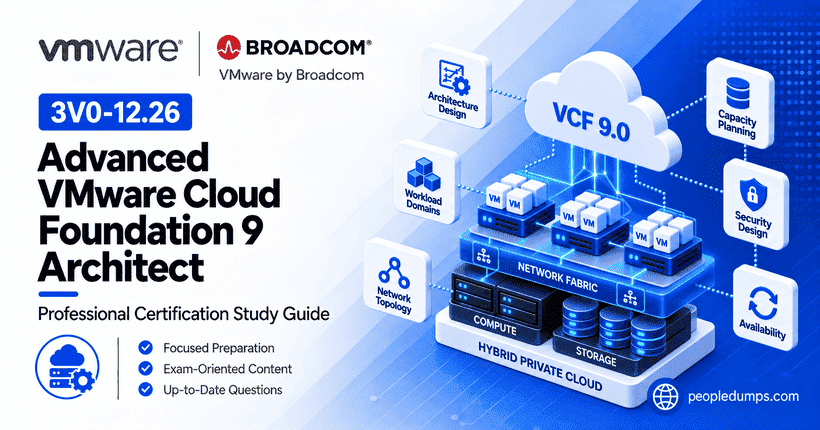
VMware Cloud Foundation (VCF) 9 is an integrated private cloud platform that brings together virtualized compute, storage, networking, automation, and operations management.
Instead of treating each infrastructure component as a completely separate management environment, VCF provides a more coordinated approach to deployment, lifecycle management, and cloud service consumption.
The platform supports traditional virtual machines alongside modern application infrastructure, including Kubernetes-based workloads.
The Major VMware Cloud Foundation Components
| Component | Primary Responsibility |
|---|---|
| VMware vSphere | Provides virtualization, ESX hosts, virtual machines, clustering, and compute resource management. |
| VMware vSAN | Provides software-defined storage capabilities integrated with the VMware infrastructure. |
| VMware NSX | Provides software-defined networking, virtual network services, and security capabilities. |
| VCF Operations | Provides unified monitoring, capacity management, operational visibility, and fleet lifecycle capabilities. |
| VCF Automation | Enables self-service cloud consumption, organization and project management, and infrastructure governance. |
| VCF Identity Broker | Supports centralized identity integration and authentication across the VCF environment. |
| vSphere Kubernetes Service | Supports Kubernetes-based applications and modern workload consumption. |
For beginners, the easiest way to understand these components is to think of VCF as a private cloud platform rather than simply a collection of VMware products.
vSphere provides compute resources. Storage technologies hold application data. NSX supplies network connectivity and security controls. VCF Automation makes resources available to consumers, while VCF Operations helps the infrastructure team monitor and maintain the environment.
The important architectural work happens at the boundaries between these systems.
VCF Fleets, Instances, and Workload Domains
VMware Cloud Foundation 9 introduces architectural constructs that are particularly important for understanding management at scale.
The basic hierarchy can be represented as:
VCF Private Cloud
  |
  +-- VCF Fleet
       |
       +-- VCF Instance
       |    |
       |    +-- Management Domain
       |    |
       |    +-- VI Workload Domain(s)
       |         |
       |         +-- vSphere Clusters
       |
       +-- Additional VCF Instance(s)
A VCF instance contains a management domain and can contain additional virtual infrastructure workload domains. Each workload domain uses its own vCenter Server for management.
The management domain hosts core platform management components. VI workload domains provide infrastructure resources for application workloads and can be designed around different performance, availability, or organizational requirements.
A VCF fleet groups one or more VCF instances under shared fleet-level services, including VCF Operations and VCF Automation.
This architecture matters when an organization operates multiple data centers, regions, or business units.
For example, an enterprise may need separate infrastructure environments while maintaining consistent operational policies, identity management, and lifecycle processes.
An architect must understand where isolation is required and where centralized management is beneficial.
VCF 9 Deployment Options
VCF 9 also provides more flexible ways to build or adopt the platform. These include deploying a new VCF instance, expanding an existing fleet, converging an existing vCenter environment into VCF, and importing supported vSphere infrastructure into an existing VCF instance.
The VCF Installer replaces the older Cloud Builder deployment approach and introduces guided workflows for supported deployment scenarios.
Choosing a deployment method is an architectural decision, not merely an installation preference.
A greenfield deployment may offer a cleaner starting point, while converging or importing existing infrastructure can preserve investments and reduce the need for disruptive workload migrations.
The right choice depends on compatibility, operational risk, migration constraints, and the desired final architecture.
What Does the 3V0-12.26 Exam Cover?
The published exam blueprint contains 20 testable objectives grouped into three main sections.
Unlike an administrator-focused examination, which concentrates on implementing and operating a solution, the Architect examination is organized around architectural methodology, product selection, and design.
Section 1: IT Architectures, Technologies, and Standards
This section covers five objectives related to the foundations of solution architecture.
Candidates should be able to distinguish business requirements from technical requirements, classify assumptions, constraints, and risks, understand architectural quality attributes, develop defensible design decisions, and define validation strategies.
Consider a company that states: “Our customer portal must remain available during a server failure.”
That statement is a business requirement. The architect must translate it into technical criteria and evaluate appropriate mechanisms such as cluster availability, workload placement, redundancy, and recovery procedures.
Four terms are especially important in architecture discussions:
| Term | Example |
|---|---|
| Requirement | The application must meet an agreed recovery time objective. |
| Constraint | The organization must reuse an existing, supported Fibre Channel storage environment. |
| Assumption | The secondary data center will have sufficient network bandwidth for the planned replication workload. |
| Risk | Replication performance may be inadequate during periods of peak network utilization. |
These terms may look simple, but confusing them leads to weak designs.
An assumption is not a verified fact. A risk is not automatically a design failure. And a constraint cannot simply be ignored because another option looks more technically attractive.
Section 2: VMware Products and Solutions
This section contains three objectives focused on selecting suitable VCF architectures and understanding the VMware portfolio.
Candidates need to compare architecture options, evaluate recommended designs against designs that are merely supported, and identify appropriate use cases for VCF Advanced Services.
Consider storage selection.
VMware vSAN is an important storage technology within VCF, but VCF 9 also supports qualifying external storage configurations. The supported options depend on factors such as deployment method, storage protocol, and compatibility requirements.
An organization with a substantial investment in enterprise SAN infrastructure may have good reasons to retain that storage.
The architect should evaluate performance, operational complexity, resilience, compatibility, and lifecycle implications rather than automatically selecting a preferred technology.
The same principle applies to advanced capabilities such as VMware vDefend, VMware Live Recovery, Avi Load Balancer, and other platform services. Their purpose, integration requirements, and applicable licensing must be understood before recommending them.
Section 3: Plan and Design the VMware Solution
This is the largest section of the Architect blueprint, containing 12 objectives.
It begins with gathering requirements and developing conceptual, logical, and physical designs.
It then examines several architectural quality attributes, commonly summarized as AMPRS:
- Availability: Keeping services accessible when components fail.
- Manageability: Making the environment practical to monitor, maintain, and upgrade.
- Performance: Delivering suitable compute, storage, and network performance for workloads.
- Recoverability: Restoring systems and data within agreed recovery objectives.
- Security: Protecting access, workloads, management services, and data.
The section also includes identity management design, cloud consumption strategy, and monitoring strategy.
These topics reflect an important reality: a private cloud architecture is incomplete if it only describes servers, storage, and network connectivity.
Someone must also decide how users request infrastructure, who approves that access, how changes are governed, and how operations teams will know when something is going wrong.
Technical Skills Every VCF 9 Architect Should Understand
Although the examination is design-oriented, sound architectural decisions require a working understanding of the underlying technologies.
1. Compute and Cluster Architecture
A candidate should understand vSphere cluster design, ESX resource allocation, workload placement, capacity planning, and how management and workload infrastructure are separated.
Questions about high availability frequently involve more than enabling a feature.
For example, a cluster sized to use nearly all available compute resources may run normally until a host fails. The design must account for failure capacity, maintenance requirements, and expected workload growth.
Similarly, allocating excessive resources to virtual machines can create inefficiency without necessarily improving application performance.
A good architect considers actual workload behavior rather than designing entirely around maximum theoretical specifications.
2. Storage Architecture and vSAN Design
Storage design is much more than calculating the number of terabytes an organization needs.
It involves performance characteristics, latency, fault tolerance, storage policies, usable capacity, failure domains, and operational requirements.
VCF architects should understand the architectural considerations behind vSAN, including vSAN Express Storage Architecture, while recognizing the role of supported external storage.
A design should account for capacity overhead, rebuild operations, expected growth, and how storage decisions affect availability and recovery.
One practical habit is to document why a particular storage option was chosen and what trade-offs the organization accepted.
3. NSX Networking and Security Design
Networking is one of the areas where students with a server administration background often need additional preparation.
Understanding TCP/IP, VLANs, routing, DNS, MTU, and network segmentation provides an essential foundation.
VMware NSX extends these concepts through software-defined networking and security services.
VCF 9 also makes Virtual Private Clouds (VPCs) an important part of network consumption and tenant isolation.
For example, separate development teams may need independent network environments while sharing the same underlying physical infrastructure.
The architect must consider connectivity between applications, external network access, IP addressing, routing boundaries, firewall policy, and the operational responsibilities of different teams.
It is also important to recognize that distributed network connectivity and centralized services through NSX Edge components can have different requirements and trade-offs.
4. Automation, Identity, and Multi-Tenancy
Cloud infrastructure becomes considerably more useful when approved users can request resources without submitting a manual ticket for every virtual machine.
VCF Automation supports a private cloud consumption model involving organizations, projects, policies, and self-service infrastructure.
Architects must design how these capabilities are exposed to users without giving every team unrestricted access to the environment.
Identity management is equally important. Authentication, role-based authorization, privileged access, and emergency administrative access all influence the security of the private cloud.
For a university or enterprise with many departments, the challenge is to provide enough independence for different teams while maintaining centralized governance.
5. Operations, Monitoring, and Lifecycle Management
A design may meet every initial requirement and still become difficult to operate after deployment.
VCF Operations provides visibility into infrastructure health, capacity, performance, and fleet-level management. Its capabilities also support lifecycle activities such as upgrades, configuration management, and certificate operations.
An architectural monitoring strategy should define what needs to be measured, which alerts are actionable, who owns incident response, and how capacity trends are reviewed.
Monitoring every possible metric is not automatically a good strategy. Useful monitoring connects technical signals to service health and operational decisions.
6. Kubernetes and Modern Workloads
Traditional virtual machines remain important, but modern private cloud environments increasingly need to support containerized applications.
vSphere Kubernetes Service (VKS) provides capabilities for running Kubernetes workloads within the VMware platform.
An architect should understand the design implications of Kubernetes networking, resource isolation, storage consumption, availability, and developer access.
The goal is not necessarily to become a Kubernetes application developer. It is to understand what the underlying infrastructure must provide so that modern workloads can operate reliably.
A Practical VCF Architecture Design Example
Consider a fictional university planning to modernize its on-premises infrastructure using VMware Cloud Foundation 9.
The university runs a student registration system, library applications, administrative databases, and several research environments.
Its requirements include:
- Separate network environments for different departments.
- Self-service virtual machine provisioning for approved users.
- Reuse of an existing enterprise Fibre Channel SAN where supported.
- A four-hour recovery time objective (RTO) and a 30-minute recovery point objective (RPO) for the registration application.
- Capacity planning for approximately 30% projected growth over two years.
- Centralized visibility into infrastructure health and resource consumption.
These values are illustrative, not an official VMware examination question.
Step 1: Develop the Conceptual Design
The conceptual design describes the intended solution at a high level.
In this case, the university needs a centrally governed private cloud that supports departmental isolation, self-service provisioning, and recoverable critical applications.
At this stage, the architect should avoid making unnecessary hardware-level decisions.
Step 2: Develop the Logical Design
The logical design identifies the relationships between the major components.
It may define a VCF management domain, suitable VI workload domains, departmental organizations and projects in VCF Automation, NSX-backed network isolation, and monitoring through VCF Operations.
The design must also establish a recovery strategy capable of addressing the university’s stated RTO and RPO.
That strategy could involve a secondary recovery location and appropriate data protection or replication technology, subject to the application’s requirements and the supported solution design.
High availability alone does not guarantee disaster recovery. Likewise, taking backups does not automatically ensure that a four-hour recovery target can be achieved.
Step 3: Develop the Physical Design
The physical design translates the logical architecture into implementation details.
It addresses ESX host quantities, cluster sizing, network interfaces, physical connectivity, storage integration, management appliances, capacity reservations, and recovery infrastructure.
These specifications must be developed using verified requirements, current sizing guidance, and supported hardware and software compatibility information.
For example, the existing Fibre Channel SAN may influence the storage architecture, but its presence does not eliminate the need to validate compatibility, performance, and operational support.
Step 4: Validate the Design
A design is not complete simply because the diagram looks convincing.
The architect should define how critical assumptions and requirements will be tested.
That may include validating available recovery-site bandwidth, testing application restoration, reviewing fault tolerance, verifying tenant isolation, and confirming that the proposed monitoring system can detect important failure conditions.
The university’s recovery objectives should be tested through an agreed recovery exercise rather than accepted solely on the basis of product specifications.
This example captures the mindset behind the Architect examination: every major technical choice should trace back to a requirement, constraint, or accepted risk.
How to Prepare for the 3V0-12.26 Exam
One of the least productive ways to study for an architecture exam is to memorize product features without understanding when those features should be used.
A better approach is to combine official documentation, technology fundamentals, hands-on familiarization, and repeated design exercises.
Candidates looking for a starting point can review the 3V0-12.26 exam preparation course while using the official Broadcom blueprint to organize their study priorities.
The following six-week study plan is intended for readers who already have a basic understanding of VMware virtualization. Complete beginners should allow additional time for vSphere, networking, and storage fundamentals.
Week 1: Build Your VCF Foundation
Start with the official exam blueprint and the VCF 9 architecture documentation.
Understand the relationships between VCF fleets, instances, management domains, workload domains, vCenter Servers, and vSphere clusters.
Spend time learning the major responsibilities of vSphere, vSAN, NSX, VCF Operations, and VCF Automation.
Study deliverable: Create a simple VCF architecture diagram and explain each component in your own words.
Week 2: Learn Architecture Methodology
Concentrate on business requirements, technical requirements, constraints, assumptions, risks, and design decisions.
Practice turning an informal business request into a structured requirements document.
Study conceptual, logical, and physical design models and understand how the level of detail changes between them.
Study deliverable: Produce a requirements matrix and a short conceptual design for a fictional organization.
Week 3: Study Compute, Storage, and Networking Design
Review cluster sizing, failure capacity, workload placement, storage architecture, NSX networking, and tenant isolation.
Pay attention to the differences between technically supported solutions and recommended architectural approaches.
Compare multiple designs against the same requirements rather than assuming there is always one universally best configuration.
Study deliverable: Create two alternative infrastructure designs and document the advantages, disadvantages, and risks of each.
Week 4: Focus on Automation, Identity, and Modern Workloads
Explore VCF Automation’s organization and project models, resource consumption, governance policies, and the role of identity management.
Study the fundamentals of vSphere Kubernetes Service and how container workloads consume infrastructure resources.
Study deliverable: Design a simple departmental self-service model with defined access boundaries and resource policies.
Week 5: Design for AMPRS
Dedicate this week to availability, manageability, performance, recoverability, and security.
Review RTO and RPO concepts, redundancy, recovery strategies, capacity planning, lifecycle management, and monitoring.
Learn to distinguish solutions that reduce the probability of failure from those that improve recovery after a failure occurs.
Study deliverable: Build a design validation checklist and a decision log explaining how the five quality attributes are addressed.
Week 6: Practice Architectural Decision-Making
Revisit the entire blueprint and concentrate on your weakest topics.
Practice timed scenario-based questions using legitimate study materials that explain the reasoning behind their answers.
For every difficult question, identify the controlling requirement, the available alternatives, and the trade-off that makes one option preferable.
Do not rely on unauthorized exam materials or memorized answers. Apart from ethical concerns, memorization is a poor substitute for the architectural judgment this certification is intended to validate.
Study deliverable: Complete an end-to-end design exercise covering requirements, conceptual architecture, logical design, physical considerations, risks, and validation.
Practical Exam Preparation Tips
When reading a design scenario, slow down at the requirements. The most sophisticated technical option is not necessarily the best answer.
These habits can help:
- Identify mandatory conditions first. Words such as “must,” “cannot,” and “required” often determine which options are viable.
- Separate requirements from preferences. A preferred technology should not override a non-negotiable business or technical constraint.
- Understand recommended versus supported configurations. A design can be technically supported without being the most appropriate recommendation.
- Evaluate operational consequences. A choice that improves availability may increase cost, complexity, or maintenance effort.
- Look for validation evidence. A sound design should include a way to confirm that important requirements can actually be met.
One useful exercise is to write a short explanation for every architecture decision: what requirement it addresses, which alternative was rejected, and what would cause the decision to change.
If you can explain those three things clearly, you are moving beyond product memorization and toward genuine architectural reasoning.
Common Mistakes to Avoid
There are several preparation mistakes worth watching for.
Studying only vSphere: VMware Cloud Foundation is a full-stack platform. Knowledge of NSX, automation, operations, storage, and Kubernetes is necessary to understand the architecture as a whole.
Confusing high availability with disaster recovery: Cluster-level redundancy addresses certain infrastructure failures. Recovering applications after a major site disruption introduces additional requirements.
Ignoring operational complexity: A technically impressive solution can be a poor design if the organization lacks the staff, processes, or budget to maintain it.
Assuming every environment should use the same architecture: Different workloads, service objectives, existing infrastructure, and regulatory requirements may justify different designs.
Using outdated documentation: VMware Cloud Foundation has evolved significantly. Confirm that technical references match the VCF version and exam blueprint you are studying.
Frequently Asked Questions About the 3V0-12.26 Exam
Is the 3V0-12.26 exam suitable for beginners?
It is an advanced-level exam and is not the easiest starting point for someone new to virtualization. However, beginners can use the published objectives as a longer-term learning roadmap while developing their vSphere, networking, storage, and cloud architecture knowledge.
Do I need a VCP certification before taking the VCAP-VCF Architect exam?
VMware’s published exam-based certification policy removed mandatory prerequisite certifications and training courses. A professional-level foundation is still strongly recommended. Check the current certification requirements before registering.
Is 3V0-12.26 a hands-on lab examination?
The published Architect blueprint focuses on architecture and design objectives. The exam uses proctored question formats rather than requiring candidates to complete a full live infrastructure deployment lab. Practical experience remains valuable because it improves architectural judgment.
What is the difference between the VCAP-VCF Architect and Administrator exams?
The Architect exam, 3V0-12.26, emphasizes requirements analysis, architecture selection, and solution design. The Administrator exam, 3V0-11.26, focuses on implementing, configuring, and operating VCF environments.
Does VMware Cloud Foundation 9 require vSAN for every deployment?
No. VCF 9 supports additional storage options in qualifying configurations. Availability depends on the deployment workflow, storage protocol, and compatibility requirements. Architects should verify the current storage support documentation before making a design decision.
How long does it take to prepare for the exam?
Preparation time depends on existing experience. An engineer already familiar with vSphere, NSX, vSAN, and VCF operations may need less time than a student learning these technologies for the first time. The six-week plan in this article is a study framework, not a guaranteed preparation duration.
Does passing the exam guarantee an architect job?
No. The certification can help demonstrate advanced technical knowledge, but architecture positions also require practical experience, communication skills, design documentation, and an understanding of business requirements.
Final Thoughts: Learning to Think Like a Cloud Architect
The Advanced VMware Cloud Foundation 9 Architect (3V0-12.26) examination represents a shift from understanding individual infrastructure features to designing an integrated private cloud.
That shift is valuable even for professionals who are not planning to take the exam immediately.
The ability to distinguish requirements from assumptions, compare alternative designs, understand failure scenarios, and defend technical decisions is useful across many infrastructure platforms.
For students, the most effective starting point is to build strong fundamentals and work gradually toward more complex architecture exercises. For experienced VMware engineers, the challenge is to connect existing product knowledge to business outcomes and design trade-offs.
Ultimately, a good cloud architect is not the person who always recommends the most powerful technology. It is the person who can explain why a particular solution meets the organization’s needs, what it will cost to operate, and how its most important requirements will be validated.
That is the skill worth developing, with or without the certification.
Additional 3V0-12.26 Certification Preparation Resources
If you are planning to pursue the VMware Certified Advanced Professional – VMware Cloud Foundation Architect credential, begin with the official exam objectives, identify gaps in your technical knowledge, and develop a study plan that includes practical architecture exercises.
You can also explore our Advanced VMware Cloud Foundation 9 Architect exam course as an additional starting point for organizing your certification preparation.
Combining structured study with official VMware documentation and practical design experience is a stronger long-term approach than memorizing isolated technical facts.
Official References and Recommended Resources
The following resources provide authoritative documentation, current certification information, and additional technical material for VMware Cloud Foundation architecture.
- Broadcom – VCAP-VCF Architect CertificationOfficial certification information and registration resources.
- Broadcom – Advanced VMware Cloud Foundation 9 Architect Exam GuideThe primary source for exam objectives, specifications, and recommended preparation topics.
- VMware by Broadcom – New VCAP Certification AnnouncementOfficial information about the newer role-based VCAP certification portfolio.
- Broadcom TechDocs – VMware Cloud Foundation DocumentationTechnical documentation for VCF architecture, components, deployment, configuration, and supported designs.
- VMware – VMware Cloud Foundation Architecture PosterA useful visual reference for understanding the relationships between major VCF components.
- VMware – Deployment Pathways for VMware Cloud Foundation 9Explains new deployments, fleet expansion, and the convergence or import of existing infrastructure.
- VMware – Planning a Successful VCF 9 DeploymentCovers architecture planning, sizing, deployment decisions, and infrastructure preparation.
- VMware – Virtual Private Cloud Networking in VCF 9Explains NSX-backed Virtual Private Clouds and their role in private cloud networking.
- VMware – Storage Options in VMware Cloud Foundation 9Discusses supported storage approaches and the role of external storage in VCF deployments.
- VMware – Cloud Consumption with VCF AutomationExplores self-service infrastructure, cloud consumption, and governance features.
- VMware – Certification Policy and Renewal UpdatesOfficial guidance on exam-based certification and the VCF certification renewal lifecycle.