This 350-401 ENCOR Study Guide focuses on what each objective means for a student or early-career network engineer. You will find a domain-by-domain explanation, realistic lab checkpoints, and a study sequence that helps you connect technical concepts to actual network behaviour. For additional 350-401 ENCOR exam preparation resources, compare any practice material with Cisco’s official blueprint and reinforce it with hands-on work.
Think of this as the exam-topic roadmap within a broader CCNP Enterprise Exam Guide: use it to prioritise your time, identify where configuration practice matters, and decide when you are ready to move from reading to troubleshooting.
1. What Is the 350-401 ENCOR Exam?
Table of Contents
Toggle350-401 ENCOR stands for Implementing Cisco Enterprise Network Core Technologies. It is the core exam associated with Cisco’s CCNP Enterprise certification and is also used as the core exam for the CCIE Enterprise Infrastructure path. The exam checks whether candidates understand the technologies used to build, operate, secure, and troubleshoot modern enterprise networks.
ENCOR is broader than a traditional routing-and-switching test. Routing and switching remain essential, but the blueprint also includes network architecture, virtualization, network assurance, security, and automation. That combination reflects how enterprise network teams work today: they must understand both packet-forwarding fundamentals and the systems used to manage networks at scale.
ENCOR exam at a glance
| Exam code | 350-401 ENCOR |
|---|---|
| Current blueprint | Version 1.2 |
| Exam title | Implementing Cisco Enterprise Network Core Technologies |
| Duration | 120 minutes |
| Published list price | US$400 (confirm the current price and local taxes when scheduling) |
| Languages listed by Cisco | English and Japanese |
| Formal prerequisites | None listed by Cisco |
| Result | Pass or fail; Cisco lists online results within 48 hours |
| Certification validity | Three years |
Passing ENCOR earns the Cisco Certified Specialist – Enterprise Core certification. It also satisfies the core-exam requirement for CCNP Enterprise. However, passing ENCOR alone does not complete the CCNP Enterprise certification; you must also pass one approved concentration exam.
Cisco can update exam logistics, prices, languages, and objectives. Always check the official exam page before booking rather than relying on an older training post or a third-party exam listing.
2. How the CCNP Enterprise Certification Works
The CCNP Enterprise path has two parts:
- Pass the core exam: 350-401 ENCOR.
- Pass one concentration exam: choose the option that best matches your role or the technical area you want to develop.
This structure gives candidates a shared foundation while allowing them to demonstrate a more focused skill set. Someone working in campus and WAN operations may choose an advanced routing or SD-WAN concentration, while someone interested in design or programmability may choose a different option.
Current CCNP Enterprise concentration options
| Exam | Focus | Typical fit |
|---|---|---|
| 300-410 ENARSI | Advanced routing and services | Engineers who implement and troubleshoot complex Layer 3 networks and infrastructure services. |
| 300-415 ENSDWI | Cisco Catalyst SD-WAN solutions | Engineers working with software-defined WAN architecture, deployment, policy, and operations. |
| 300-420 ENSLD | Enterprise network design | Network professionals involved in campus, WAN, routing, and enterprise architecture design. |
| 300-435 ENAUTO | Enterprise automation and programmability | Engineers developing Python, API, controller-based, and configuration automation skills. |
| 300-440 ENCC | Secure cloud connectivity | Engineers designing and implementing secure connectivity between enterprise networks and cloud providers. |
| 300-445 ENNA | Enterprise network assurance | Professionals focused on visibility, telemetry, monitoring, and network assurance. |
Each exam passed can also earn a corresponding Cisco Specialist certification. The best concentration is not necessarily the one with the most familiar name. Choose the one that aligns with the work you want to do and the technologies you can practise in a lab or production environment.
There is no formal CCNA certification prerequisite listed for the CCNP Enterprise exams. Even so, candidates with a solid CCNA-level foundation usually find the material much easier to understand.
3. 350-401 ENCOR v1.2 Exam Topics and Domain Weights
The official v1.2 blueprint divides the exam into six domains. This is the core of your study roadmap: identify the technologies in each domain, note the action verbs in the objectives, and decide which ones require hands-on verification. The percentages show Cisco’s published domain weights; they do not reveal the exact number of questions on an individual exam form.
| Domain | Exam weight | Main areas |
|---|---|---|
| 1.0 Architecture | 15% | Enterprise design, high availability, Catalyst SD-WAN, SD-Access, and QoS interpretation. |
| 2.0 Virtualization | 10% | Hypervisors, virtual machines, virtual switching, VRF, GRE, IPsec, LISP, and VXLAN. |
| 3.0 Infrastructure | 30% | Layer 2, Layer 3, and IP services, including switching, routing, redundancy, NAT, and multicast. |
| 4.0 Network Assurance | 10% | Troubleshooting, NetFlow, SPAN, IP SLA, Catalyst Center, NETCONF, and RESTCONF. |
| 5.0 Security | 20% | Device access control, AAA, ACLs, CoPP, REST API security, and network security design. |
| 6.0 Automation and Artificial Intelligence | 15% | Python, JSON, YANG, APIs, REST responses, EEM, and orchestration approaches. |
Study priority: Infrastructure is the largest domain at 30%, followed by Security at 20%. Architecture and Automation and Artificial Intelligence each account for 15%, while Virtualization and Network Assurance each account for 10%. Do not ignore the smaller domains, but give Infrastructure and Security enough time for repeated configuration and troubleshooting practice.
A blueprint-to-lab checklist for every domain
Before you mark a domain complete, write down one thing you should be able to explain, one thing you can verify, and one symptom you would know how to troubleshoot. This keeps your preparation focused on usable skills rather than passive reading.
| Domain | Practical checkpoint |
|---|---|
| Architecture | Sketch a resilient campus topology, then explain the traffic path and the purpose of redundancy. |
| Virtualization | Show how two VRFs can maintain separate routing tables; identify the underlay and overlay in a tunnel design. |
| Infrastructure | Build a small switched and routed topology, verify protocol state, and diagnose an intentional misconfiguration. |
| Network Assurance | Use logs, counters, or monitoring output to explain why an endpoint is unreachable or traffic is degraded. |
| Security | Explain the order and effect of ACL rules, verify management access, and describe control-plane protection. |
| Automation and AI | Read a small JSON payload, explain an API request and response, and trace a basic automation workflow. |
These are suggested study exercises, not additional Cisco exam objectives. Use the exact wording of the official blueprint when deciding how deeply to prepare for a particular technology.
How to read each CCNP Exam Topic
The verbs in Cisco’s blueprint are important. A topic that asks you to describe a technology requires a different level of preparation from one that asks you to configure and verify it. For configuration objectives, be ready to recognise valid commands, understand the resulting state, and troubleshoot common mistakes. For interpretation objectives, practise reading configurations and outputs and explaining what they mean.
Use the official v1.2 blueprint as your checklist. Older ENCOR study resources may still contain objectives that have since changed. Cisco’s 2026 update removed a number of wireless-specific objectives from the ENCOR blueprint, so check the version number and publication date of any book, course, or practice resource you use.
After mapping the objectives, you can use these 350-401 ENCOR practice questions as an additional knowledge check. Treat question-based resources as supplementary review: verify the underlying concepts against Cisco documentation and reinforce them through hands-on labs.
4. The Technical Areas You Need to Understand
This section turns the blueprint into a study map. It is not a replacement for Cisco’s complete exam-topic document; it is a practical explanation of what to learn and why the technologies matter.
4.1 Architecture: design choices and availability
Enterprise architecture is about making a network scalable, resilient, and manageable. Understand the differences between two-tier and three-tier campus designs, fabric-based networks, and cloud-connected environments. Be able to explain where access, distribution, and core functions sit in a traditional design and why a fabric architecture may be useful in a larger environment.
High availability is another important theme. Study redundancy, First Hop Redundancy Protocols (FHRPs), and Stateful Switchover (SSO). Know the purpose of HSRP and VRRP and understand how a redundant default gateway helps hosts continue communicating when a device or path fails.
For Cisco Catalyst SD-WAN and SD-Access, focus on the architecture and the roles of their control and data planes. Learn what each major component does, how policy and forwarding are separated, and what benefits and limitations these approaches introduce. You should also be comfortable interpreting basic Quality of Service (QoS) configurations, including how traffic is classified and treated.
4.2 Virtualization: separating logical networks from physical infrastructure
Virtualization allows multiple logical environments to share physical resources while maintaining separation. Start with Type 1 and Type 2 hypervisors, virtual machines, and virtual switching. Then move to network virtualization.
- VRF: Understand how Virtual Routing and Forwarding maintains separate routing tables on the same device and how to configure and verify a basic VRF setup.
- GRE: Know how Generic Routing Encapsulation creates a tunnel interface and why it is useful for carrying traffic across an IP network.
- IPsec: Understand the security purpose of IPsec and how it can protect traffic across an untrusted network.
- LISP and VXLAN: Learn the basic roles of these technologies in network overlays, endpoint or location mapping, and scalable segmentation.
Do not study these as isolated definitions. Draw a simple topology, identify the underlay and overlay, and trace how a packet travels through the logical network.
4.3 Infrastructure: the largest exam domain
Infrastructure accounts for 30% of the ENCOR blueprint and deserves substantial lab time. It covers Layer 2, Layer 3, and IP services.
Layer 2: Review static and dynamic 802.1Q trunking, EtherChannel, and Spanning Tree Protocol. Understand how trunk mismatches affect VLAN traffic, how EtherChannel negotiation and member consistency affect bundling, and how RSTP and MST improve Layer 2 convergence. Practise verifying root bridge selection and understanding root guard and BPDU guard.
Layer 3: Compare EIGRP and OSPF, including their routing approaches, metrics, path selection, and load balancing. Practise OSPFv2 and OSPFv3 in simple multi-area topologies. Be able to verify neighbor adjacencies, distinguish point-to-point and broadcast network types, use passive interfaces appropriately, and understand summarisation and filtering. The blueprint also includes directly connected eBGP neighbors, basic best-path selection, and policy-based routing.
IP services: Learn to interpret NTP and PTP configurations, configure NAT and PAT, and implement first-hop redundancy with HSRP or VRRP. For multicast, understand the purpose of Reverse Path Forwarding (RPF), PIM Sparse Mode, IGMP v2/v3, Source-Specific Multicast (SSM), bidirectional PIM, and MSDP. Focus on the role each protocol plays in delivering traffic to the correct receivers.
4.4 Network Assurance: finding out what the network is really doing
Network assurance is the discipline of collecting evidence about network health and using it to identify problems before they become major incidents. Be comfortable with ping, traceroute, debug and conditional debug, SNMP, and syslog. Understand what each tool can tell you—and what it cannot.
Practise Flexible NetFlow to identify traffic patterns, and learn the differences between SPAN, RSPAN, and ERSPAN. Understand how IP SLA can measure reachability or service performance. Cisco Catalyst Center is included as a platform for configuration, monitoring, and management, including traditional and AI-powered workflows.
Finally, study NETCONF and RESTCONF. Both support programmatic interaction with network devices, but they use different protocols and data representations. Be able to explain their purpose and practise basic configuration and verification where your lab platform supports them.
4.5 Security: protecting devices, control planes, and network access
Security is 20% of the exam. Begin with device access control: console and VTY lines, local user authentication, and Authentication, Authorization, and Accounting (AAA). Understand the difference between authenticating a user, authorising an action, and recording activity.
Next, practise access control lists (ACLs) and Control Plane Policing (CoPP). An ACL controls which traffic is permitted or denied according to matching rules; CoPP helps protect the device control plane from excessive or unwanted traffic. You should understand the direction and placement of controls, not simply memorise command syntax.
The blueprint also includes REST API security and broader network security design. Review threat defence, endpoint security, next-generation firewalls, Cisco TrustSec, and MACsec. Be able to describe the problem each technology addresses and how it fits into a layered security strategy.
4.6 Automation and Artificial Intelligence: the network is becoming programmable
Network automation does not mean that every engineer must become a full-time software developer. It does mean that network professionals should understand structured data, APIs, and repeatable workflows.
- Python: Recognise basic data types, variables, lists, dictionaries, loops, conditionals, and simple scripts.
- JSON: Read and construct valid JSON objects and arrays. Pay attention to braces, brackets, quotation marks, commas, and data types.
- YANG: Understand why data models describe the structure and constraints of configuration and operational data.
- APIs: Know the purpose of APIs exposed by Cisco Catalyst Center and SD-WAN Manager. Understand requests, responses, payloads, and common HTTP response codes.
- EEM: Learn how an Embedded Event Manager applet can automate a simple response to an event or condition on a Cisco device.
- Orchestration: Compare agent-based and agentless approaches and understand the operational trade-offs.
For beginners, the most effective approach is to start small: read a JSON response, make sense of a simple Python script, and understand what an API request is asking a controller or device to do.
5. What to Know Before You Start
Cisco lists no formal prerequisite for the 350-401 exam, but that does not mean the material is beginner-level. Candidates who have never configured a VLAN or interpreted a routing table may find the learning curve steep. Before starting a full ENCOR course, make sure you can work comfortably with the following foundations:
- IP addressing and subnetting: Calculate network and host ranges, identify subnet masks, and understand IPv4 and IPv6 addressing.
- Ethernet and switching: Explain MAC learning, VLANs, access ports, trunk ports, and the purpose of Spanning Tree.
- Routing: Read a routing table, understand a default route, and explain how a router selects a next hop.
- Network services: Understand DHCP, DNS, NAT, NTP, and basic first-hop gateway behaviour.
- Cisco CLI: Navigate configuration modes, save configurations, and use show commands to verify device state.
- Basic troubleshooting: Work from symptoms to evidence instead of changing several settings at once.
If these topics are unfamiliar, review CCNA-level material first. That is not wasted time. A strong foundation makes advanced routing, virtualization, and network assurance much easier to learn.
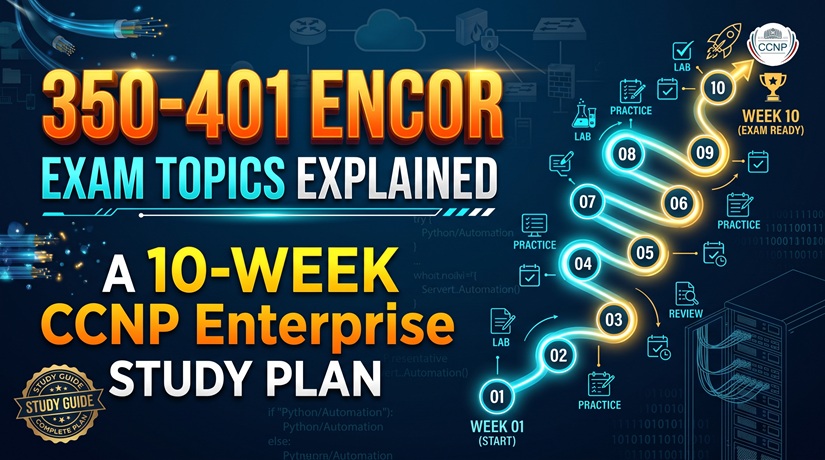
6. A Practical 10-Week Study Plan
The schedule below translates the exam-topic map into a study sequence. It is a starting point for someone who can study consistently for several hours each week, not an estimate of how long every candidate needs. Adjust the pace to your experience. If routing is already familiar but automation is new, spend less time repeating basic routing labs and more time with Python, JSON, and APIs.
| Week | Main focus | Suggested outcome |
|---|---|---|
| 1 | Architecture | Explain campus design models, high availability, SD-WAN, SD-Access, and QoS at a high level. |
| 2 | Virtualization | Describe hypervisors, virtual switching, VRF, GRE, IPsec, LISP, and VXLAN; complete a basic VRF or tunnel lab. |
| 3 | Layer 2 infrastructure | Configure and troubleshoot VLANs, 802.1Q trunks, EtherChannel, RSTP, and MST. |
| 4 | OSPF and EIGRP | Compare routing behaviour and build simple OSPFv2/v3 topologies with multiple areas. |
| 5 | BGP and routing policy | Establish directly connected eBGP neighbors, inspect best-path behaviour, and review PBR. |
| 6 | IP services | Practise NAT/PAT, NTP/PTP interpretation, HSRP/VRRP, and multicast fundamentals. |
| 7 | Network Assurance | Use troubleshooting tools, NetFlow, SPAN, IP SLA, Catalyst Center concepts, NETCONF, and RESTCONF. |
| 8 | Security | Configure local access, AAA, ACLs, and CoPP; review API security and security design concepts. |
| 9 | Automation and AI | Read basic Python, construct JSON, understand YANG and APIs, and practise a simple EEM example. |
| 10 | Review and exam readiness | Revisit weak objectives, repeat selected labs without notes, and complete timed practice sessions. |
Use the official topic list as a progress tracker. Mark each objective as not started, understood, or practised. A topic should not be marked complete just because you watched a video about it. For configuration objectives, aim to build and verify the feature yourself. As the exam approaches, combine that hands-on work with additional ENCOR exam practice materials to identify topics that still need review.
7. How to Get More from Your Network Labs
Reading builds vocabulary, but lab work builds judgement. A useful ENCOR lab does more than show that a command is accepted. It gives you a chance to observe the network before and after a change, identify a failure, and explain why the result occurred.
Build a small, reusable topology
You do not need a huge virtual network for every objective. Start with a few routers and switches, then expand the topology when a topic requires it. Keep a clean baseline configuration so you can repeat a lab without spending half the session rebuilding devices.
Packet Tracer can be useful for foundational switching and routing practice. For more advanced IOS XE features or controller-related exercises, use a lab platform and software images that support the feature you are studying. Follow the applicable licensing terms; do not rely on unofficial or unauthorised software images.
Use a repeatable lab workflow
- Define the goal. Write down what the network should do before entering commands.
- Capture the starting state. Record the relevant interfaces, routing tables, neighbor relationships, and logs.
- Configure one feature at a time. Make changes in small steps so you can identify their effect.
- Verify the result. Use show commands, pings, traceroutes, and protocol-specific checks.
- Introduce a fault. Change a VLAN, remove a route, alter a timer, or create a mismatch and observe the symptoms.
- Write a short post-lab note. Record the cause, evidence, fix, and commands that helped you find it.
Useful verification habits
For Layer 2, practise checking trunk status, EtherChannel membership, and spanning-tree roles. For routing, inspect the routing table and protocol neighbors before changing configuration. For services, verify translations, redundancy state, and time synchronisation. For assurance, compare traffic observations with logs and device counters.
Build the habit of asking three questions: What should happen? What is actually happening? What evidence explains the difference? This troubleshooting mindset is more valuable than memorising long command lists.
8. Exam Preparation and Test-Day Advice
- Study from the current blueprint. Use Cisco’s 350-401 ENCOR v1.2 PDF as the master checklist. Check the version of every course, book, and practice test you use.
- Learn the meaning behind commands. Be able to predict the effect of a configuration and interpret operational output.
- Practise troubleshooting. A working configuration is only half the story. Learn to recognise common causes of failed adjacencies, blocked VLANs, routing problems, and service interruptions.
- Use practice questions as a diagnostic tool. A Cisco 350-401 ENCOR question set can help you spot topics that need another look. Review the reasoning behind each answer and confirm the relevant concepts with official documentation. A score is useful only when it helps you identify a knowledge gap.
- Avoid exam dumps. Unauthorised dumps can be inaccurate, outdated, and inconsistent with Cisco’s exam policies. They also do little to develop skills that you will need on the job.
- Plan your time. In the final week, focus on weak areas and concise review rather than trying to learn every technology from scratch.
On exam day, read the whole question before choosing an answer. Pay attention to words such as best, first, must, and most likely. In network scenarios, identify the requirement and the relevant evidence before deciding which technology or configuration fits.
Do not assume that every objective will appear in the same proportion as the blueprint percentages on your particular exam form. The published weights are planning guidance, not a promise of a fixed question count.
9. What the Certification Can Do for Your Career
CCNP Enterprise is a professional-level certification for people who want to demonstrate a broader understanding of enterprise networking. Preparing for ENCOR can strengthen practical knowledge in routing, switching, network design, virtualization, security, monitoring, and automation.
These skills are relevant to roles such as network engineer, enterprise network administrator, infrastructure engineer, network operations engineer, and network support specialist. They can also provide a useful foundation for engineers moving toward network architecture, SD-WAN, network assurance, or automation.
A certification does not guarantee a job or a particular salary. Employers also look for hands-on experience, communication skills, sound troubleshooting, and the ability to explain technical decisions. The strongest preparation combines the credential with lab projects, documented problem-solving, and experience supporting real networks.
10. Frequently Asked Questions
Is 350-401 ENCOR enough to earn CCNP Enterprise?
No. ENCOR is the required core exam, but you must also pass one approved CCNP Enterprise concentration exam. Passing ENCOR on its own earns the Cisco Certified Specialist – Enterprise Core certification.
Can a beginner take the ENCOR exam?
Cisco lists no formal prerequisite, so candidates are not required to hold CCNA before taking ENCOR. However, the exam assumes a broad understanding of networking. Beginners should first become comfortable with IP addressing, VLANs, switching, routing, and Cisco CLI basics.
How long does it take to prepare for 350-401 ENCOR?
It depends on your experience and weekly study time. Someone with practical enterprise networking experience may need a shorter review period, while a learner building skills from the ground up may need several months. Use the 10-week plan in this guide as a framework, not a guarantee.
What is the highest-weighted ENCOR domain?
Infrastructure is the largest domain at 30%. Security is next at 20%. These percentages should influence your study schedule, but every domain in the official blueprint deserves attention.
Does the current ENCOR v1.2 blueprint include wireless topics?
The v1.2 update removed a number of wireless-specific objectives that appeared in the earlier blueprint, including several WLAN design, wireless infrastructure, and wireless security tasks. Do not rely on an older v1.1 topic list without checking it against Cisco’s current v1.2 exam document.
Which concentration should I choose after ENCOR?
Choose according to your career direction. ENARSI is a natural option for advanced routing and services; ENSDWI focuses on Catalyst SD-WAN; ENSLD covers enterprise design; ENAUTO develops automation and programmability; ENCC focuses on secure cloud connectivity; and ENNA focuses on network assurance. Review each official exam page before deciding.
Can ENCOR count toward a CCIE certification?
Yes. Cisco identifies 350-401 ENCOR as the core exam for the CCIE Enterprise Infrastructure path as well. Passing the core exam does not earn CCIE by itself; the applicable expert-level lab exam is a separate requirement.
11. Official References and Further Reading
Use official Cisco resources to confirm exam requirements and keep your study plan aligned with the current blueprint. The IETF references below provide standards-based background for some of the programmability topics.
- Cisco: 350-401 ENCOR Exam Information — exam overview, duration, price, languages, and preparation links.
- Cisco: 350-401 ENCOR v1.2 Official Exam Topics (PDF) — the primary source for the six exam domains, weights, and detailed objectives.
- Cisco: CCNP Enterprise Certification — certification requirements and current concentration exam options.
- Cisco: Implementing and Operating Cisco Enterprise Network Core Technologies (ENCOR) Training — Cisco’s official training course and lab outline.
- Cisco Learning Network — certification communities, study discussions, and learning resources.
- Cisco U. — Cisco learning paths, training, and practice resources.
- Cisco Press — Cisco-authorised technical books and certification study materials.
- IETF RFC 6241: Network Configuration Protocol (NETCONF) — the NETCONF protocol specification.
- IETF RFC 8040: RESTCONF Protocol — the RESTCONF protocol specification.
- IETF RFC 7950: The YANG 1.1 Data Modeling Language — the YANG data modelling language specification.
- IETF RFC 8259: The JavaScript Object Notation (JSON) Data Interchange Format — the JSON specification.
Editorial note: Exam details and certification paths can change. This article reflects the Cisco information and ENCOR v1.2 blueprint reviewed on October 31, 2026. Always verify the current official Cisco pages before purchasing training or scheduling an exam.