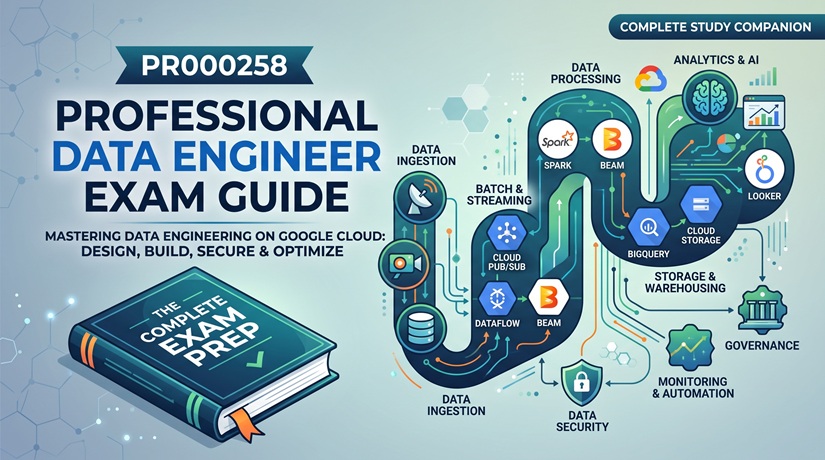
The PR000258 Professional Data Engineer certification exam is designed for professionals who work with data processing, analytics, storage, security, automation, and data-driven solutions on Google Cloud. It is one of the more technical professional-level certifications in the Google Cloud certification portfolio and requires much more than simply memorizing product names.
To prepare effectively, candidates need to understand how Google Cloud data services work together in real-world architectures. BigQuery, Dataflow, Pub/Sub, Dataproc, Cloud Storage, Spanner, Bigtable, Dataform, Dataplex, and Cloud Composer are all important, but the exam is primarily about choosing the right technology for a particular business and technical requirement.
This PR000258 Professional Data Engineer exam guide explains the certification, current exam structure, important Google Cloud technologies, major exam domains, preparation strategies, hands-on projects, and a practical study roadmap for beginners, students, and working IT professionals.
PR000258 Professional Data Engineer Exam Overview
Table of Contents
ToggleThe Google Cloud Professional Data Engineer certification focuses on a candidate’s ability to design, build, operate, monitor, secure, and optimize data processing systems on Google Cloud.
A professional data engineer is expected to turn raw data into information that can be reliably consumed by analysts, applications, machine learning systems, and business decision-makers.
For candidates preparing specifically for PR000258 Google Cloud Professional Data Engineer, it is useful to understand the basic exam format before creating a study plan.
| Exam Information | Details |
|---|---|
| Certification | Google Cloud Certified – Professional Data Engineer |
| Exam Reference | PR000258 |
| Certification Level | Professional |
| Exam Duration | Approximately 2 hours |
| Number of Questions | Approximately 40–50 questions |
| Question Type | Multiple choice and multiple select |
| Standard Registration Fee | USD $200 plus applicable tax |
| Available Languages | English and Japanese |
| Exam Delivery | Online proctored or testing center |
| Formal Prerequisites | None |
| Recommended Experience | 3+ years of industry experience, including 1+ years designing and managing solutions on Google Cloud |
| Professional Certification Validity | 2 years |
Google does not require another certification before taking the Professional Data Engineer exam. However, the absence of formal prerequisites should not be interpreted as meaning that the certification is entry-level.
Many questions are easier to understand if you have already worked with production data pipelines, IAM policies, SQL workloads, cloud databases, monitoring systems, or data processing platforms.
Exam information and registration details may change over time, so candidates should always confirm the latest information on the official Google Cloud certification website before scheduling the exam.
Is the Google Cloud Professional Data Engineer Certification Worth It?
For professionals interested in cloud data engineering, analytics engineering, data architecture, business intelligence, and data platform engineering, the certification can provide meaningful technical and career value.
One reason is that the exam covers much more than a single Google Cloud service. A successful candidate needs to understand the complete lifecycle of data.
- Collecting and ingesting data
- Processing batch and streaming data
- Selecting suitable storage technologies
- Designing analytical data models
- Protecting sensitive information
- Automating data workflows
- Monitoring production systems
- Optimizing performance and cost
- Preparing data for analytics and machine learning
This makes the certification especially useful for engineers who want to develop a broader understanding of Google Cloud’s data ecosystem rather than learning only BigQuery or one database product.
However, certification should complement practical experience rather than replace it. Being able to recognize the correct answer in a multiple-choice question is useful, but a real data engineer must also be able to explain why an architecture works, identify its limitations, and troubleshoot it when something fails.
PR000258 Professional Data Engineer Exam Domains
The current Professional Data Engineer exam guide organizes the exam around five major areas. Understanding the approximate weighting can help candidates prioritize their preparation time.
| Exam Domain | Approximate Weight |
|---|---|
| Designing data processing systems | 22% |
| Ingesting and processing data | 25% |
| Storing data | 20% |
| Preparing and using data for analysis | 15% |
| Maintaining and automating data workloads | 18% |
Candidates studying for the PR000258 Professional Data Engineer exam should avoid treating these domains as completely separate topics. A typical scenario may combine storage selection, security, data processing, monitoring, and cost optimization in a single question.
1. Designing Data Processing Systems – Approximately 22%
This area focuses heavily on architecture and design decisions.
You should understand how business requirements are translated into technical designs. Important considerations include:
- Availability
- Reliability
- Scalability
- Security
- Data residency
- Compliance
- Performance
- Cost
- Operational complexity
Candidates should also understand IAM, encryption, key management, personally identifiable information, organization policies, disaster recovery, and development versus production environments.
Migration scenarios may involve services such as Database Migration Service, BigQuery Data Transfer Service, Datastream, Transfer Appliance, and network connectivity between existing infrastructure and Google Cloud.
2. Ingesting and Processing Data – Approximately 25%
This is one of the largest parts of the exam and deserves significant preparation time.
Candidates should understand the difference between batch processing and streaming processing and know when each model is appropriate.
Important technologies include:
- Dataflow
- Apache Beam
- Pub/Sub
- Dataproc
- Apache Spark
- Apache Hadoop
- Apache Kafka
- BigQuery
- Cloud Data Fusion
- Cloud Composer
- Workflows
For streaming architectures, study concepts such as event time, processing time, windows, late-arriving events, duplicate data, throughput, latency, retries, and failure handling.
It is also important to understand when Dataflow is more appropriate than Dataproc. Dataflow provides managed batch and streaming data processing and is commonly associated with Apache Beam. Dataproc, by comparison, is particularly relevant when organizations already use Spark, Hadoop, or related open-source technologies.
3. Storing Data – Approximately 20%
Storage selection is a major part of both the certification exam and real-world data engineering.
You should understand the characteristics and common use cases of:
- BigQuery
- BigLake
- Cloud Storage
- Bigtable
- Spanner
- AlloyDB
- Cloud SQL
- Firestore
- Memorystore
Instead of memorizing product descriptions, learn to evaluate requirements.
Ask questions such as:
- Is the workload analytical or transactional?
- Is SQL required?
- Does the application need ACID transactions?
- What latency is acceptable?
- How much data is involved?
- How quickly will the dataset grow?
- Are reads or writes more important?
- Is global consistency required?
- Does the application require flexible schemas?
- How much operational management is acceptable?
The correct storage service often becomes much easier to identify after answering these questions.
4. Preparing and Using Data for Analysis – Approximately 15%
A data platform is valuable only when people or applications can use the information that it produces.
Candidates should therefore understand analytical workloads and important BigQuery features such as:
- Partitioned tables
- Clustered tables
- Materialized views
- BI Engine
- BigQuery ML
- Data sharing
- Analytics Hub
- Query optimization
Security remains important in analytical environments. IAM, data masking, sensitive-data protection, and appropriate access controls should be part of the design rather than added later.
The modern Professional Data Engineer exam also reflects the relationship between data engineering and artificial intelligence. Candidates should be familiar with preparing data for machine learning, embeddings, and retrieval-augmented generation workloads.
5. Maintaining and Automating Data Workloads – Approximately 18%
Production data systems must be monitored, automated, and maintained.
Candidates should understand:
- Cloud Monitoring
- Cloud Logging
- Pipeline scheduling
- Workflow orchestration
- Cloud Composer DAGs
- Retries
- Failure handling
- Capacity planning
- Quota management
- Cost optimization
- Disaster recovery
- Replication
- Failover strategies
A data pipeline that works once is not necessarily a production-ready data pipeline. The exam frequently tests the operational consequences of an architectural decision.
Important Google Cloud Services for the PR000258 Exam
BigQuery
BigQuery is one of the most important services for anyone preparing for the Professional Data Engineer certification.
Candidates should understand:
- Datasets and tables
- SQL analytics
- Partitioning
- Clustering
- BigQuery storage concepts
- Query optimization
- Materialized views
- BI Engine
- BigQuery ML
- IAM and data security
- BigQuery Editions
- Reservations and workload capacity
- Data sharing
- Cost management
Do not learn BigQuery simply by reading documentation. Create datasets, load data, run queries, inspect query execution details, and observe how partitioning affects the amount of data scanned.
Dataflow and Apache Beam
Dataflow is Google’s managed data processing service for batch and streaming workloads.
Professional Data Engineer candidates should understand the relationship between Dataflow and Apache Beam, as well as concepts including:
- Pipelines
- Sources and sinks
- Transforms
- Windowing
- Event time
- Processing time
- Late data
- Streaming reliability
A common architecture might ingest events through Pub/Sub, process them with Dataflow, and write the processed records into BigQuery.
Pub/Sub
Pub/Sub is an important component of event-driven and streaming systems.
Understand:
- Publishers
- Topics
- Subscriptions
- Subscribers
- Message delivery
- Acknowledgements
- Retries
- Integration with Dataflow
For exam questions, focus on how Pub/Sub fits into the overall architecture rather than memorizing every configuration option.
Dataproc
Dataproc provides managed environments for technologies such as Apache Spark and Hadoop.
The important exam skill is recognizing when an existing Spark or Hadoop workload should remain within that ecosystem rather than being redesigned unnecessarily.
For example, an organization with a substantial existing Spark codebase may find Dataproc a more straightforward migration path than completely rewriting pipelines using another processing framework.
Dataform
Dataform supports SQL-based transformation workflows in BigQuery-centric environments.
You should understand how it can help with:
- SQL transformations
- Dependencies
- Data quality assertions
- Version-controlled development
- Repeatable transformation workflows
- ELT architecture
Cloud Composer
Cloud Composer is Google’s managed Apache Airflow service.
It is primarily an orchestration service. A Composer workflow may coordinate BigQuery jobs, Dataflow pipelines, Dataproc tasks, APIs, and other processing operations.
Candidates should understand DAGs, scheduling, task dependencies, retries, and workflow failure handling.
Dataplex
Dataplex is relevant to governance, organization, data discovery, and management across distributed data environments.
Professional-level candidates should think beyond individual databases and understand how organizations can govern data across larger platforms.
Spanner
Spanner is important when a system requires a relational database with horizontal scalability, strong consistency, and global distribution.
It should not automatically be selected for every relational database scenario. Cloud SQL or AlloyDB may be more suitable when global scale and Spanner’s specific capabilities are unnecessary.
Bigtable
Bigtable is designed for large-scale, low-latency workloads and is commonly associated with use cases involving high throughput and very large datasets.
Understanding access patterns and row-key design is important when evaluating whether Bigtable is appropriate.
Google Cloud Data Service Selection Guide
Many PR000258 Professional Data Engineer preparation questions ultimately test whether you can select the correct service for a specific requirement.
| Requirement | Google Cloud Service to Consider |
|---|---|
| Large-scale analytical SQL and data warehousing | BigQuery |
| Object storage and data lake foundation | Cloud Storage |
| Analytics over lake-style data | BigLake and BigQuery-related architecture |
| Low-latency, high-throughput wide-column workloads | Bigtable |
| Globally distributed relational transactions | Spanner |
| High-performance PostgreSQL-compatible workloads | AlloyDB |
| Managed MySQL, PostgreSQL, or SQL Server | Cloud SQL |
| Document-oriented application database | Firestore |
| In-memory caching | Memorystore |
| Managed batch and streaming processing | Dataflow |
| Spark and Hadoop workloads | Dataproc |
| Asynchronous messaging and event ingestion | Pub/Sub |
| Apache Airflow workflow orchestration | Cloud Composer |
| SQL transformations in BigQuery | Dataform |
This table is useful for revision, but real exam scenarios are usually more complicated. A question may include several requirements that change the correct answer.
For example, two systems may both require SQL, but one may be a large analytical warehouse while the other processes transactional application data. Those requirements point toward very different Google Cloud services.
10-Week PR000258 Professional Data Engineer Study Plan
A structured study plan is particularly helpful for candidates who have not worked with every service covered by the certification.
Week 1: Google Cloud Fundamentals
Review:
- Projects
- IAM
- Service accounts
- Billing
- VPC fundamentals
- Regions and zones
- Cloud Storage
- Cloud Logging
- Cloud Monitoring
Week 2: BigQuery
Spend a full week working with BigQuery.
Practice:
- Loading datasets
- Writing analytical SQL
- Creating partitioned tables
- Creating clustered tables
- Reviewing query plans
- Monitoring bytes processed
- Creating views
- Creating materialized views
- Configuring access controls
Week 3: Streaming Data
Create a simple architecture using:
Pub/Sub → Dataflow → BigQuery
Study windowing, late events, throughput, acknowledgements, retries, and error handling.
Week 4: Batch Processing
Review Dataflow, Apache Beam, Dataproc, Spark, and Hadoop.
Focus especially on the architectural differences between Dataflow and Dataproc.
Week 5: Google Cloud Databases
Compare:
- BigQuery
- Bigtable
- Spanner
- Cloud SQL
- AlloyDB
- Firestore
- Cloud Storage
For each service, write down:
- Primary use case
- Data model
- Typical access pattern
- Consistency requirements
- Scalability model
- Operational considerations
Week 6: Data Transformation and Orchestration
Study Dataform, Cloud Composer, and Workflows.
Create at least one workflow with task dependencies and failure handling.
Week 7: Security and Governance
Review:
- IAM
- Least privilege
- Service accounts
- Encryption
- Key management
- Sensitive data protection
- Data masking
- Data residency
- Dataplex
- Development and production separation
Week 8: Monitoring, Reliability, and Cost
Study:
- Cloud Monitoring
- Cloud Logging
- Quotas
- Capacity planning
- BigQuery cost optimization
- BigQuery reservations and editions
- Replication
- High availability
- Disaster recovery
Week 9: Analytics, Machine Learning, and AI Data
Review BigQuery ML, BI Engine, Analytics Hub, feature preparation, embeddings, and data preparation for retrieval-augmented generation.
The objective is not to become a machine learning researcher. Instead, understand the data engineering requirements that support AI and machine learning workloads.
Week 10: PR000258 Exam Review
During the final week, return to the official Professional Data Engineer exam guide and review every objective.
You can also use your PR000258 exam preparation resources together with official Google Cloud documentation to identify areas where additional revision is needed.
Spend more time solving architectural scenarios and less time memorizing isolated definitions.
Recommended Hands-On Practice for PR000258
Hands-on experience is one of the most effective ways to prepare for a professional-level cloud certification.
Project 1: Streaming Analytics Pipeline
Build:
Event Producer → Pub/Sub → Dataflow → BigQuery → Analytics
Then deliberately introduce malformed events, delayed messages, and IAM restrictions. Troubleshooting those problems teaches more than simply following a successful tutorial.
Project 2: BigQuery ELT Pipeline
Load raw data into BigQuery or Cloud Storage and use BigQuery with Dataform to transform the data into analytical tables.
Add:
- Data quality assertions
- Table dependencies
- Partitioning
- Clustering
- Access control
Project 3: Cloud Composer Workflow
Create a Composer DAG that runs several dependent data tasks.
Include retries, logging, scheduled execution, and failure handling.
Project 4: Database Comparison
Create small experimental workloads using BigQuery, Cloud SQL, and another database such as Bigtable or Firestore.
Compare what happens when requirements change in terms of:
- Transactions
- Latency
- Scale
- Query flexibility
- Consistency
Project 5: Secure Data Platform
Build separate development and production environments with restricted service accounts and dataset permissions.
Add basic governance and monitoring so that the environment more closely resembles a real production system.
PR000258 Professional Data Engineer Exam Strategy
The Professional Data Engineer exam rewards architectural reasoning more than simple memorization.
When reading a scenario, identify the requirements before selecting an answer.
A useful approach is to classify the requirements into six areas:
- Scale: How much data and how many users?
- Latency: Does the system need real-time, near-real-time, or batch processing?
- Reliability: What happens when a component fails?
- Security: What IAM, encryption, privacy, or compliance requirements apply?
- Operations: How much infrastructure management is acceptable?
- Cost: What is the most efficient solution that still satisfies the requirements?
Look for Keywords in the Scenario
Small phrases can completely change the correct answer.
For example:
- “Existing Spark workloads” may point toward Dataproc.
- “Serverless analytical SQL” may point toward BigQuery.
- “Streaming event ingestion” may involve Pub/Sub.
- “Batch and streaming transformations” may involve Dataflow.
- “Global relational transactions” may point toward Spanner.
- “Apache Airflow” strongly suggests Cloud Composer.
Prefer the Simplest Architecture That Meets the Requirements
Do not automatically select the most complicated answer.
Professional cloud architecture frequently involves reducing operational overhead through managed services. If two architectures satisfy the requirements equally well, the solution with less unnecessary infrastructure is often worth serious consideration.
Understand the Difference Between Similar Services
Before taking PR000258, make sure you can explain the difference between:
- Dataflow vs Dataproc
- BigQuery vs Cloud SQL
- BigQuery vs Bigtable
- Spanner vs Cloud SQL
- AlloyDB vs Cloud SQL
- Cloud Storage vs BigQuery
- Cloud Composer vs Dataflow
- Dataform vs Cloud Composer
If you can explain these comparisons without looking at documentation, you are moving in the right direction.
Is PR000258 Suitable for Students and Beginners?
Students can take the exam, but the PR000258 Professional Data Engineer certification should not normally be treated as an introduction to cloud computing.
Before attempting a professional-level data certification, beginners should understand:
- SQL
- Basic Python
- Database fundamentals
- Relational databases
- NoSQL concepts
- Data modeling
- ETL and ELT
- Batch processing
- Streaming processing
- Linux and command-line fundamentals
- Basic networking
- Cloud IAM
- Basic security principles
Students who are new to Google Cloud may also want to explore Google’s Associate Data Practitioner certification before attempting Professional Data Engineer.
Another useful approach is to create a small GitHub portfolio. A portfolio containing an actual streaming pipeline, BigQuery project, or Composer workflow can complement the certification and demonstrate that you understand more than exam theory.
Professional Data Engineer Certification Validity and Renewal
Google Cloud Professional certifications are generally valid for two years.
Eligible certification holders may have access to different renewal options, including a renewal examination or eligible continuing-education activities made available through Google’s learning platforms.
Renewal policies can change, so always check Google’s official certification FAQ and renewal documentation before making decisions based on older information.
PR000258 Professional Data Engineer FAQ
What is the PR000258 Professional Data Engineer exam?
PR000258 refers to the Google Cloud Professional Data Engineer certification exam covered in this guide. The exam evaluates a candidate’s ability to design, build, secure, monitor, automate, and optimize data systems on Google Cloud.
Is the PR000258 Professional Data Engineer exam difficult?
Yes. It is a professional-level certification that covers data architecture, storage, processing, security, analytics, monitoring, automation, and several Google Cloud products.
How many questions are on the Professional Data Engineer exam?
The current standard exam typically contains approximately 40–50 multiple-choice and multiple-select questions.
How long is the Professional Data Engineer exam?
The standard exam is approximately two hours long.
What is the passing score for PR000258?
Google does not publicly provide a numerical passing score for its cloud certification examinations. Candidates generally receive a pass or fail result rather than a percentage score.
Is BigQuery enough to pass PR000258?
No. BigQuery is extremely important, but candidates should also understand Dataflow, Pub/Sub, Dataproc, Cloud Storage, Bigtable, Spanner, Cloud SQL, AlloyDB, Dataplex, Dataform, Cloud Composer, IAM, monitoring, governance, and related technologies.
Do I need Python for the PR000258 exam?
The exam is not primarily a programming test. However, understanding Python, SQL, data processing concepts, and the role of Apache Beam SDKs can make many technical scenarios easier to understand.
Does PR000258 include machine learning and generative AI topics?
The current Professional Data Engineer blueprint includes data preparation for machine learning as well as concepts related to embeddings and retrieval-augmented generation. The emphasis remains on the data engineering responsibilities that support these workloads.
How long should I study for the PR000258 Professional Data Engineer exam?
Preparation time depends heavily on experience. Someone already working with Google Cloud data services may only need several weeks of focused review. Candidates moving from another cloud platform may need two or three months, while beginners may need considerably longer.
Where can I find PR000258 Professional Data Engineer preparation resources?
In addition to Google’s official documentation and certification resources, you can review this PR000258 Professional Data Engineer course and exam preparation page for additional exam-focused study information.
Final Thoughts on PR000258 Professional Data Engineer
The best way to prepare for the PR000258 Professional Data Engineer exam is to treat the certification objectives as a roadmap for learning real cloud data engineering.
Do not focus only on remembering which Google Cloud service performs a particular function. Learn why that service is appropriate, what trade-offs it introduces, and how it behaves when the workload reaches production.
A good Professional Data Engineer should be able to answer questions such as:
- Where should this data be stored?
- Should the pipeline use batch or streaming processing?
- How should access to sensitive data be controlled?
- How will the platform recover from failure?
- How can query and processing costs be reduced?
- Which services minimize unnecessary operational work?
- How should workflows be monitored and automated?
If you can answer those questions confidently, you are developing skills that matter beyond the certification itself.
Candidates preparing specifically for the exam can also review the PR000258 Professional Data Engineer preparation page together with Google’s official exam guide and product documentation.
Official and Authoritative PR000258 Study References
- Google Cloud – Professional Data Engineer Certification
- Google Cloud – Professional Data Engineer Exam Guide
- Google Cloud – Data Engineering and Analytics Training
- Google Cloud Skills – Data Engineer Learning Path
- Google Cloud Certification FAQs
- Google Cloud BigQuery Documentation
- Google Cloud Dataflow Documentation
- Google Cloud Pub/Sub Documentation
- Google Cloud Dataproc Documentation
- Google Cloud Composer Documentation
- Google Cloud Dataform Documentation
- Google Cloud Dataplex Documentation