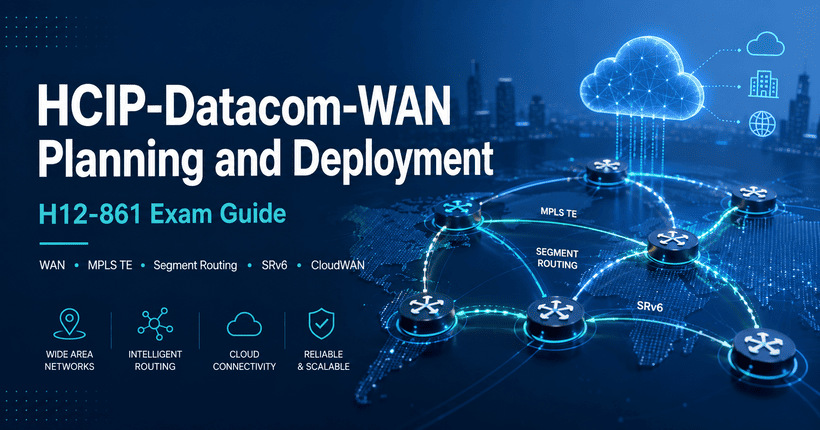
Enterprise wide area networks have changed considerably over the last decade. A modern WAN is no longer simply a collection of routers connected through leased lines. Large enterprises now expect their WAN infrastructure to support multiple services, traffic engineering, VPN isolation, centralized management, fast convergence, IPv6, and increasingly programmable forwarding technologies.
The HCIP-Datacom-WAN Planning and Deployment certification is designed for network professionals who want to develop deeper skills in enterprise bearer WAN technologies. The associated H12-861 exam moves beyond basic routing and switching and focuses on technologies such as WAN VPNs, MPLS Traffic Engineering, Segment Routing, SRv6, and Huawei CloudWAN.
For students and junior network engineers, H12-861 can initially look intimidating because many of these technologies are normally associated with carrier networks or large enterprise backbones. However, once the technologies are studied as parts of one WAN architecture rather than as isolated protocols, the subject becomes much easier to understand.
This guide explains what the H12-861 HCIP-Datacom-WAN Planning and Deployment exam covers, why the certification can be valuable, which technologies deserve the most attention, and how to build a practical study strategy.
What Is HCIP-Datacom-WAN Planning and Deployment?
Table of Contents
ToggleHCIP stands for Huawei Certified ICT Professional. Within Huawei’s Datacom certification system, HCIP represents the professional-level stage between HCIA and HCIE.
The WAN Planning and Deployment specialization focuses specifically on enterprise bearer WAN scenarios. Instead of concentrating only on individual routing protocols, the certification expects candidates to understand how technologies work together to build scalable and reliable WAN infrastructure.
Typical areas include:
- Enterprise bearer WAN architecture
- WAN VPN technologies
- MPLS Traffic Engineering
- Segment Routing
- SRv6
- WAN traffic optimization
- Centralized WAN management and control
- Huawei CloudWAN architecture
- WAN operations and troubleshooting
- Enterprise WAN planning and design
This makes the certification particularly relevant to engineers working with large enterprise networks, financial networks, government networks, service provider-style enterprise backbones, and Huawei-based WAN infrastructure.
Candidates who are beginning their preparation can also review the dedicated
Huawei H12-861 exam preparation
page while working through the major WAN technology domains discussed below.
H12-861 Exam at a Glance
| Item | Details |
|---|---|
| Exam Code | H12-861 |
| Exam Name | HCIP-Datacom-WAN Planning and Deployment |
| Certification Level | HCIP – Professional |
| Technology Domain | Datacom / Enterprise Bearer WAN |
| Published Version | V1.0 |
| Published Exam Duration | 90 minutes |
| Published Languages | English and Chinese |
| Recommended Background | HCIA-Datacom knowledge and HCIP-Datacom Core Technology skills |
Huawei’s published certification documentation lists H12-821 HCIP-Datacom-Core Technology together with H12-861 HCIP-Datacom-WAN Planning and Deployment for this specialization. Candidates should therefore understand that H12-861 represents the WAN specialization rather than the entire HCIP-Datacom learning path by itself.
Exam policies, registration fees, versions, and availability can change over time, so candidates should always confirm the latest information through Huawei’s certification portal before scheduling an examination.
What Does the H12-861 Exam Cover?
The H12-861 WAN specialization is divided into several major technology areas. Understanding the relationship between these domains is particularly important when building an effective H12-861 study plan.
| Knowledge Area | Published Weight |
|---|---|
| Enterprise Bearer WAN Network Solution | 5% |
| Enterprise Bearer WAN Architecture and Key Technologies | 12% |
| WAN VPN Technologies | 10% |
| MPLS TE Fundamentals and Configuration | 15% |
| Segment Routing | 20% |
| SRv6 Overview | 10% |
| Huawei CloudWAN Solution Architecture and Fundamentals | 15% |
| Huawei CloudWAN O&M and Troubleshooting | 3% |
| Huawei CloudWAN Solution Design Practice | 10% |
The weighting shows an important characteristic of the H12-861 exam: simply learning conventional MPLS is not enough. Segment Routing, CloudWAN, traffic engineering, and modern WAN architecture represent a substantial part of the certification.
1. Enterprise Bearer WAN Architecture
Before studying individual protocols, candidates should understand what an enterprise bearer WAN is trying to accomplish.
A large organization may have headquarters, regional offices, data centers, disaster recovery sites, branches, and cloud resources spread across different geographic areas. The WAN must connect these locations while maintaining predictable performance, service isolation, reliability, security, and operational visibility.
A useful way to study WAN architecture is to divide it into several logical components:
- Transport infrastructure: provides connectivity between WAN nodes.
- Routing infrastructure: determines reachability and network paths.
- Service layer: provides VPN and customer or department isolation.
- Traffic engineering layer: controls how traffic uses available network resources.
- Management and control layer: provides topology visibility, configuration, optimization, and troubleshooting.
Understanding these layers will make later subjects such as MPLS TE, SR-MPLS, SRv6, and CloudWAN much easier to connect conceptually.
2. WAN VPN Technologies
VPN technology is one of the foundations of enterprise WAN design. A physical backbone is often shared by many departments, applications, branches, customers, or business units while their logical traffic must remain separated.
Candidates should therefore be comfortable with the relationship between routing, MPLS labels, BGP extensions, and VPN forwarding.
Important concepts worth reviewing include:
- Provider Edge and customer-side connectivity concepts
- VPN routing and forwarding instances
- Route Distinguisher concepts
- Route Target import and export policies
- MP-BGP distribution of VPN routes
- MPLS label forwarding
- Control-plane and data-plane relationships
- End-to-end packet forwarding through a VPN
Do not study these items as definitions only. A stronger approach is to take a packet from one branch and trace exactly what happens as it enters a PE router, crosses the backbone, and exits toward another site.
If you understand both the routing information and the label operations at each step, many VPN troubleshooting questions become much easier.
3. MPLS Traffic Engineering
Traditional IP routing normally chooses paths according to routing protocol metrics. That approach works well in many networks, but it does not necessarily make efficient use of every available WAN link.
Consider a network with two possible paths between large regional sites. If the shortest IGP path carries most of the traffic while another path remains underutilized, simply increasing bandwidth may not be the most efficient solution.
MPLS Traffic Engineering introduces mechanisms that allow operators to influence traffic paths according to network requirements rather than relying only on conventional shortest-path forwarding.
Candidates preparing for the H12-861 exam should understand concepts such as:
- Traffic Engineering tunnels
- Path constraints
- Bandwidth requirements
- Explicit and calculated paths
- Traffic steering
- Network resource utilization
- Tunnel forwarding behavior
- Protection and reliability concepts
The key question is not simply, “How do I configure an MPLS TE tunnel?” A professional-level engineer should also be able to explain why a particular tunnel is required and what problem it solves.
4. Segment Routing
Segment Routing is one of the most important topics in the H12-861 blueprint and deserves significant study time.
The basic idea behind Segment Routing is elegant: instead of maintaining complex per-flow state throughout the network, a source or controller can describe the intended forwarding path as an ordered sequence of segments.
In an MPLS data plane, Segment Routing is commonly referred to as SR-MPLS.
Candidates should become comfortable with:
- Segment Routing architecture
- Segment Identifiers or SIDs
- Node SIDs
- Adjacency SIDs
- Label stacks
- IGP extensions for Segment Routing
- SR paths and policies
- Traffic steering
- Interaction between controllers and the network
A good exercise is to draw a topology containing five or six routers and manually determine which SID stack would be required to force traffic through a specific sequence of nodes or links.
This type of exercise helps transform Segment Routing from an abstract theory into something much more intuitive.
5. SRv6
Segment Routing over IPv6, or SRv6, extends the Segment Routing concept into the IPv6 architecture.
Instead of relying on an MPLS label stack, SRv6 can encode segment information using IPv6 addressing and associated Segment Routing mechanisms. This creates interesting possibilities for combining routing, service instructions, traffic engineering, and programmability.
For beginners, SRv6 can initially appear complex because several technologies are being discussed at the same time:
- IPv6 addressing
- Segment Routing
- Segment Identifiers
- SR policies
- IPv6 extension mechanisms
- Service programming concepts
The easiest approach is to first master traditional Segment Routing concepts and then compare how those ideas are represented in an SRv6 environment.
Candidates should especially understand the architectural differences between SR-MPLS and SRv6 rather than treating SRv6 as merely another IPv6 chapter.
6. Huawei CloudWAN
Another major component of HCIP-Datacom WAN H12-861 is Huawei’s CloudWAN solution.
Traditional WAN operations frequently involve engineers logging in to individual routers, manually analyzing routing tables, comparing paths, and modifying configurations device by device. This model becomes increasingly difficult as a WAN grows to hundreds or thousands of nodes.
Modern WAN architectures therefore introduce centralized management, control, analytics, and automation capabilities.
When studying Huawei CloudWAN, candidates should focus on the architectural purpose of the solution as well as its individual components.
Important questions include:
- How does a controller obtain network topology information?
- How can network paths be centrally calculated or optimized?
- How are network policies delivered?
- How can operators visualize service paths?
- How can network analytics help identify performance problems?
- How can automated operations reduce troubleshooting time?
Huawei training for this specialization also introduces controller-based WAN management concepts associated with iMaster NCE-IP. Candidates should therefore understand the relationship between the physical forwarding network and the centralized management and control platform.
7. WAN Operations and Troubleshooting
A network engineer’s job does not end when the WAN is successfully deployed. Operational troubleshooting is equally important.
A useful troubleshooting model is to investigate the network layer by layer.
- Check physical and interface status.
- Confirm IGP connectivity.
- Verify routing protocol neighbors.
- Confirm MPLS or Segment Routing forwarding information.
- Verify VPN route distribution.
- Check traffic-engineering policies.
- Inspect service paths and controller information.
- Compare the actual forwarding behavior with the intended design.
This systematic approach is more reliable than randomly changing configuration commands until connectivity returns.
Why Is the H12-861 Certification Valuable?
The value of H12-861 comes primarily from the technologies it forces candidates to study.
Basic routing skills remain important, but large enterprise WANs increasingly require engineers who can understand the relationship between IP routing, MPLS services, traffic engineering, Segment Routing, IPv6, centralized controllers, and network automation.
Someone who properly prepares for the certification should develop a broader view of network engineering. Instead of thinking only about individual device configuration, they begin to think about:
- Network architecture
- Service requirements
- Traffic flows
- Scalability
- Availability
- Path optimization
- Operational complexity
- Troubleshooting methodology
These skills can be useful for positions such as:
- WAN Network Engineer
- Datacom Engineer
- Network Operations Engineer
- Network Deployment Engineer
- Technical Support Engineer
- Pre-sales Network Engineer
- Post-sales Network Engineer
- Enterprise Network Consultant
The certification is especially relevant in organizations and projects where Huawei routers and Huawei WAN solutions are part of the infrastructure.
What Should You Know Before Studying H12-861?
H12-861 should not normally be treated as a beginner networking exam.
Before spending significant time on the WAN specialization, you should be comfortable with:
- IPv4 and IPv6 fundamentals
- IP subnetting
- Static and dynamic routing
- OSPF
- IS-IS
- BGP
- Routing policies
- Basic MPLS concepts
- Network reliability
- Basic QoS concepts
A solid understanding of the HCIP-Datacom Core Technology curriculum is particularly helpful because the WAN course assumes candidates already understand the routing technologies on which the advanced WAN features depend.
A Practical H12-861 Study Strategy
Step 1: Build the WAN Foundation
Begin with enterprise bearer WAN architecture. Learn what problems the WAN is designed to solve before learning individual configuration commands.
You should be able to draw a simple enterprise WAN and identify the access, aggregation, core, VPN, management, and controller roles.
Step 2: Review MPLS and BGP
Before moving into Traffic Engineering and Segment Routing, make sure MPLS label forwarding and BGP route distribution are already clear.
If a simple MPLS VPN packet flow is confusing, Segment Routing will probably be confusing as well.
Step 3: Study MPLS TE
Learn why shortest-path routing can create inefficient traffic distribution and how Traffic Engineering provides greater control over the forwarding path.
Focus equally on architecture, configuration logic, and troubleshooting.
Step 4: Spend Extra Time on Segment Routing
Because Segment Routing represents one of the largest areas of the published H12-861 blueprint, it deserves extra attention.
Practice interpreting topologies and determining how Node SIDs, Adjacency SIDs, and SR policies affect forwarding.
Step 5: Learn SRv6 by Comparison
Instead of memorizing SRv6 independently, compare it directly with SR-MPLS.
Ask yourself:
- What represents a segment?
- How is the path expressed?
- What information does the packet carry?
- How does an intermediate router process it?
- What changes in the data plane?
Step 6: Study CloudWAN as a System
Do not memorize controller menu options without understanding the architecture.
Think about the complete workflow:
Network devices → topology collection → controller → path calculation or policy → configuration delivery → monitoring → analysis → optimization.
Once that workflow makes sense, many controller-related concepts become much easier to remember.
Step 7: Build Labs
Reading documentation is necessary, but WAN technologies become significantly easier once you see their forwarding behavior in a lab.
Useful lab exercises include:
- Building an IGP underlay
- Creating MPLS forwarding paths
- Configuring VPN services
- Testing MPLS Traffic Engineering
- Configuring SR-MPLS
- Testing different SID sequences
- Building simple SRv6 scenarios
- Introducing failures and observing convergence
You do not need an enormous topology. A carefully designed topology with four to eight routers can demonstrate a surprising number of WAN concepts.
Do Not Memorize Commands Without Understanding Packet Flow
One of the most common mistakes in advanced network certification study is memorizing CLI commands without understanding what those commands change inside the network.
For every technology you study, try to answer four questions:
- What problem does this technology solve?
- What control-plane information must be exchanged?
- What forwarding information is installed?
- What happens to an actual packet?
For example, when studying an MPLS VPN, do not stop after learning how to configure a VPN instance. Follow the customer packet from the source CE through the ingress PE, across the MPLS backbone, through the egress PE, and finally to the destination CE.
The same method works for MPLS TE, Segment Routing, and SRv6.
Common H12-861 Preparation Mistakes
Ignoring the Core Technologies
Advanced WAN technologies still depend on routing fundamentals. Weak knowledge of OSPF, IS-IS, BGP, or MPLS will make H12-861 unnecessarily difficult.
Memorizing Definitions
Knowing that a Node SID identifies a node is not enough. You should understand what happens when that SID appears in a forwarding path.
Studying SRv6 Too Early
Candidates who jump directly into SRv6 without understanding Segment Routing frequently become overwhelmed by terminology. Master the SR architecture first.
Ignoring Troubleshooting
A network may have correct-looking configuration but still fail because of missing routes, incorrect VPN policies, unavailable paths, or inconsistent controller information.
Practice troubleshooting deliberately rather than only building working configurations.
Focusing Only on Exam Questions
Practice questions can help identify weak areas, but they should be used as a diagnostic tool rather than as a substitute for learning.
When using H12-861 HCIP-Datacom WAN study resources, try to understand the technical reasoning behind each topic rather than relying only on memorization. If you answer a question correctly, make sure you can also explain why the other choices are incorrect.
A Suggested H12-861 Study Plan
| Week | Main Study Area | Practice Goal |
|---|---|---|
| Week 1 | Enterprise WAN architecture and routing review | Build a basic routed WAN topology |
| Week 2 | MPLS and WAN VPN technologies | Trace VPN packet forwarding |
| Week 3 | MPLS Traffic Engineering | Create and test engineered paths |
| Week 4 | Segment Routing | Practice Node SID and Adjacency SID forwarding |
| Week 5 | SRv6 | Compare SR-MPLS and SRv6 forwarding |
| Week 6 | Huawei CloudWAN | Understand controller architecture and workflows |
| Week 7 | Troubleshooting and design scenarios | Break and repair lab topologies |
| Week 8 | Full review | Review weak areas and complete practice tests |
The exact schedule depends on your existing networking background. Someone already experienced with MPLS and BGP may progress much faster, while a student coming directly from HCIA-level networking should allow additional time for routing fundamentals.
How H12-861 Differs from Other HCIP-Datacom Tracks
Huawei Datacom contains several professional-level specialization directions, and they should not be confused with one another.
The WAN Planning and Deployment direction is particularly focused on bearer WAN infrastructure and advanced transport technologies.
By comparison:
- Advanced Routing & Switching Technology focuses more heavily on advanced routing and switching technologies.
- Campus Network Planning and Deployment focuses on enterprise campus architecture and deployment.
- Enterprise Network Solution Design takes a broader solution-design perspective across enterprise networking scenarios.
- SD-WAN Planning and Deployment concentrates on SD-WAN architecture and enterprise branch interconnection.
- Network Automation Developer focuses more strongly on network programmability and automation.
H12-861 is therefore a particularly good fit for engineers interested in large WAN backbones, MPLS, Segment Routing, SRv6, and centralized WAN control.
Is H12-861 Difficult?
For a beginner, H12-861 is challenging. For someone who already understands routing protocols and MPLS, it is much more manageable.
The difficulty usually comes from three areas.
First, several technologies depend on each other. BGP knowledge affects VPN understanding, MPLS knowledge affects Traffic Engineering, and Segment Routing knowledge affects SRv6.
Second, the exam focuses on technologies that many junior engineers do not encounter in small office networks.
Third, candidates need to think about architecture and packet forwarding rather than simply remember configuration syntax.
The positive side is that these same characteristics make the certification useful as a structured learning path. Preparing properly can significantly deepen your understanding of modern WAN engineering.
Who Should Consider the H12-861 Exam?
H12-861 is worth considering if you are:
- A network engineer working with Huawei routers
- A student planning to move beyond entry-level networking
- An engineer supporting enterprise WAN infrastructure
- A technical support or post-sales engineer
- A pre-sales engineer designing Huawei network solutions
- An operations engineer responsible for MPLS or IP backbone networks
- An engineer interested in Segment Routing and SRv6
- A professional planning to continue toward HCIE-Datacom
If your current knowledge is limited to VLANs, static routes, and basic OSPF, it may be more productive to strengthen your HCIA-Datacom and HCIP Core Technology foundation before beginning serious H12-861 preparation.
Frequently Asked Questions About H12-861
What is the H12-861 exam?
H12-861 is the exam associated with the Huawei HCIP-Datacom-WAN Planning and Deployment certification. It focuses on professional-level enterprise bearer WAN technologies, including WAN VPNs, MPLS Traffic Engineering, Segment Routing, SRv6, and Huawei CloudWAN.
Is H12-861 suitable for beginners?
It is not designed as an introductory networking exam. Candidates should already understand IP networking, routing protocols, BGP, MPLS fundamentals, and common enterprise network concepts.
Do I need to know MPLS for H12-861?
Yes. MPLS concepts are important because WAN VPN, MPLS Traffic Engineering, and SR-MPLS technologies rely on an understanding of label-based forwarding.
Is Segment Routing important for the H12-861 exam?
Yes. Segment Routing represents one of the most important technical areas in the H12-861 curriculum and should receive significant attention during preparation.
Does H12-861 include SRv6?
Yes. SRv6 is included as one of the major knowledge areas. Candidates should understand its architecture and how it relates to traditional Segment Routing concepts.
Does the exam cover Huawei CloudWAN?
Yes. Huawei CloudWAN architecture, fundamentals, operations, troubleshooting, and WAN design scenarios are important parts of the curriculum.
Should I study H12-821 before H12-861?
That is generally a sensible approach. H12-821 covers the core Datacom technologies that provide much of the routing foundation required for advanced WAN topics.
Is hands-on lab practice necessary?
Although theoretical study is important, lab practice is strongly recommended. Technologies such as MPLS VPN, MPLS TE, Segment Routing, and SRv6 become considerably easier to understand when you can observe routing tables, labels, SIDs, policies, and packet forwarding directly.
Final Thoughts
The H12-861 HCIP-Datacom-WAN Planning and Deployment exam is more than a test of Huawei router commands. It represents a transition from traditional routing knowledge toward modern WAN architecture.
The most valuable subjects in the curriculum—MPLS VPN, MPLS Traffic Engineering, Segment Routing, SRv6, and CloudWAN—are connected by a common goal: building networks that are scalable, programmable, resilient, observable, and capable of directing traffic according to business requirements.
If you are preparing for H12-861, avoid treating each chapter as an isolated list of facts. Start with the architecture, understand the problem each technology solves, trace the control plane, trace the forwarding plane, and then reinforce that knowledge with hands-on labs.
For a structured overview of the certification and additional H12-861 preparation content, visit the
H12-861 HCIP-Datacom WAN Planning and Deployment course page.
Official References and Further Reading
For candidates preparing for the Huawei H12-861 HCIP-Datacom-WAN Planning and Deployment exam, the following official Huawei and authoritative industry resources provide additional information about enterprise bearer WAN architecture, MPLS, WAN VPNs, traffic engineering, Segment Routing, SRv6, CloudWAN, network reliability, and modern wide area network technologies.
- Huawei Career Certification – Official Portal
– Huawei’s official certification portal covering HCIA, HCIP, and HCIE certification paths, exam information, learning resources, certification policies, and recertification requirements.
Huawei Career Certification – HCIP-Datacom-WAN Planning and Deployment
– An official Huawei certification reference describing the H12-861 exam, its certification path, learning objectives, WAN technologies, and recommended training materials. - Huawei CloudWAN Solution Overview
– Huawei’s technical overview of the CloudWAN solution, including iMaster NCE-IP, SRv6, intelligent traffic engineering, differentiated SLA assurance, network automation, and cloud-oriented WAN architecture. - Huawei MPLS Traffic Engineering Fundamentals
– Official Huawei technical documentation covering MPLS TE concepts, constraint-based path calculation, RSVP-TE, CR-LSPs, priorities, preemption, traffic forwarding, and traffic engineering mechanisms. - Huawei Segment Routing IPv6 (SRv6) Overview
– Huawei documentation explaining SRv6 architecture, Segment Routing Headers, SIDs, source routing, traffic optimization, network programmability, and fast reroute capabilities. - Huawei SRv6 Configuration Guide
– A detailed Huawei configuration reference covering SRv6 BE, SRv6 TE Policy, BGP SRv6, network slicing, protection mechanisms, troubleshooting, and migration from MPLS to SRv6 networks. - Huawei Enterprise Technical Support
– Huawei’s official technical support portal providing configuration guides, feature documentation, troubleshooting resources, software information, and technical references for enterprise routers and WAN solutions. - RFC 4364 – BGP/MPLS IP Virtual Private Networks
– The authoritative IETF specification for BGP/MPLS Layer 3 VPNs, including Provider Edge routers, VRFs, route distinguishers, route targets, and VPN route distribution. - RFC 3209 – RSVP-TE Extensions for LSP Tunnels
– An important IETF reference explaining RSVP extensions used to establish traffic-engineered MPLS Label Switched Paths and supporting the theoretical foundation of MPLS TE. - RFC 8402 – Segment Routing Architecture
– The authoritative IETF reference describing Segment Routing architecture, Segment Identifiers (SIDs), source routing, SR-MPLS, and traffic engineering concepts. - RFC 8986 – Segment Routing over IPv6 Network Programming
– An IETF standard describing the SRv6 network programming model, SRv6 behaviors, SIDs, endpoint functions, and programmable IPv6-based network services. - RFC 4271 – Border Gateway Protocol 4 (BGP-4)
– The core IETF specification for BGP-4, an essential routing protocol for WAN VPNs, large-scale enterprise networks, service provider connectivity, and modern IP backbone architectures.