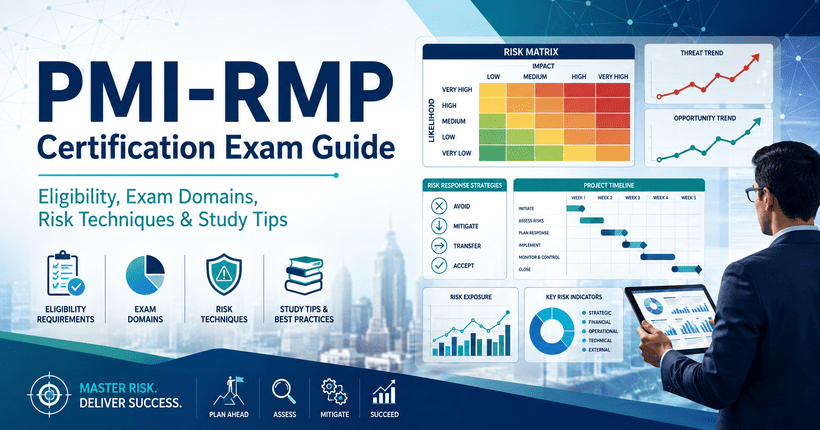
Every project contains uncertainty. A supplier may miss a delivery date, a technical assumption may prove wrong, a regulatory change may increase costs, or an unexpected opportunity may allow a team to finish earlier than planned. The difference between an experienced project professional and an inexperienced one is often not whether these events occur, but how effectively they are anticipated and managed.
This is where the PMI Risk Management Professional (PMI-RMP)® certification becomes particularly relevant.
Offered by the Project Management Institute (PMI), the PMI-RMP certification is designed for professionals who specialize in identifying, analyzing, responding to, and monitoring project risks. Unlike broader project management certifications, PMI-RMP focuses deeply on uncertainty and the decisions project teams make when outcomes cannot be predicted with complete confidence.
If you are considering a career in project management, risk management, PMO operations, consulting, engineering, construction, IT, finance, or other project-driven environments, understanding PMI-RMP can also improve the way you think about projects—even before you become eligible to take the exam.
What Is the PMI-RMP Certification?
Table of Contents
TogglePMI-RMP stands for PMI Risk Management Professional. It is a specialized PMI certification intended to demonstrate professional competence in project risk management.
Risk management is sometimes misunderstood as simply creating a list of things that could go wrong. Professional risk management goes much further. It requires practitioners to understand the organization’s risk appetite, identify threats and opportunities, evaluate probability and impact, quantify uncertainty where appropriate, design responses, assign ownership, communicate with stakeholders, and continually monitor whether the project’s risk exposure has changed.
The PMI-RMP certification exam therefore tests much more than terminology. It evaluates whether candidates can apply risk management principles to realistic project situations and make appropriate decisions.
The certification is particularly relevant to professionals working as:
- Project Managers
- Project Risk Managers
- Risk Analysts
- Program Managers
- PMO Professionals
- Project Controls Specialists
- Cost and Schedule Analysts
- Engineering Project Managers
- Construction Project Professionals
- IT and Digital Transformation Project Managers
- Consultants
- Functional Managers involved in project delivery
It can also complement broader credentials such as PMP® by demonstrating deeper specialization in one of the most important areas of project decision-making.
PMI-RMP Exam at a Glance
| Certification | PMI Risk Management Professional (PMI-RMP)® |
| Exam Code | PMI-RMP |
| Exam Questions | 115 questions |
| Scored Questions | 100 |
| Unscored Pretest Questions | 15 |
| Exam Duration | 150 minutes |
| Question Formats | Multiple-choice and multiple-answer selection |
| Exam Languages | English, Arabic, Chinese (Simplified) |
| Testing Options | Pearson VUE testing center or online-proctored testing |
| Certification Renewal Cycle | 3 years |
| PDUs Required for Renewal | 30 PDUs per 3-year cycle |
One detail candidates should understand is that the 15 pretest questions are not scored. They are used to evaluate potential future examination questions and are mixed throughout the exam, so candidates cannot identify them during the test. The best approach is therefore to treat every question seriously.
Candidates who are building a study plan can also review the dedicated PMI-RMP exam preparation page alongside the official PMI exam objectives.
PMI-RMP Eligibility Requirements
PMI-RMP is not intended to be an entry-level certification. PMI requires candidates to demonstrate both formal education and practical project risk management experience.
The PMI-RMP certification currently provides three main eligibility routes.
Set A: Secondary Education
- High school or secondary school diploma, or global equivalent
- At least 36 months of project risk management experience within the previous five years
- 40 hours of project risk management education
Set B: Bachelor’s Degree or Higher
- Bachelor’s degree or higher, or global equivalent
- At least 24 months of project risk management experience within the previous five years
- 30 hours of project risk management education
Set C: GAC-Accredited Degree
- Bachelor’s degree or higher from a PMI Global Accreditation Center (GAC) accredited program
- At least 12 months of project risk management experience within the previous five years
- 30 hours of project risk management education
An important point for applicants is that PMI is interested in your actual risk management responsibilities rather than simply your job title. You do not necessarily need to have been called a “Risk Manager.” A project manager, project controls specialist, engineer, consultant, or business professional may accumulate relevant experience by performing substantial project risk management activities.
When completing your application, describe what you did: identifying risks, facilitating risk workshops, conducting analysis, developing responses, monitoring exposure, reporting risk information, or supporting risk-related decisions.
Understanding the Five PMI-RMP Exam Domains
The PMI-RMP exam is organized around five major domains. These percentages are important because they show where candidates should concentrate their preparation.
| PMI-RMP Exam Domain | Percentage |
|---|---|
| Risk Strategy and Planning | 22% |
| Risk Identification | 23% |
| Risk Analysis | 23% |
| Risk Response | 13% |
| Monitor and Close Risks | 19% |
Another point worth noticing is that PMI does not limit the certification to traditional predictive project management. Predictive, agile, and hybrid approaches may appear throughout all five domains.
Domain 1: Risk Strategy and Planning – 22%
Effective risk management begins before individual risks are entered into a register. The project team first needs to understand the environment in which risk decisions will be made.
This domain covers subjects such as:
- Analyzing project and organizational documents
- Understanding environmental factors
- Assessing organizational risk culture
- Determining risk appetite and thresholds
- Identifying relevant stakeholders
- Creating a risk management strategy
- Defining risk categories
- Establishing risk metrics and reporting requirements
- Planning communication and stakeholder engagement
For beginners, the most important lesson is that a risk cannot be evaluated in isolation. A $100,000 exposure could be insignificant for one organization and unacceptable for another. Risk decisions must therefore be connected to business objectives and organizational tolerance for uncertainty.
Domain 2: Risk Identification – 23%
Risk identification is one of the highest-weighted PMI-RMP exam areas.
The objective is not simply to create the longest possible risk list. Good risk identification aims to find meaningful uncertainty early enough for the project team to take action.
Common techniques include:
- Brainstorming
- Expert interviews
- Workshops
- Checklists
- Lessons learned
- SWOT analysis
- PESTLE analysis
- Root cause analysis
- Assumption analysis
- Prompt lists
- Risk Breakdown Structures (RBS)
- Document analysis
- Stakeholder analysis
A useful way to describe a risk is with a clear cause-event-effect structure. Instead of writing something vague such as “supplier risk,” a stronger description might be:
Because the selected component is produced by a single overseas supplier, there is a possibility that customs or production delays may occur, which could postpone system integration and affect the planned launch date.
This type of description makes later analysis and response planning much easier.
Domain 3: Risk Analysis – 23%
Finding risks is only the beginning. Project teams must determine which risks actually deserve management attention.
This domain covers both qualitative and quantitative risk analysis.
Qualitative Risk Analysis
Qualitative analysis is used to prioritize risks using factors such as:
- Probability
- Impact
- Urgency
- Proximity
- Manageability
- Detectability
- Strategic importance
One of the best-known tools is the probability-impact matrix. Risks with a high probability and high potential impact normally require greater attention than low-probability, low-impact risks.
However, experienced risk managers know that simple scoring is not enough. A low-probability event capable of threatening regulatory approval, public safety, or the survival of a project may still require executive attention.
Quantitative Risk Analysis
Quantitative analysis attempts to express uncertainty numerically. Candidates preparing for the PMI-RMP exam should understand the purpose and interpretation of common techniques rather than memorizing formulas without context.
Important methods include:
- Monte Carlo simulation
- Expected Monetary Value (EMV)
- Decision tree analysis
- Sensitivity analysis
- Tornado diagrams
- Probability distributions
- Schedule risk analysis
- Cost risk analysis
- Contingency modeling
For example, Monte Carlo simulation does not simply produce a single completion date. It can generate a probability distribution showing the likelihood of achieving different dates or cost targets. This gives decision-makers a much more realistic picture than relying exclusively on one deterministic estimate.
Expected Monetary Value: A Concept Worth Understanding
Expected Monetary Value is a basic quantitative concept that frequently appears in project risk discussions.
The simplified calculation is:
EMV = Probability × Financial Impact
Suppose a project has a 30% probability of experiencing an equipment failure that would cost $100,000.
The expected monetary exposure is:
0.30 × $100,000 = $30,000
This does not mean the project will actually lose $30,000. The real outcome might be zero or the full $100,000. EMV provides a statistical basis that can help with decision analysis and contingency planning across uncertain outcomes.
Domain 4: Risk Response – 13%
Risk analysis has little value if no one acts on the results.
Risk response planning asks a practical question: What are we going to do about this risk?
For threats, common response strategies include:
- Avoid – eliminate the threat or its cause
- Mitigate – reduce its probability or impact
- Transfer – shift responsibility for some consequences to another party
- Accept – acknowledge the risk without taking proactive action beyond agreed contingency arrangements
- Escalate – move the issue to a level with the authority and responsibility to manage it
Opportunities require a different mindset. Positive uncertainty can create additional project value.
Common opportunity strategies include:
- Exploit
- Enhance
- Share
- Accept
- Escalate
This distinction is important. Professional risk management is not only about preventing failure. It is also about increasing the probability that favorable events will occur.
Primary, Residual, and Secondary Risks
One area that often causes confusion for new candidates is the relationship between the original risk and the consequences of a risk response.
A residual risk is the uncertainty that remains after a response has been implemented.
A secondary risk, by contrast, is a new risk created as a direct result of implementing a response.
Imagine that a project transfers a technical component to an external specialist to reduce internal development risk. This may reduce the original technical risk but create new supplier dependency or cybersecurity risks. Those newly introduced uncertainties are secondary risks.
The PMI-RMP mindset is therefore iterative: implementing a response does not mean risk management is finished.
Domain 5: Monitor and Close Risks – 19%
Projects change constantly. A risk rated as minor three months ago may become critical today, while another risk may no longer be relevant.
Monitoring therefore includes activities such as:
- Tracking identified risks
- Reviewing risk triggers
- Analyzing project performance data
- Evaluating response effectiveness
- Identifying emerging risks
- Monitoring residual and secondary risks
- Updating the risk register
- Reporting overall project risk exposure
- Closing expired or no-longer-relevant risks
- Capturing lessons learned
This is one reason risk registers should never become static documents that are created during planning and forgotten. Useful risk information has to remain current enough to support decisions.
Risk Appetite, Tolerance, and Thresholds
These concepts are related, and candidates sometimes use them interchangeably when they should not.
Risk appetite describes the general level of uncertainty an organization is willing to pursue or retain in pursuit of objectives.
Risk tolerance provides a more practical view of the acceptable degree of variation around objectives.
Risk thresholds establish measurable boundaries at which exposure becomes unacceptable or requires specific action.
For example, an organization may be relatively tolerant of minor schedule experimentation but have almost no appetite for regulatory, information-security, or safety risks.
PMI-RMP candidates should become comfortable interpreting risk decisions from the organization’s perspective rather than automatically selecting the most conservative possible response.
The Risk Register Is Important, but It Is Not the Entire Risk Process
The risk register is one of the most recognizable project risk management artifacts. Depending on the organization, it may contain information including:
- Risk ID
- Risk description
- Cause
- Potential impact
- Category
- Probability
- Impact
- Priority
- Risk owner
- Response strategy
- Response actions
- Trigger conditions
- Residual risk
- Current status
But the exam is unlikely to reward candidates who think of risk management as spreadsheet maintenance. The real purpose of the register is to support decisions, ownership, communication, and action.
Contingency Reserve vs. Management Reserve
Another useful distinction concerns reserves.
Contingency reserves are generally associated with identified uncertainty that has been analyzed and for which the project has deliberately made provision.
Management reserves are intended for uncertainty that is not included within the project’s established contingency assumptions and typically requires management-level control.
Rather than memorizing these definitions in isolation, think about governance: who controls the money or schedule allowance, what uncertainty is being addressed, and under what conditions it may be used?
How Risk Management Changes in Agile and Hybrid Projects
A common mistake is assuming that formal risk management belongs only to predictive or waterfall projects.
Agile projects still face uncertainty. They simply manage some of it through shorter feedback loops, incremental delivery, frequent reprioritization, experimentation, and continuous stakeholder interaction.
Examples of agile risk management practices may include:
- Reducing technical uncertainty with prototypes or spikes
- Delivering high-risk features earlier
- Reviewing emerging risks during iteration planning
- Using frequent demonstrations to reduce requirements uncertainty
- Reprioritizing the backlog when risk exposure changes
- Using retrospectives to identify recurring sources of uncertainty
Hybrid environments introduce another challenge: different parts of the same initiative may use different delivery methods. A physical infrastructure component might follow predictive planning while software development operates iteratively.
Risk professionals therefore need to adapt techniques instead of forcing one methodology onto every project.
Is the PMI-RMP Exam Difficult?
The PMI-RMP exam should not be treated as a simple memorization test.
Knowing terminology is necessary, but professional judgment matters more. Candidates need to understand why a technique is appropriate, what information is required before making a decision, who should own an action, and what should happen next in a risk management scenario.
A question may provide several answers that appear reasonable. The challenge is identifying the response that best follows disciplined risk management practice.
This makes practical experience valuable. Someone who has facilitated risk workshops, challenged project assumptions, maintained risk information, performed analysis, and discussed uncertainty with stakeholders will normally understand the context behind the terminology more easily.
How to Prepare for the PMI-RMP Exam
A strong preparation strategy should begin with the official PMI-RMP Examination Content Outline (ECO). The ECO is effectively the blueprint for what the examination is designed to assess.
Do not make the mistake of selecting one project management book and assuming that memorizing it will be enough. PMI explicitly treats PMI-RMP as a competency-based certification, and the exam is not built around a single reference text.
Alongside official PMI materials, candidates may use a structured PMI-RMP exam study resource to organize domain review and identify areas that require additional attention.
1. Start With the Exam Content Outline
Read every domain, task, and enabler in the ECO. Use it as a checklist to identify weaknesses.
If you cannot comfortably explain a particular task without reading your notes, that subject deserves additional study.
2. Build Strong Risk Management Fundamentals
Before attempting large numbers of practice questions, make sure you understand concepts such as:
- Individual risk versus overall project risk
- Threats and opportunities
- Risk appetite
- Risk thresholds
- Risk ownership
- Risk registers
- Risk Breakdown Structures
- Qualitative risk analysis
- Quantitative risk analysis
- Probability-impact matrices
- Monte Carlo simulation
- Expected Monetary Value
- Decision trees
- Sensitivity analysis
- Contingency planning
- Fallback planning
- Residual risks
- Secondary risks
- Risk audits
- Risk reporting
3. Use PMI’s Current Risk Management Guidance
PMI’s Risk Management in Portfolios, Programs, and Projects: A Practice Guide is particularly useful because it provides practical guidance on applying risk management principles, processes, tools, and techniques.
The PMBOK® Guide can also provide important project management context, but candidates should keep the examination content outline at the center of their study plan.
4. Practice Scenario-Based Decision Making
When answering a practice question, avoid asking only, “Which definition matches this sentence?”
Instead ask:
- What stage of the risk management process are we in?
- What information is already available?
- What information is missing?
- Has this uncertainty occurred yet?
- Who owns the risk?
- Who has decision authority?
- What should the risk professional do first?
- Would this action prevent, analyze, respond to, or monitor the risk?
This style of reasoning is much more valuable than memorizing isolated answers.
5. Review Every Incorrect Practice Question
A practice exam is useful only if you learn from it.
For every incorrect question, determine whether the error came from:
- A knowledge gap
- Misreading the scenario
- Confusing two similar concepts
- Applying the wrong process
- Choosing an action too early
- Ignoring stakeholder or organizational context
- Poor time management
Keeping a small error log can reveal patterns surprisingly quickly.
A Practical 8-Week PMI-RMP Study Plan
The amount of preparation time required depends heavily on your existing experience, but an eight-week structure can provide a useful starting point for PMI-RMP exam preparation.
Weeks 1–2: Risk Strategy and Foundations
- Read the PMI-RMP ECO
- Study organizational risk appetite and thresholds
- Review stakeholder analysis
- Understand the risk management plan
- Study risk categories and governance
Weeks 3–4: Identification and Qualitative Analysis
- Practice risk identification techniques
- Study risk statements and root causes
- Review probability-impact matrices
- Practice prioritizing risks
- Understand risk ownership
Week 5: Quantitative Risk Analysis
- Review EMV calculations
- Study decision trees
- Understand Monte Carlo simulation
- Review sensitivity analysis
- Study cost and schedule uncertainty
Week 6: Risk Responses
- Review threat response strategies
- Review opportunity response strategies
- Study contingency and fallback responses
- Understand secondary and residual risks
Week 7: Monitoring and Agile/Hybrid Risk
- Review risk monitoring techniques
- Study risk reporting
- Review risk audits and performance information
- Practice agile and hybrid scenarios
Week 8: Mock Exams and Final Review
- Complete timed practice exams
- Analyze incorrect answers
- Review weak ECO tasks
- Practice completing questions under time pressure
- Avoid learning large amounts of completely new material immediately before exam day
PMI-RMP Exam Time Management
With 115 questions and 150 minutes, candidates have roughly 78 seconds per question on average.
That does not mean every question should receive exactly the same amount of time. Some questions may be answered quickly, while calculations or complex scenarios can require longer analysis.
A practical strategy is to answer straightforward questions efficiently and avoid allowing one difficult question to consume several minutes.
The current PMI-RMP examination structure also provides an optional 10-minute break after the first exam section, around the midpoint of the examination. Once that section has been completed and reviewed and the break begins, candidates cannot return to questions in the previous section.
Therefore, review flagged questions before ending the first section.
Common PMI-RMP Preparation Mistakes
Memorizing Definitions Without Understanding Context
Risk management terminology is important, but the certification assesses whether you can use that knowledge appropriately.
Focusing Only on Negative Risks
PMI treats risk as uncertainty that can include both threats and opportunities. Candidates should understand strategies for both.
Ignoring Stakeholder Behavior
Risk management is not purely mathematical. Stakeholder expectations, organizational culture, risk appetite, communication, and governance strongly influence risk decisions.
Treating the Risk Register as a Static Document
Projects evolve, so risk information must evolve with them.
Ignoring Agile and Hybrid Environments
Predictive, agile, and hybrid approaches may appear throughout the PMI-RMP examination domains.
Doing Practice Questions Without Reviewing Mistakes
Completing a large number of questions is less useful than completing fewer questions while carefully understanding why each answer is correct or incorrect.
What Makes PMI-RMP Valuable?
PMI-RMP is a specialist credential rather than a general introduction to project management. That specialization is its main advantage.
Large and complex projects frequently operate under significant uncertainty involving suppliers, technology, contracts, schedule dependencies, cost escalation, cybersecurity, regulation, resources, market conditions, and stakeholder expectations.
Organizations therefore need professionals who can move beyond reactive problem solving and create a structured approach to uncertainty.
The knowledge behind the PMI Risk Management Professional certification can be particularly relevant in industries such as:
- Construction
- Engineering
- Information Technology
- Telecommunications
- Energy
- Financial Services
- Healthcare
- Government
- Infrastructure
- Manufacturing
- Consulting
- Digital Transformation
Even when a position does not explicitly require PMI-RMP, the underlying skills—risk analysis, uncertainty modeling, stakeholder communication, contingency planning, and decision-making—are highly transferable.
PMI-RMP vs. PMP: Which One Should You Choose?
PMP® and PMI-RMP® serve different purposes.
PMP validates broad project leadership and management competence across a wide range of project responsibilities.
PMI-RMP goes deeper into project risk management.
| Area | PMP | PMI-RMP |
|---|---|---|
| Primary Focus | Overall project management and leadership | Project risk management |
| Scope | Broad | Specialized |
| Risk Management Depth | Part of overall project management | Core focus of the certification |
| Best Suited For | Project leaders and managers | Risk specialists and project professionals with significant risk responsibilities |
For many professionals, the certifications are complementary rather than competing alternatives. A project manager may first establish broad project management expertise and later add PMI-RMP to demonstrate deeper risk specialization.
Maintaining Your PMI-RMP Certification
Passing the examination is not the end of the certification journey.
PMI-RMP holders currently need to earn 30 Professional Development Units (PDUs) during each three-year certification cycle to maintain the credential.
PDUs can come from eligible professional development activities such as learning, teaching, presenting, reading, volunteering, and creating professional content, subject to PMI’s current Continuing Certification Requirements.
This continuing education requirement reflects an important reality: risk management practice changes as project environments, technologies, regulations, and business models evolve.
Frequently Asked Questions About PMI-RMP
What does PMI-RMP stand for?
PMI-RMP stands for PMI Risk Management Professional. It is a specialized professional certification offered by the Project Management Institute.
What is the PMI-RMP exam code?
The certification and exam are commonly identified as PMI-RMP.
How many questions are on the PMI-RMP exam?
The current PMI-RMP exam contains 115 questions, including 100 scored questions and 15 unscored pretest questions.
How long is the PMI-RMP exam?
Candidates currently receive 150 minutes to complete the examination.
What languages are available for the PMI-RMP exam?
The current exam is offered in English, Arabic, and Simplified Chinese.
Do I need a PMP before taking PMI-RMP?
The published PMI-RMP eligibility requirements do not require candidates to hold PMP certification. Candidates must instead satisfy the applicable education, project risk management experience, and risk management training requirements.
Is PMI-RMP only for Risk Managers?
No. Professionals with other titles may qualify if their work includes sufficient professional project risk management experience. Project managers, engineers, consultants, PMO professionals, and project controls specialists are common examples of roles that may involve substantial risk responsibilities.
Does the PMI-RMP exam include agile project management?
Yes. PMI’s examination content outline states that predictive, agile, and hybrid approaches can appear throughout the five PMI-RMP exam domains.
Is PMI-RMP harder than PMP?
The two certifications test different scopes of competence, so a direct difficulty comparison is not particularly useful. PMP covers project management broadly, while PMI-RMP examines project risk management in considerably greater depth. Candidates with extensive risk experience may find PMI-RMP concepts familiar, while those with limited exposure to formal risk analysis may need more preparation.
How many PDUs are required to maintain PMI-RMP?
PMI-RMP holders currently need 30 PDUs during every three-year certification cycle.
Final Thoughts
The PMI Risk Management Professional (PMI-RMP) certification is best understood not as a certification about predicting the future, but as a credential about making better decisions when the future cannot be predicted perfectly.
Strong risk professionals help project teams recognize uncertainty early, distinguish important risks from background noise, analyze exposure intelligently, select practical responses, communicate clearly with stakeholders, and continually adjust as conditions change.
For students and early-career project professionals, you may not yet satisfy the PMI-RMP experience requirements. That does not make the material irrelevant. Learning risk identification, probability and impact analysis, decision trees, Monte Carlo concepts, risk response planning, stakeholder risk communication, and risk monitoring can immediately improve your understanding of professional project management.
For experienced practitioners who already manage significant project uncertainty, PMI-RMP provides a structured way to validate that specialization.
If you decide to pursue the certification, use the current PMI-RMP Examination Content Outline as the foundation of your preparation. Understand the concepts rather than simply memorizing them, practice applying them to realistic project situations, and pay particular attention to the relationship between organizational objectives, stakeholder expectations, and risk decisions.
For additional study support, you can also visit our PMI-RMP certification exam resource page while preparing for the exam.
Risk can never be completely removed from projects. The real professional skill is learning how to understand it, communicate it, and make informed decisions because of it.