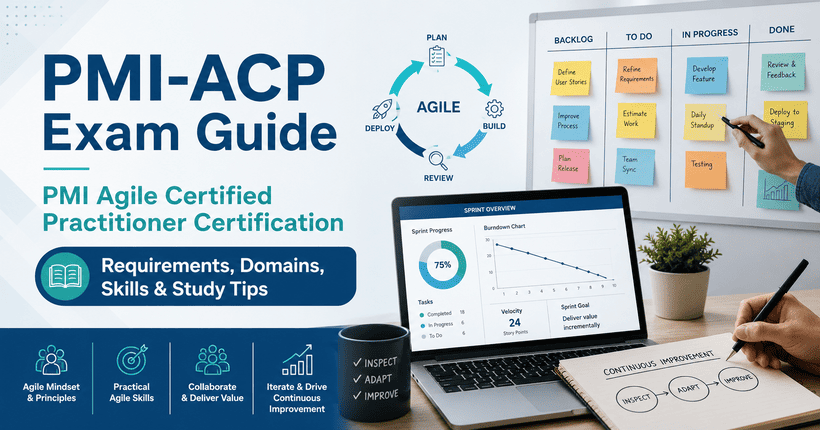
The PMI Agile Certified Practitioner (PMI-ACP)® certification is designed for professionals who work with Agile teams, products, projects, and organizations. Rather than concentrating on a single framework such as Scrum, the certification evaluates whether a practitioner can apply Agile principles across different approaches, including Scrum, Kanban, Lean, iterative delivery, product development, and hybrid environments.
That framework-neutral approach is one of the main reasons the PMI-ACP certification continues to attract project managers, Scrum Masters, product owners, Agile team leaders, developers, Agile coaches, and professionals moving from traditional project management into adaptive delivery.
The certification is not simply an Agile terminology test. The modern PMI-ACP exam places considerable emphasis on mindset, leadership, product value, delivery flow, collaboration, feedback, and practical decision-making. Candidates are expected to understand not only what an Agile practice is, but also when and why it should be used.
This guide explains the current PMI-ACP exam structure, eligibility requirements, exam domains, important Agile techniques, certification value, and a practical preparation strategy for candidates planning to take the exam.
Table of Contents
Table of Contents
Toggle- What Is the PMI-ACP Certification?
- Is PMI-ACP Worth It?
- Who Should Consider PMI-ACP?
- PMI-ACP Exam Overview
- PMI-ACP Certification Requirements
- PMI-ACP Exam Domains
- Agile Methods and Techniques You Should Know
- How Difficult Is the PMI-ACP Exam?
- How to Prepare for the PMI-ACP Exam
- PMI-ACP Exam-Day Strategy
- PMI-ACP vs. PMP
- Maintaining the PMI-ACP Certification
- PMI-ACP FAQ
What Is the PMI Agile Certified Practitioner (PMI-ACP)® Certification?
The PMI Agile Certified Practitioner (PMI-ACP)® is a professional certification offered by the Project Management Institute (PMI). Its purpose is to validate a practitioner’s ability to work effectively in Agile environments and apply Agile principles across multiple frameworks and methodologies.
This distinction is important. Some Agile certifications are closely associated with a particular framework or role. PMI-ACP takes a broader view. Candidates may encounter concepts associated with:
- Scrum
- Kanban
- Lean product development
- Iterative and incremental delivery
- Continuous improvement
- Agile product management
- Value-based prioritization
- Adaptive planning
- Agile leadership
- Enterprise agility
- Hybrid delivery approaches
The current examination also extends beyond team-level practices. PMI expects Agile practitioners to understand how teams connect their work with organizational priorities, optimize value delivery, coordinate across teams, work with stakeholders, and continuously adapt based on feedback.
For that reason, PMI-ACP is best understood as a certification of practical Agile capability, not simply knowledge of Scrum ceremonies or Agile vocabulary. Candidates who want to review the certification topics in a more exam-focused format can also explore this PMI Agile Certified Practitioner exam preparation resource.
Is the PMI-ACP Certification Worth It?
The value of PMI-ACP depends heavily on your role and career direction, but it can be particularly useful for professionals working in organizations where Agile and hybrid delivery models are becoming standard.
One of its strongest characteristics is its broad scope. Instead of teaching candidates that one Agile framework is always the correct answer, PMI-ACP emphasizes selecting and tailoring practices according to context.
This can make the certification relevant in industries and environments where teams do not follow a textbook implementation of Scrum.
1. It Demonstrates Knowledge Beyond a Single Agile Framework
A practitioner may use Scrum for iteration planning, Kanban principles to control work in progress, Lean techniques to remove waste, and product discovery methods to validate customer needs. PMI-ACP recognizes this type of mixed and adaptive environment.
This broader perspective is increasingly valuable because real-world Agile organizations rarely operate exactly according to one framework.
2. It Connects Agile Practices With Business Value
The exam does not treat delivery velocity as the ultimate objective. Agile teams should produce meaningful outcomes and customer value.
Candidates therefore need to understand concepts such as:
- Minimum viable product (MVP)
- Minimum marketable feature (MMF)
- Customer feedback
- Value-based prioritization
- Return on investment
- Product vision
- Roadmaps
- Incremental delivery
- Outcome measurement
This makes PMI-ACP relevant not only to project managers but also to product-oriented professionals.
3. It Strengthens Agile Leadership Skills
Agile leadership is quite different from traditional command-and-control management. A good Agile leader creates conditions in which the team can make decisions, experiment, learn, resolve problems, and continuously improve.
The PMI-ACP exam therefore places substantial emphasis on coaching, facilitation, collaboration, psychological safety, conflict resolution, knowledge sharing, and team development.
4. It Complements Traditional Project Management Experience
Many experienced project professionals now work in hybrid environments rather than purely predictive or purely Agile environments.
A professional who already understands scope, risk, stakeholders, schedules, budgets, and governance may use PMI-ACP to deepen his or her understanding of adaptive planning, incremental delivery, feedback loops, experimentation, and self-managing teams.
5. It Is an Experience-Oriented Certification
PMI-ACP has professional experience requirements. This matters because the certification is intended to validate the ability to apply Agile concepts in real working environments rather than simply memorize definitions.
For employers, that distinction can make the credential more meaningful when evaluating candidates for Agile delivery and leadership roles.
Who Should Consider the PMI-ACP Certification?
PMI identifies several roles that can benefit from the certification. In practice, PMI-ACP can be especially relevant for:
- Project managers working with Agile or hybrid teams
- Scrum Masters
- Product owners
- Product managers
- Agile team leaders
- Agile coaches
- Software development professionals
- Business analysts
- Delivery managers
- Program or project professionals transitioning to Agile
Students and project management beginners can also benefit from studying PMI-ACP concepts because the syllabus provides a useful overview of modern Agile management. However, the certification itself includes professional experience requirements, so candidates without practical Agile experience may need to treat PMI-ACP as a medium-term career goal rather than an immediate first certification.
PMI-ACP Exam Overview
Understanding the PMI-ACP exam structure and preparation topics before beginning your studies can help you allocate your preparation time more effectively.
According to the current PMI examination information, the PMI-ACP exam uses the following structure:
| Exam Item | Current PMI-ACP Information |
|---|---|
| Certification | PMI Agile Certified Practitioner (PMI-ACP)® |
| Exam / Credential Code | PMI-ACP |
| Total Questions | 120 |
| Scored Questions | 100 |
| Unscored Pretest Questions | 20 |
| Exam Duration | 180 minutes |
| Scheduled Break | One 10-minute break |
| Exam Delivery | Pearson VUE test center or secure online proctored exam |
| Major Domains | Mindset, Leadership, Product, Delivery |
The current PMI-ACP Examination Content Outline indicates that exam items can include traditional multiple-choice questions as well as multiple-response, drag-and-drop-style items, and exhibits.
The 20 pretest questions are not scored, but they are mixed throughout the exam and are not identified. From a candidate’s perspective, every question should therefore be treated seriously.
The 10-minute break becomes available after the first 60 questions have been completed and reviewed. Once you finish that section and begin the break, you cannot return to those earlier questions.
PMI-ACP Certification Requirements
PMI-ACP is not designed as a purely academic entry-level certification. Candidates must satisfy educational, training, and professional Agile experience requirements.
Educational Background
Candidates need at least a:
- High school diploma,
- Secondary school diploma,
- GED, or
- Global equivalent.
Formal Agile Training
Candidates need 21 hours of formal training in Agile practices, frameworks, and methodologies before submitting the certification application.
The training should address relevant Agile subjects such as Agile mindset, leadership, team collaboration, value delivery, Agile metrics, frameworks, tools, and techniques.
Professional Agile Experience
Candidates must meet one of the accepted Agile experience pathways.
- Path 1: Two years of Agile experience within the past five years.
- Path 2: One year of Agile experience plus a degree from a Global Accreditation Center (GAC) accredited program.
- Path 3: One year of Agile experience plus a qualifying active third-party Agile certification.
- Path 4: Hold an active PMP® certification.
For candidates using a third-party Agile certification toward the requirement, PMI’s current Examination Content Outline provides additional conditions concerning the status and age of that certification, so applicants should verify the latest eligibility rules before submitting their application.
Important: PMI can revise certification policies. Always confirm the latest eligibility details on the official PMI website before applying.
PMI-ACP Exam Domains
The modern PMI-ACP exam is divided into four domains. Understanding their relative weighting is important when building a study plan.
| Domain | Percentage of Exam |
|---|---|
| Domain I: Mindset | 28% |
| Domain II: Leadership | 25% |
| Domain III: Product | 19% |
| Domain IV: Delivery | 28% |
These four areas should also form the foundation of your PMI-ACP study and exam preparation, because successful candidates need to connect Agile knowledge with realistic workplace scenarios.
Domain I: Mindset – 28%
The Mindset domain is fundamental because Agile is not simply a collection of ceremonies and tools. Candidates need to understand the principles behind adaptive ways of working.
Important topics include:
- Experimenting early
- Applying Agile values and principles
- Understanding complexity
- Creating collaborative environments
- Building transparency
- Psychological safety
- Shortening feedback loops
- Responding to change
- Continuous learning
- Inter-team collaboration
A common exam pattern is to present a team with uncertainty and ask what the Agile practitioner should do next. The best answer is often the action that produces learning quickly without unnecessarily committing large amounts of time or money.
That is why experiments, prototypes, spikes, MVPs, feedback, and incremental delivery are so important.
Domain II: Leadership – 25%
Leadership questions evaluate how Agile practitioners support people rather than simply control tasks.
You should understand:
- Team-centric leadership
- Coaching and mentoring
- Facilitation
- Conflict management
- Knowledge sharing
- Stakeholder collaboration
- Team empowerment
- Decision-making
- Removing impediments
- Building high-performing teams
Many beginners approach these questions with a traditional management mindset: assign work, escalate problems, tell people what to do, and tightly control execution.
That approach often conflicts with Agile principles.
The better Agile response is frequently to facilitate discussion, expose the problem, help the team understand the situation, remove organizational obstacles, and enable the people closest to the work to determine an effective solution.
Domain III: Product – 19%
The Product domain connects Agile project delivery with customer and business value.
Topics may include:
- Product vision
- Product roadmaps
- Backlog management
- User stories
- Acceptance criteria
- Minimum viable product
- Prioritization
- Customer feedback
- Value measurement
- Incremental product development
A strong candidate understands that product success is not measured by completing the largest possible number of backlog items.
The objective is to deliver the right value, obtain feedback, learn from actual outcomes, and adjust future priorities accordingly.
Domain IV: Delivery – 28%
Delivery is another heavily weighted area of the PMI-ACP exam.
This domain includes the practical mechanisms used to turn priorities into working outcomes while maintaining quality and sustainable flow.
Important areas include:
- Incremental delivery
- Iteration and release planning
- Work-in-progress limits
- Flow optimization
- Backlog refinement
- Quality practices
- Risk management
- Agile metrics
- Customer collaboration
- Continuous improvement
Expect questions that ask how a practitioner should respond when flow slows down, defects increase, requirements change, dependencies block progress, or customers are dissatisfied with the delivered result.
Important Agile Methods and Project Management Techniques for PMI-ACP
Memorizing the four domains is not enough. Successful candidates need to understand the Agile techniques behind them.
Scrum
You should be comfortable with common Scrum concepts such as:
- Product backlog
- Sprint backlog
- Product goal
- Sprint goal
- Daily Scrum
- Sprint review
- Sprint retrospective
- Increment
- Definition of Done
- Product Owner responsibilities
- Scrum Master responsibilities
However, PMI-ACP questions are usually less interested in whether you memorized a framework definition and more interested in whether you can apply Agile principles to the situation.
Kanban and Flow Management
Kanban concepts are especially useful when studying the Delivery domain.
Know how to work with:
- Visual workflow boards
- Work-in-progress limits
- Cycle time
- Lead time
- Throughput
- Bottlenecks
- Cumulative flow diagrams
- Pull systems
A critical principle is that starting more work does not necessarily mean finishing more work.
Limiting work in progress can reduce context switching, expose bottlenecks, improve focus, and help work flow through the system more predictably.
Lean Thinking
Lean principles help Agile teams identify activities that consume resources without producing meaningful customer value.
Important ideas include:
- Eliminating waste
- Optimizing flow
- Delivering value quickly
- Building quality into the process
- Continuous improvement
- Respect for people
Value stream mapping can be particularly useful when trying to identify delays, unnecessary handoffs, queues, rework, or approval bottlenecks.
Adaptive Planning
Traditional projects often try to develop detailed plans early and control deviations later. Agile planning is different.
Planning still matters, but plans are expected to evolve as the team learns more.
Candidates should understand concepts such as:
- Progressive elaboration
- Rolling-wave planning
- Iteration planning
- Release planning
- Relative estimation
- Story points
- Velocity
- Planning poker
- Affinity estimation
The important principle is that estimates are decision-support tools, not promises about an uncertain future.
Value-Based Prioritization
Not every requirement deserves equal priority.
Agile practitioners should continually ask which items will deliver the greatest value, reduce the greatest risk, or generate the most useful learning.
Useful prioritization techniques include:
- MoSCoW prioritization
- Kano analysis
- Relative ranking
- Customer-value prioritization
- ROI analysis
- Risk-adjusted backlog prioritization
MVP and Early Validation
An MVP is not simply a low-quality version of a finished product. Its purpose is to validate important assumptions with the smallest reasonable investment.
For exam questions involving high uncertainty, ask yourself:
What is the smallest experiment or increment that would allow the team to learn whether its assumption is correct?
That question reflects the Agile mindset extremely well.
Retrospectives and Continuous Improvement
Agile teams should regularly examine how they work and identify practical improvements.
Useful techniques include:
- Retrospectives
- Five Whys
- Root-cause analysis
- Fishbone diagrams
- Kaizen
- Value stream mapping
- Process experiments
The purpose of a retrospective is not to identify someone to blame. It is to improve the system in which the team works.
Agile Quality Management
Quality should not be postponed until the end of an Agile project.
Important practices can include:
- Definition of Done
- Continuous integration
- Frequent verification and validation
- Automated testing
- Exploratory testing
- Usability testing
- Early feedback
The cost of fixing a problem usually increases when feedback is delayed. Agile therefore attempts to shorten the distance between creating something and discovering whether it actually works.
Agile Risk Management
Agile does not eliminate risk management. It often manages uncertainty through early learning and incremental delivery.
Techniques worth studying include:
- Risk-adjusted backlog
- Risk burndown
- Technical spikes
- Architectural spikes
- Early prototyping
- Incremental releases
- Frequent stakeholder feedback
High-risk assumptions are often better addressed early instead of being postponed until the final stages of delivery.
How Difficult Is the PMI-ACP Exam?
PMI-ACP can be challenging, particularly for candidates who try to prepare by memorizing Agile definitions.
The difficulty comes from applying principles to situations rather than recognizing isolated facts.
A question may provide four answers that are technically possible. Your job is to identify the response most consistent with Agile values, team empowerment, value delivery, transparency, collaboration, and rapid feedback.
Common Reasons Candidates Struggle
1. Thinking Like a Traditional Command-and-Control Manager
Immediately assigning tasks, directing the team, or escalating every issue is rarely the first choice in a healthy Agile environment.
2. Treating Agile as Scrum Only
PMI-ACP covers a much broader Agile landscape. Kanban, Lean, product development, flow, leadership, value delivery, and continuous improvement matter as well.
3. Memorizing Terms Without Understanding Their Purpose
Knowing the definition of a retrospective does not help much if you cannot identify when one is needed or what the team should do with its findings.
4. Ignoring Product Value
Finishing all planned work is not automatically success. Agile teams should continually evaluate whether the work creates meaningful outcomes.
5. Failing to Practice Scenario-Based Questions
Practice questions are useful because they train the decision-making process required by the real exam. A structured set of PMI-ACP practice questions and study materials can also help candidates identify weak domains and become more familiar with scenario-based question patterns.
How to Prepare for the PMI-ACP Exam
A productive PMI-ACP exam preparation plan should combine concepts, practical application, and question practice.
Step 1: Start With the PMI-ACP Examination Content Outline
The Examination Content Outline should be the foundation of your study plan.
Do not organize your preparation entirely around a random textbook or question bank. Use the four official domains to determine what you need to learn.
Step 2: Build Strong Agile Fundamentals
Make sure you understand:
- Agile values and principles
- Incremental versus iterative development
- Empirical decision-making
- Customer collaboration
- Adaptive planning
- Continuous learning
- Feedback loops
- Self-managing teams
Step 3: Learn More Than Scrum
Study Scrum carefully, but do not stop there.
Spend meaningful time learning Kanban, Lean, flow metrics, product management, value prioritization, Agile leadership, and continuous improvement.
Step 4: Understand the Reason Behind Each Technique
Whenever you study a technique, ask four questions:
- What problem does this technique solve?
- When should it be used?
- What information does it provide?
- What should the team do with that information?
This approach produces much stronger exam readiness than simple memorization.
Step 5: Practice Scenario-Based Questions
When answering practice questions, do not simply record whether the answer was right or wrong.
Analyze why the correct answer is more Agile than the alternatives.
Look for recurring principles such as:
- Collaborate before escalating.
- Make work visible.
- Get feedback early.
- Address high-risk assumptions early.
- Deliver value incrementally.
- Enable the team rather than command it.
- Find the root cause rather than treating symptoms.
- Adapt based on evidence.
At this stage, candidates may benefit from using a dedicated PMI-ACP exam study resource alongside the official PMI materials to reinforce important concepts and practice applying them to exam-style situations.
Step 6: Take Full-Length Practice Exams
The real exam contains 120 questions and requires sustained concentration for three hours.
A full-length simulation helps you test:
- Time management
- Mental endurance
- Question interpretation
- Domain weaknesses
- Decision-making consistency
A Practical 6-Week PMI-ACP Study Schedule
| Week | Study Focus |
|---|---|
| Week 1 | Agile principles, Agile mindset, complexity, feedback, experimentation |
| Week 2 | Leadership, team development, coaching, facilitation, conflict management |
| Week 3 | Product vision, backlog, user stories, prioritization, MVP, value delivery |
| Week 4 | Scrum, Kanban, Lean, flow, metrics, quality, risk and delivery |
| Week 5 | Scenario questions, weak-topic review and mixed practice tests |
| Week 6 | Full mock exams, error review and final domain revision |
There is no universal number of study hours that guarantees success. Candidates with several years of hands-on Agile experience may need less time, while someone coming from a predictive project environment may need significantly more.
PMI-ACP Exam-Day Strategy
Watch Your Average Time Per Question
You have 180 minutes for 120 questions, which works out to an average of about 90 seconds per question.
Some questions will take much less time, giving you additional time for difficult scenarios.
Identify the Real Problem
PMI-style scenarios often contain extra information.
Before choosing an answer, determine:
- What has actually gone wrong?
- What does the team know?
- What does the team not know?
- Who should be involved?
- What action produces the fastest useful feedback?
Do Not Rush to Escalate
If the team can solve a problem collaboratively, escalation is often premature.
Escalation can be appropriate, but usually after the practitioner understands the issue and has tried the appropriate team-level response.
Prefer Evidence Over Assumptions
When uncertainty is high, a small experiment, prototype, customer conversation, spike, or incremental release can be more valuable than additional speculation.
Use the Break Strategically
The exam includes a 10-minute break after the first 60 questions. Before starting it, make sure you have reviewed that section because you cannot return to those questions afterward.
PMI-ACP vs. PMP: Which Certification Should You Choose?
PMI-ACP and PMP serve different purposes, and they should not be viewed simply as competing certifications.
| Area | PMI-ACP | PMP |
|---|---|---|
| Main Focus | Agile practices, mindset, leadership, product and adaptive delivery | Broad professional project management |
| Agile Depth | High | Part of a broader project management scope |
| Best Fit | Agile practitioners, Scrum Masters, product and Agile delivery professionals | Project managers and project leaders across different delivery environments |
| Framework Approach | Framework-neutral Agile perspective | Predictive, Agile and hybrid project management |
If your work is heavily centered on Agile teams, adaptive delivery, product development, flow, and iterative improvement, PMI-ACP may provide more specialized depth.
If your responsibilities cover broader project leadership, governance, financial considerations, stakeholder management, business environments, and multiple delivery approaches, PMP may be the more comprehensive credential.
For experienced professionals, holding both certifications can make sense because they demonstrate different but complementary capabilities.
How Do You Maintain the PMI-ACP Certification?
Passing the exam is not the end of the certification lifecycle.
PMI-ACP holders currently need to earn 30 Professional Development Units (PDUs) during each three-year certification cycle to maintain the credential.
PDUs can be earned through eligible professional development activities such as learning, teaching, presenting, reading, volunteering, and creating relevant content, subject to PMI’s current Continuing Certification Requirements rules.
This continuing education requirement reflects an important idea behind the certification itself: Agile practitioners should continue learning rather than treating certification as the final destination.
PMI-ACP Certification FAQ
How many questions are on the PMI-ACP exam?
The current PMI-ACP exam contains 120 questions. According to PMI’s current Examination Content Outline, 100 are scored and 20 are unscored pretest items.
How long is the PMI-ACP exam?
Candidates have 180 minutes, or three hours, to complete the exam.
Does the PMI-ACP exam include a break?
Yes. The current exam includes one 10-minute break after the first 60 questions have been completed and reviewed.
What are the current PMI-ACP exam domains?
The current exam consists of four domains:
- Mindset – 28%
- Leadership – 25%
- Product – 19%
- Delivery – 28%
Do I need Agile experience to earn PMI-ACP?
Yes. PMI-ACP is an experience-oriented certification. Candidates must satisfy one of PMI’s accepted Agile experience pathways in addition to the educational and formal training requirements.
How many Agile training hours are required?
The current requirement is 21 hours of formal Agile training covering Agile practices, frameworks, methodologies, tools, or related subjects.
Is PMI-ACP only about Scrum?
No. This is one of the most important things candidates should understand. PMI-ACP is framework-neutral and covers a broader range of Agile approaches and techniques, including Scrum, Kanban, Lean, product management, Agile leadership, flow optimization, adaptive planning, and continuous improvement.
Is PMI-ACP suitable for beginners?
The knowledge itself is valuable for beginners, but the certification requires professional Agile experience. Students or new project management professionals can begin learning the material now while building the practical experience needed for eligibility.
Can PMP holders apply for PMI-ACP?
An active PMP certification is currently one of PMI’s accepted pathways for satisfying the professional Agile experience portion of PMI-ACP eligibility. Candidates must still meet the other applicable PMI-ACP requirements, including education and Agile training.
Can I take the PMI-ACP exam online?
Yes. PMI currently offers the exam through both Pearson VUE testing centers and secure online proctored delivery, subject to PMI and Pearson VUE testing policies.
How should I study for PMI-ACP?
Start with the official Examination Content Outline, learn the Agile principles behind each domain, study Scrum, Kanban, Lean, product and leadership concepts, and then spend substantial time working through scenario-based practice questions. You can also review this PMI Agile Certified Practitioner (PMI-ACP) exam preparation page for additional exam-focused study support.
Final Thoughts
The PMI Agile Certified Practitioner (PMI-ACP)® certification is a strong choice for professionals who want to demonstrate practical Agile capability across multiple frameworks rather than expertise in only one methodology.
The modern exam reflects how Agile work is actually evolving. It includes team collaboration and iterative delivery, but it also asks candidates to think about organizational priorities, product outcomes, leadership, psychological safety, value, flow, experimentation, and enterprise agility.
For candidates preparing for the exam, the most important shift is moving away from memorization.
Do not study Agile as a collection of rigid rules.
Study the reasoning behind the practices.
Ask why an Agile team limits work in progress. Ask why feedback should arrive early. Ask why a leader facilitates instead of commands. Ask why a small experiment may be more valuable than a detailed long-term forecast.
Once those principles become natural, PMI-ACP scenario questions become much easier to interpret—and the knowledge becomes far more useful after the exam as well.
If you are preparing to sit for the certification, combining official PMI references with focused PMI-ACP exam preparation materials can help you review the domains systematically and identify the topics that need more attention before exam day.
Exam structures and certification requirements may change. Candidates should confirm current requirements with PMI before applying or scheduling an examination.