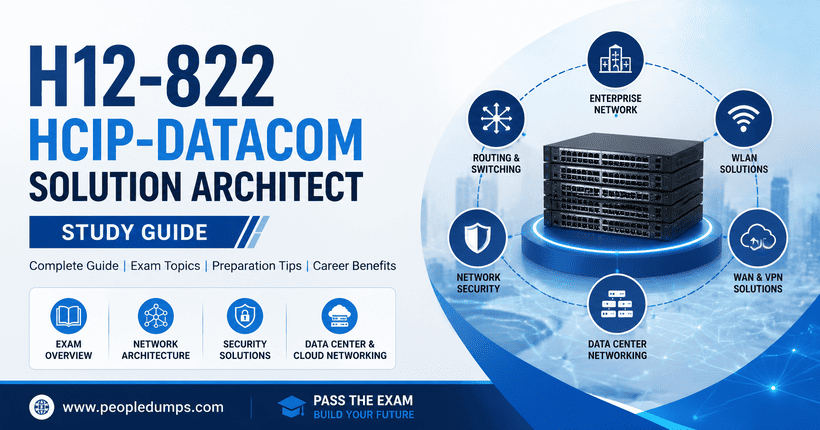
This H12-822 HCIP-Datacom Solution Architect Study Guide is designed for network engineers, students, and IT professionals preparing for Huawei’s professional-level Datacom certification. It explains the major technologies, solution architecture concepts, design principles, and preparation strategies that candidates should understand before taking the H12-822 exam.
Unlike an entry-level networking certification that concentrates mainly on individual protocols and configuration tasks, the HCIP-Datacom Solution Architect track requires candidates to look at a network as a complete system. Routing, switching, WLAN, WAN, data center networking, security, reliability, automation, and operations must all work together to support business requirements.
If you are already familiar with basic Huawei Datacom technologies and want to move from device-level configuration toward network planning and architecture, H12-822 is a logical next step. Candidates looking for structured preparation materials can also review the H12-822 HCIP-Datacom Solution Architect course alongside Huawei’s official documentation and hands-on lab practice.
What Is the HCIP-Datacom Solution Architect H12-822 Exam?
Table of Contents
ToggleThe H12-822 exam is associated with Huawei’s HCIP-Datacom Solution Architect certification direction. HCIP represents the professional level in Huawei’s career certification system and is intended for candidates who already possess networking fundamentals and want to develop more advanced solution-design skills.
The key difference between traditional network administration and solution architecture is the level at which decisions are made.
A network administrator may ask:
“How do I configure OSPF between these two routers?”
A solution architect is more likely to ask:
“Should OSPF be used here at all? What are the scalability, convergence, redundancy, security, and operational requirements of this environment?”
This shift from configuration to design is central to H12-822 preparation.
| Item | Overview |
|---|---|
| Exam Code | H12-822 |
| Certification Track | HCIP-Datacom Solution Architect |
| Vendor | Huawei |
| Certification Level | Professional / HCIP |
| Main Focus | Enterprise Datacom solution planning, architecture, technology selection, and design |
| Recommended Knowledge | Routing, switching, WLAN, WAN, VPN, data center networking, security, reliability, QoS, and network management |
Huawei periodically updates its certification portfolio, learning materials, exam policies, and technical coverage. For this reason, candidates should verify the latest H12-822 requirements through Huawei’s official certification portal before scheduling the exam.
Why Is the H12-822 Certification Valuable?
The value of the H12-822 certification is not simply that it adds another credential to a resume. Its greater value is that it encourages engineers to think about networking from an architectural perspective.
In a real enterprise, network problems are rarely limited to one protocol. A new corporate campus may involve:
- Access, aggregation, and core network design
- Layer 2 and Layer 3 boundary planning
- OSPF, IS-IS, or BGP routing
- Gateway redundancy
- WLAN coverage and capacity
- Internet access
- Firewall and security zone design
- WAN connectivity between offices
- VPN segmentation
- QoS for voice and video
- Centralized network management
- High availability and failure recovery
The individual technologies may be familiar, but combining them into a scalable and manageable solution is much more challenging.
This is why HCIP-Datacom Solution Architect knowledge can be useful for engineers interested in positions such as:
- Senior Network Engineer
- Enterprise Network Designer
- Network Solution Consultant
- Huawei Datacom Engineer
- Presales Network Engineer
- ICT Solution Architect
- Network Architect
What Makes a Good Network Solution Architect?
A strong solution architect does not automatically choose the newest or most complicated technology. The objective is to select an architecture that satisfies the technical and business requirements with an appropriate level of complexity.
A well-designed enterprise network should normally consider several major factors:
- Availability: Can the network continue operating after device or link failures?
- Scalability: Can the architecture support future users, branches, applications, and traffic?
- Performance: Can critical applications receive the bandwidth and latency characteristics they require?
- Security: Are users, devices, applications, and management systems appropriately separated and protected?
- Manageability: Can administrators monitor and troubleshoot the network efficiently?
- Cost: Does the architecture provide sufficient capability without unnecessary infrastructure?
- Simplicity: Can the solution be operated reliably without excessive configuration complexity?
These considerations should remain in mind throughout your H12-822 preparation.
Key Technologies Covered in H12-822 Preparation
A successful study plan should not treat every technology as an isolated chapter. Try to understand why each technology exists, where it is normally deployed, and how it interacts with other parts of the network.
1. Enterprise Campus Network Architecture
Campus networking is one of the foundations of enterprise network design.
A traditional enterprise campus may use access, aggregation, and core layers. Smaller networks may use a simplified two-tier model, while larger organizations may require additional segmentation, redundancy, and centralized policy control.
Important areas to understand include:
- Access, aggregation, and core architecture
- Two-tier and three-tier network designs
- Layer 2 and Layer 3 boundaries
- Gateway placement
- VLAN planning
- Network segmentation
- Redundant links and devices
- Campus network scalability
- Wired and wireless convergence
When studying campus architecture, avoid assuming that more layers always produce a better network. A smaller enterprise may benefit from a simplified architecture, while a large campus may require additional hierarchy to control failure domains and improve scalability.
2. Ethernet Switching and VLAN Technologies
Even highly advanced networks still rely on basic Ethernet technologies.
You should be comfortable with:
- Ethernet switching principles
- MAC address learning
- VLANs
- 802.1Q VLAN tagging
- Trunk links
- STP
- RSTP
- MSTP
- Eth-Trunk
- Link aggregation
For solution architecture, the key question is not simply how these technologies work. You should also understand their limitations.
Large Layer 2 domains can increase broadcast traffic and make fault isolation more difficult. For this reason, modern enterprise designs often move Layer 3 boundaries closer to the access layer where appropriate.
3. OSPF and IS-IS
Interior Gateway Protocols remain fundamental to enterprise and service-provider networking.
For H12-822, candidates should understand both OSPF and IS-IS concepts, including:
- Neighbor establishment
- Link-state operation
- Areas and hierarchy
- Route summarization
- Cost calculation
- Convergence
- Route filtering
- Network scalability
From an architecture perspective, it is important to understand why hierarchical routing designs are valuable.
A flat routing domain may work in a small network, but larger environments benefit from summarization and clearly defined routing boundaries.
4. BGP and Routing Policy
BGP is one of the most important technologies for candidates who want to move toward advanced network architecture.
BGP is commonly associated with Internet routing, but it also appears in data center fabrics, MPLS VPN environments, EVPN networks, and large enterprise architectures.
Important areas include:
- eBGP and iBGP
- BGP path selection
- Route advertisement
- Routing policies
- Prefix filtering
- Local Preference
- MED
- AS_Path
- Community attributes
- Route reflectors
- BGP scalability
For solution design questions, you should understand how policy attributes influence traffic paths rather than simply memorizing the BGP decision process.
5. IPv6 and Modern IP Networks
IPv6 is increasingly important in enterprise and service-provider environments.
Candidates should understand:
- IPv6 address structure
- IPv6 address planning
- IPv6 routing
- IPv4 and IPv6 coexistence
- Dual-stack networks
- Transition considerations
A network architect should be able to think beyond whether IPv6 connectivity works and consider how addressing, routing, security, monitoring, and operational processes change when IPv6 is introduced.
6. WLAN Planning and Design
Wireless networking is now one of the primary access methods for enterprise users.
A good WLAN solution must consider more than simply installing access points throughout a building.
Important design areas include:
- WLAN architecture
- Access point placement
- Wireless controller concepts
- SSID planning
- Radio frequency fundamentals
- 2.4 GHz, 5 GHz, and modern WLAN frequency planning
- Channel planning
- Coverage planning
- Capacity planning
- Roaming
- High-density deployment
- Wireless authentication and security
A warehouse, hotel, university, office, hospital, and stadium may all require Wi-Fi, but their design requirements can be completely different.
User density, mobility, application requirements, physical obstacles, interference, and security policies all influence the final WLAN architecture.
7. Data Center Network Architecture
Modern enterprises increasingly depend on private data centers, cloud infrastructure, and virtualized workloads.
This makes data center networking an important part of solution architecture.
Candidates should understand concepts such as:
- Leaf-spine topology
- Underlay networks
- Overlay networks
- VXLAN
- VTEP
- VNI
- EVPN
- BGP EVPN
- Distributed gateways
- East-west traffic
- Data center interconnection
Traditional VLAN-based architectures can face scalability limitations in large virtualized environments. VXLAN provides a mechanism for building large logical Layer 2 networks over an IP-based Layer 3 underlay.
EVPN can then provide a control plane for distributing endpoint and reachability information.
For H12-822 preparation, make sure you understand the relationship between:
Underlay → VTEP → VXLAN → VNI → EVPN → BGP
Understanding this architecture is generally more useful than memorizing isolated configuration commands.
8. Enterprise WAN Architecture
Organizations with multiple branches require reliable WAN connectivity.
Traditional enterprise WAN designs may use leased lines or MPLS VPN services, while modern organizations often combine multiple transport options.
Important areas include:
- Enterprise WAN architecture
- MPLS concepts
- VPN technologies
- Internet-based connectivity
- Multiple WAN links
- Branch networking
- Cloud connectivity
- SD-WAN
- Traffic steering
- WAN reliability
One major design consideration is that not every application needs the same transport path.
A business-critical ERP application might require a predictable private WAN path, while general Internet traffic could use local Internet breakout. Modern WAN solutions allow organizations to make more flexible path-selection decisions.
9. SD-WAN
SD-WAN is an important part of modern enterprise WAN design because it can simplify branch connectivity and allow organizations to use multiple types of WAN links.
A solution architect should understand concepts such as:
- Centralized WAN management
- Application identification
- Dynamic traffic steering
- Multiple transport links
- Internet breakout
- Policy-based forwarding
- Branch automation
- WAN visibility
The architectural value of SD-WAN comes from the ability to manage large numbers of branches through centralized policies rather than treating every branch router as an isolated device.
10. MPLS and VPN Technologies
MPLS remains relevant in many enterprise and carrier networks.
Candidates should understand the purpose of MPLS and how it supports VPN services and traffic separation.
Relevant concepts include:
- MPLS labels
- LSPs
- MPLS forwarding
- MPLS VPN concepts
- VPN instances
- Route Distinguisher
- Route Target
- Customer route isolation
For solution architecture, focus on why MPLS VPN can provide scalable separation for multiple customers, departments, or service environments.
11. Segment Routing and SRv6
Modern Huawei Datacom technologies increasingly include Segment Routing and Segment Routing over IPv6 (SRv6).
SRv6 can simplify some network architectures by using IPv6 addressing and segment-routing concepts to represent forwarding instructions.
Candidates should understand introductory concepts such as:
- Segment Routing
- Segment Identifiers
- SRv6
- SRv6 paths
- Traffic engineering
- Service steering
- IPv6-based transport
When studying SRv6, start by understanding the architectural purpose of the technology before attempting to memorize detailed configurations.
12. Network Reliability and High Availability
A network should not only work under normal conditions. It should continue supporting critical services when failures occur.
Important availability technologies and concepts include:
- Device redundancy
- Link redundancy
- VRRP
- Eth-Trunk
- BFD
- Fast routing convergence
- ECMP
- Backup paths
- Dual WAN links
- Failure detection
One of the most common architecture mistakes is assuming that redundant hardware automatically creates a highly available service.
Redundancy is only useful when failures can be detected and traffic can be redirected quickly enough to meet application requirements.
13. Quality of Service
Not all network traffic has equal business importance.
Voice and video applications are often sensitive to latency, jitter, and packet loss, while backup traffic may require significant bandwidth but tolerate delay.
QoS technologies allow architects to manage these differences.
Important concepts include:
- Traffic classification
- Traffic marking
- Queuing
- Scheduling
- Congestion management
- Traffic policing
- Traffic shaping
- Bandwidth allocation
An important design principle is that QoS should be considered end-to-end. Applying a traffic policy at only one point in the network may not be sufficient if congestion occurs elsewhere.
14. Network Security Architecture
Security should be integrated into the initial network design rather than added after connectivity is completed.
Relevant areas include:
- Network segmentation
- Security zones
- Access control
- Firewalls
- NAT
- VPN security
- User authentication
- Device management security
- Infrastructure protection
- Threat prevention
Different types of users and devices should not automatically receive the same level of access.
Employees, guests, administrators, IoT devices, production servers, and management platforms can have very different security requirements.
Network segmentation is therefore both an architectural and security concern.
15. Network Automation and Intelligent Operations
As networks grow, manual configuration becomes increasingly difficult to scale.
Modern enterprise architectures therefore rely more heavily on:
- Centralized management
- Automation
- APIs
- Telemetry
- Policy-based networking
- Automated service provisioning
- Centralized monitoring
- Fault analysis
Huawei’s iMaster NCE family is relevant to this broader approach to centralized network control and intelligent operations.
From an architecture perspective, the important question is not simply what a management platform can configure. Consider how centralized management can improve consistency, visibility, troubleshooting, and operational efficiency across large networks.
H12-822 HCIP-Datacom Solution Architect Study Guide and Preparation Strategy
When using this H12-822 HCIP-Datacom Solution Architect Study Guide, focus on understanding why a particular technology is selected for a business requirement rather than simply memorizing commands or definitions.
A structured preparation process is usually more effective than randomly reading different networking topics.
Step 1: Strengthen Your Datacom Fundamentals
Before studying advanced architecture, make sure you understand:
- TCP/IP
- Ethernet
- IPv4 and IPv6
- VLANs
- OSPF
- IS-IS
- BGP
- VRRP
- Routing policies
- Basic VPN technologies
If these fundamentals are weak, advanced solution design will become much harder.
Step 2: Study by Network Scenario
Instead of learning technologies in isolation, organize your study around common network environments:
- Enterprise campus
- WLAN
- Data center
- Headquarters and branches
- Enterprise WAN
- Internet edge
- Cloud connectivity
Then ask yourself which technologies would normally be used in each environment.
Step 3: Ask Why a Technology Is Used
For every technology you study, answer these questions:
- What problem does it solve?
- Where is it normally deployed?
- What alternatives exist?
- What are its advantages?
- What are its limitations?
- How does it scale?
- How does it behave during failures?
- How does it affect network security?
This approach is particularly useful for architecture-oriented exams.
Step 4: Build Networking Labs
Architecture knowledge becomes easier to understand when you have seen the protocols operating in a real or simulated environment.
Useful labs include:
- OSPF multi-area routing
- IS-IS routing
- BGP peering
- BGP route policies
- VRRP gateway redundancy
- VLAN and Eth-Trunk configuration
- IPv6 routing
- VPN scenarios
When possible, use Huawei network equipment, Huawei-compatible lab environments, or other network simulation tools to observe protocol behavior.
Step 5: Draw Network Architecture Diagrams
Take a business scenario and draw a complete architecture including:
- Access switches
- Aggregation or core switches
- Routers
- Firewalls
- WAN connections
- Branch offices
- Data centers
- Wireless controllers
- Access points
- Internet connectivity
- Management systems
Then remove one device or connection from the diagram and ask what will happen.
This simple exercise can reveal whether your design really provides the redundancy you expected.
Step 6: Use Scenario-Based Practice Questions
Practice questions can help candidates become familiar with the way technologies are tested, but they should be used as a learning tool rather than as a substitute for technical understanding.
When reviewing H12-822 study and practice resources, do not simply memorize the correct answer.
For each question, ask:
- Why is the correct option appropriate?
- Why are the other options less suitable?
- What requirement in the scenario determines the answer?
- Would the answer change if scalability or availability requirements changed?
This method develops the reasoning skills required for solution design.
How to Analyze H12-822 Architecture Questions
When you encounter a design scenario, avoid choosing an answer simply because it contains the most advanced technology.
A useful evaluation process is:
- Identify the business objective.
- Identify the current network limitations.
- Determine scalability requirements.
- Determine availability requirements.
- Identify security boundaries.
- Analyze application traffic patterns.
- Select the appropriate architecture.
- Select the required protocols.
- Design failure recovery.
- Consider operations and management.
This method helps prevent a common mistake: selecting a technically valid solution that does not actually satisfy the scenario.
Example: Designing a Multi-Branch Enterprise Network
Consider a company with one headquarters, two data centers, and 40 branch offices.
The business requirements include:
- Employees need access to applications in the data centers.
- Some applications are hosted in public cloud environments.
- Voice traffic must receive priority.
- Branch offices require backup connectivity.
- Internet traffic should not always pass through headquarters.
- Network policies should be centrally managed.
A simple answer might be to connect every branch using MPLS.
A solution architect should ask additional questions:
- Could branches use both MPLS and Internet connections?
- Would SD-WAN simplify path selection?
- Should some Internet traffic use local breakout?
- How should critical applications be identified?
- What happens when the primary WAN link fails?
- How will voice traffic be prioritized?
- How will the network be monitored?
- How will policies be distributed to all branches?
- How should cloud traffic be routed?
This is the type of broader thinking that separates solution architecture from basic network configuration.
Common H12-822 Preparation Mistakes
Memorizing Technologies Without Understanding Them
Memorization can help with terminology, but architecture questions often require you to compare multiple technically valid options.
Understanding design trade-offs is therefore more important than memorizing definitions.
Ignoring Routing Fundamentals
Advanced architecture still depends on fundamental networking knowledge.
If OSPF, IS-IS, BGP, route policies, or IPv6 are unclear, you may struggle to understand larger enterprise designs.
Focusing Only on Configuration Commands
Commands are useful, but an architecture exam is not simply a CLI test.
Understand why a technology is used before concentrating on how it is configured.
Choosing the Most Complicated Solution
A complex design is not automatically a good design.
Every additional protocol, device, and dependency introduces operational complexity.
The best architecture normally satisfies business requirements using the simplest design that provides adequate scalability, reliability, security, and performance.
Ignoring Operations and Maintenance
A network that looks impressive in a diagram but is difficult to operate can become a serious problem after deployment.
Always consider:
- Monitoring
- Logging
- Telemetry
- Configuration management
- Automation
- Troubleshooting
- Capacity planning
Who Should Take the H12-822 Exam?
The HCIP-Datacom Solution Architect H12-822 track can be particularly useful for:
- Network engineers moving into network design
- Huawei Datacom engineers
- Enterprise network administrators
- Presales engineers
- Network consultants
- ICT infrastructure engineers
- Students pursuing advanced networking careers
- Engineers preparing for network architect responsibilities
Complete beginners may find H12-822 challenging because it assumes familiarity with several networking domains. Building a solid HCIA-Datacom-level foundation first can make the learning process significantly easier.
Skills You Can Develop While Preparing for H12-822
Studying for the exam can improve practical skills that remain useful beyond the certification itself.
These include:
- Translating business requirements into technical requirements
- Designing scalable enterprise network architectures
- Selecting appropriate routing protocols
- Planning redundancy
- Designing campus networks
- Evaluating WLAN requirements
- Understanding VXLAN and EVPN architectures
- Planning enterprise WAN connectivity
- Applying QoS policies
- Planning network segmentation
- Evaluating security requirements
- Comparing architecture alternatives
- Documenting solution decisions
Frequently Asked Questions About H12-822
Is H12-822 difficult?
The difficulty depends heavily on your networking background. Candidates with experience in routing, switching, WLAN, WAN, and enterprise network design will generally find the concepts easier than complete beginners.
Is H12-822 suitable for beginners?
It is better suited to candidates who already understand networking fundamentals. Beginners should first become comfortable with TCP/IP, VLANs, OSPF, BGP, IPv4, IPv6, and common enterprise networking concepts.
Do I need hands-on experience?
Hands-on experience is strongly recommended. Architecture decisions become easier to understand when you have observed how protocols behave during normal operation and failures.
Should I memorize Huawei commands?
Command knowledge can be helpful, but it should not be the main focus of your preparation. Architecture requires understanding technologies, design choices, limitations, scalability, and operational impact.
Is BGP important for H12-822?
Yes. BGP is relevant to Internet connectivity, large enterprise networks, EVPN architectures, data centers, and many advanced routing scenarios.
Should I study VXLAN and EVPN?
Yes. VXLAN and EVPN are important concepts in modern data center architecture. Make sure you understand the roles of the underlay, overlay, VTEPs, VNIs, and BGP EVPN control plane.
Should I study SRv6?
Yes. SRv6 is relevant to modern IP transport architecture. Candidates should understand its basic principles, design objectives, and typical use cases.
How can I tell whether I am ready for the exam?
You should be able to look at a network scenario and explain not only what technology you would use, but why it is more appropriate than the alternatives.
Using a structured H12-822 preparation resource together with official Huawei materials, technical documentation, and lab practice can help identify areas that need additional study.
Final Thoughts on the H12-822 HCIP-Datacom Solution Architect Study Guide
The H12-822 HCIP-Datacom Solution Architect Study Guide is ultimately about learning how to connect individual networking technologies into complete enterprise solutions.
Routing, switching, WLAN, WAN, VXLAN, EVPN, MPLS, SRv6, QoS, security, reliability, and automation should not be viewed as completely separate subjects. In a production environment, they are different components of the same architecture.
For students and junior engineers, H12-822 can provide a useful roadmap for developing more advanced networking knowledge. For experienced network engineers, preparing for the certification can help formalize architectural principles that may previously have been learned through deployment and troubleshooting experience.
During your preparation, avoid asking only:
“Which technology is correct?”
Instead, ask:
“Why is this technology the most appropriate choice for this particular requirement?”
That question represents the transition from configuring networks to designing them.
External References and Further Reading
Use official Huawei documentation and authoritative certification resources to verify current exam requirements and deepen your understanding of the technologies discussed in this guide.
-
Huawei Career Certification
Official Huawei information about career certifications, certification levels, learning paths, and certification policies.
Huawei Career Certification Portal -
Pearson VUE – Huawei Certification
Information about Huawei certification exam registration, testing procedures, and scheduling.
Huawei Exams on Pearson VUE -
Huawei Intelligent Campus Solutions
Huawei’s official resources covering enterprise campus network architectures and intelligent campus solutions.
Huawei Intelligent Campus -
Huawei WAN Solutions
Official Huawei information covering enterprise WAN architecture, connectivity, and modern WAN technologies.
Huawei WAN Solutions -
Huawei Enterprise Support Documentation
Technical documentation for Huawei routers, switches, WLAN products, data center networking technologies, and network management platforms.
Huawei Enterprise Support