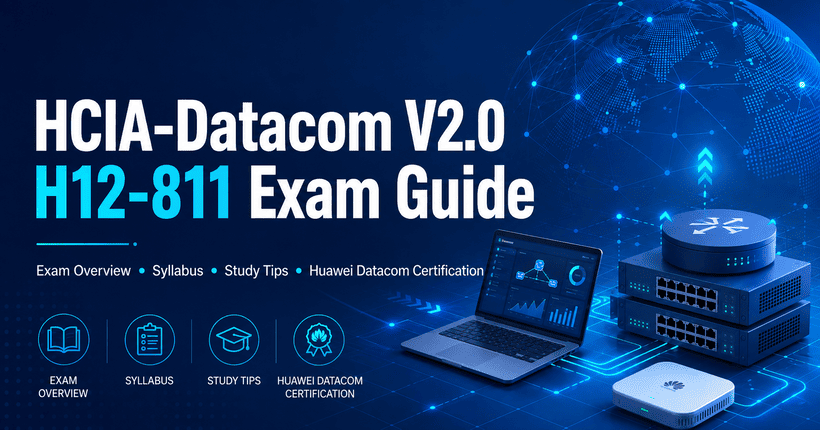
If you are learning computer networking and want to move beyond theory into real enterprise networking technologies, HCIA-Datacom H12-811 is one of the certifications worth knowing about. It is Huawei’s associate-level certification for the data communications field and is designed to establish a practical foundation in routing, switching, IP networking, WLAN, network security, operations, troubleshooting, and increasingly, network automation.
The certification is particularly relevant to students, junior network engineers, technical support engineers, NOC personnel, and anyone who works with—or expects to work with—Huawei enterprise networking equipment.
For candidates preparing in 2026, there is one important detail to understand before buying a book or starting a video course: HCIA-Datacom has moved to V2.0. You may still find a large amount of HCIA-Datacom V1.0 material online because the original H12-811 curriculum was used for several years. The current V2.0 direction introduces a reorganized exam blueprint and places more emphasis on modern network operations, troubleshooting, automation, data center networking, and campus solutions.
What Is HCIA-Datacom?
Table of Contents
ToggleHCIA stands for Huawei Certified ICT Associate. Huawei organizes its career certification system into three primary levels:
- HCIA – Huawei Certified ICT Associate: foundational and associate-level engineering skills.
- HCIP – Huawei Certified ICT Professional: deeper technical knowledge and professional-level implementation skills.
- HCIE – Huawei Certified ICT Expert: expert-level architecture, deployment, troubleshooting, and solution capabilities.
Within this certification system, Huawei HCIA-Datacom certification focuses specifically on data communication networks.
That sounds simple, but “Datacom” covers a fairly wide technical area. You are not studying only how a router chooses a route or how a switch learns a MAC address. The certification introduces the complete foundation of a modern enterprise network: Ethernet switching, IPv4 and IPv6, routing protocols, WLAN, access control, network services, device management, automation, troubleshooting, and campus network architecture.
This makes HCIA-Datacom a logical starting point for somebody who eventually wants to become a Huawei network engineer or continue toward HCIP-Datacom and HCIE-Datacom.
HCIA-Datacom H12-811 Exam Overview
| Item | Details |
|---|---|
| Certification | Huawei Certified ICT Associate – Datacom |
| Exam Family | H12-811 |
| Current Study Direction | HCIA-Datacom V2.0 |
| Certification Level | Associate / HCIA |
| Exam Duration | 90 minutes |
| Passing Score | 600 out of 1000 |
| Typical Exam Fee | US$200; regional pricing and taxes should be confirmed before booking |
| Exam Delivery | Pearson VUE / Huawei certification examination system |
| Prerequisites | No formal prerequisite; basic IT and networking knowledge is strongly recommended |
| Certification Validity | Huawei HCIA certifications have generally been valid for three years; check the latest recertification policy |
The examination is a written computer-based test. Current V2.0 examination information includes question formats such as single-answer questions, multiple-answer questions, true-or-false questions, short-response items, and drag-and-drop items. The exact combination can change, so memorizing an assumed number of questions is less useful than understanding the official exam objectives.
Before beginning serious preparation, it is useful to review a structured H12-811 study guide and exam preparation resource alongside Huawei’s current exam objectives. A useful rule for certification exams is simple: trust the current exam outline more than an old study guide.
HCIA-Datacom V2.0 Exam Topics and Weighting
The V2.0 blueprint is easier to understand if we divide it into eight technical domains:
| Exam Domain | Approximate Weight |
|---|---|
| Data Communication Network Basics | 10% |
| Ethernet Technology Basics | 20% |
| IP Technology Basics | 25% |
| Network Security and Services | 15% |
| Data Center Network Basics | 5% |
| WLAN Technology Basics | 10% |
| Network O&M and Troubleshooting | 10% |
| Typical Campus Networking Solution | 5% |
The percentages tell us something important. IP technology, Ethernet, and security/network services account for roughly 60% of the curriculum. Those areas should therefore form the core of your preparation.
However, do not interpret the smaller domains as optional. Concepts such as WLAN, NETCONF, troubleshooting, IPv6, and campus architecture often connect with larger topics in scenario-based questions.
1. Data Communication and Network Fundamentals
Before configuring anything, you need to understand how data actually moves through a network.
Expect to work with concepts such as:
- OSI and TCP/IP reference models
- Encapsulation and decapsulation
- Ethernet frames and IP packets
- MAC addresses and IP addresses
- ARP
- TCP and UDP
- Network devices and their functions
- Basic data forwarding processes
- Network operating systems
This is also where Huawei’s network operating environment becomes important. Huawei routers and switches commonly use VRP, or Versatile Routing Platform.
If you have previously used Cisco IOS, many networking concepts will feel familiar, but the command syntax and configuration workflow are different. An HCIA candidate should become comfortable moving between Huawei command views and using display commands to inspect the state of a device.
A very simple VRP session might look conceptually like this:
<Huawei> system-view
[Huawei] sysname R1
[R1] interface GigabitEthernet 0/0/0
[R1-GigabitEthernet0/0/0] ip address 192.168.10.1 255.255.255.0
[R1-GigabitEthernet0/0/0] quit
[R1] display ip interface brief
Exact interface names can differ between Huawei product families and software releases, so focus on understanding the configuration logic rather than blindly memorizing one interface format.
2. Ethernet Switching, VLANs, STP, and Link Aggregation
Ethernet is one of the most important parts of the HCIA-Datacom exam because switching is fundamental to almost every campus network.
You should understand how a switch learns source MAC addresses, builds its MAC address table, and makes forwarding decisions. More importantly, you should be able to reason about what happens when a VLAN or trunk is configured incorrectly.
VLANs
Virtual LANs divide a Layer 2 network into separate broadcast domains. A candidate should understand access interfaces, trunk links, VLAN membership, VLAN tagging, and how traffic moves between switches.
Don’t stop at the definition of a VLAN. Ask practical questions:
- Why can two PCs connected to the same physical switch fail to communicate?
- What happens if their interfaces belong to different VLANs?
- What happens when a VLAN is missing from a trunk?
- When is Layer 3 routing required between VLANs?
These questions are much closer to real networking work than simply memorizing that IEEE 802.1Q supports VLAN tagging.
Spanning Tree Protocol
Redundant Ethernet links improve availability but can create Layer 2 loops. STP and its more advanced variants prevent those loops by creating a loop-free logical topology.
For HCIA level, understand concepts such as the root bridge, bridge ID, path cost, port roles, port states, and how the topology changes when links fail.
Ethernet Link Aggregation
Huawei networks commonly use Eth-Trunk technology to combine multiple physical Ethernet links into one logical link. You should understand both manual aggregation and LACP-based aggregation.
A good student does not memorize only the configuration commands. A good student also understands why an Eth-Trunk is used: additional bandwidth, redundancy, and more resilient connectivity between network devices.
3. IP Addressing, Routing, OSPF, and IPv6
At approximately 25% of the V2.0 blueprint, IP technology is the largest individual exam domain.
If there is one area where a beginner should avoid shortcuts, it is IPv4 subnetting.
You should be able to look at an address and prefix length and determine:
- Network address
- Broadcast address
- Valid host range
- Number of addresses in the subnet
- Whether two hosts are in the same subnet
- What route would be selected for a destination
Routing comes next. Make sure you understand the difference between directly connected routes, static routes, default routes, and routes learned through a dynamic routing protocol.
OSPF Fundamentals
OSPF is one of the most important routing protocols in the HCIA-Datacom curriculum.
You should understand:
- What a link-state routing protocol is
- OSPF router IDs
- Neighbor relationships
- Areas
- Basic link-state information
- Route calculation principles
- Basic OSPF configuration
- Common reasons why OSPF neighbors fail to establish
At associate level, you do not need the same depth expected from an HCIP or HCIE engineer, but you should be able to examine a simple topology and predict whether routing will work.
IPv6
IPv6 should not be treated as an appendix to IPv4. Enterprise networks increasingly need engineers who understand both protocols.
Focus on IPv6 address structure, address types, ICMPv6, address autoconfiguration, interface configuration, and basic IPv6 forwarding.
The most useful learning approach is to compare IPv4 and IPv6 instead of studying them as unrelated subjects.
4. Network Security and Services
Security at HCIA level is not about becoming a firewall specialist. It is about understanding how basic controls and network services are implemented in an enterprise environment.
Access Control Lists
ACLs are essential. You should know how traffic is matched against rules and how permit/deny logic affects packets.
When studying ACLs, always identify four things:
- What traffic are we trying to match?
- Where is the ACL applied?
- In which direction is it applied?
- What happens to traffic that does not match the expected rule?
AAA
AAA stands for authentication, authorization, and accounting. These three functions answer different questions: Who is the user? What is the user allowed to do? What activity should be recorded?
NAT
Network Address Translation remains highly relevant in IPv4 networks. Candidates should understand basic source NAT concepts, destination NAT concepts, and the relationship between private and public addresses.
Common Network Services
HCIA-Datacom also introduces services and management protocols such as DHCP, FTP, Telnet, and SSH.
From a real-world engineering perspective, pay special attention to SSH. Telnet is useful for learning historical remote-access concepts, but it does not encrypt the management session. SSH is the more appropriate choice for secure device administration.
5. Data Center Network Basics
One of the notable changes in the newer HCIA-Datacom direction is the explicit introduction of data center networking.
The exam does not expect an HCIA candidate to design a large spine-leaf EVPN/VXLAN fabric. Instead, the objective is to understand why data center networks have evolved and how their requirements differ from traditional small campus networks.
This is valuable because modern network engineers increasingly work across campus, cloud, and data center environments rather than treating them as completely separate worlds.
6. WLAN Technology
Enterprise networking is no longer a wired-only discipline. WLAN concepts remain an important part of HCIA-Datacom.
You should understand:
- Basic IEEE 802.11 concepts
- Wireless network components
- Access points
- WLAN networking architectures
- Basic wireless service workflows
- Common WLAN deployment scenarios
- Basic WLAN configuration concepts
For beginners, wireless networking sometimes feels less intuitive than Ethernet because radio behavior adds another layer of complexity. Concentrate first on architecture and communication flow before trying to memorize individual configuration parameters.
7. Network O&M, Automation, and Troubleshooting
This is one of the areas that makes the modern HCIA-Datacom curriculum more interesting than a traditional entry-level routing-and-switching course.
Network operations and maintenance now involve much more than logging in to each device and typing commands manually.
The V2.0 direction introduces technologies and concepts such as:
- SNMP
- NETCONF
- RESTCONF
- Huawei iMaster NCE concepts
- Network programming
- Python fundamentals
- Paramiko
- Automation workflows
- Structured network troubleshooting
Why NETCONF and RESTCONF Matter
Traditional CLI configuration is still essential, but large networks cannot be operated efficiently by manually configuring every device forever.
NETCONF and RESTCONF introduce the idea that network infrastructure can be managed programmatically using structured data and APIs. At HCIA level, the important goal is to understand why programmable network management exists and how it differs from traditional CLI-only administration.
Python and Paramiko
You do not need to become a professional software developer before taking HCIA-Datacom. However, basic Python knowledge is increasingly valuable for network engineers.
For example, a simple script can connect to multiple devices, execute commands, collect output, and generate a report. Paramiko is a Python library that can be used for SSH connections, making it useful when introducing network automation concepts.
The lesson here is larger than one Python library: the network engineer of the future is expected to understand both networking and automation.
Troubleshooting Is a Skill, Not a Command
Students often think troubleshooting means learning commands such as ping and tracert. Those commands are useful, but troubleshooting is primarily a reasoning process.
Suppose Host A cannot reach Server B. A structured engineer may ask:
- Is the physical link up?
- Is the local VLAN correct?
- Does the host have the correct IP address, mask, and gateway?
- Can the default gateway be reached?
- Does the router have a route to the destination?
- Does the return path exist?
- Is an ACL blocking the traffic?
- Is NAT or another network service involved?
That method is more valuable than memorizing fifty troubleshooting commands without knowing when to use them.
8. Typical Campus Networking Solutions
The final domain connects individual technologies into an actual network.
A campus network might contain access switches, aggregation or distribution devices, routing devices, wireless infrastructure, different VLANs, security policies, DHCP services, and centralized management.
This section tests whether you can stop thinking about protocols in isolation.
For example, VLAN, STP, Eth-Trunk, OSPF, DHCP, WLAN, and ACLs are separate chapters in a textbook. In a real campus network, they operate at the same time.
That ability to connect multiple technologies is one of the major differences between somebody who has merely memorized exam answers and somebody who is actually developing network engineering skills.
How Valuable Is the HCIA-Datacom Certification?
The value of any IT certification depends on where you plan to work.
HCIA-Datacom is particularly valuable when:
- Your company or target employer uses Huawei routers, switches, WLAN products, or enterprise networking solutions.
- You want to work for a Huawei partner, integrator, managed service provider, or enterprise customer.
- You are studying through a Huawei ICT Academy.
- You want a structured path toward HCIP-Datacom or HCIE-Datacom.
- You want practical exposure to Huawei VRP in addition to vendor-neutral networking concepts.
Its value is more limited if you treat the certificate as a substitute for practical experience.
A recruiter may appreciate an HCIA certification, but a technical interviewer can quickly discover whether you actually understand subnetting, VLANs, STP, OSPF, and troubleshooting.
That is why the best objective is not simply:
“I want to pass H12-811.”
A stronger objective is:
“I want to reach the technical level where passing H12-811 is the natural result.”
There is an important difference between those two approaches.
HCIA-Datacom vs. CCNA
Students often ask whether they should study HCIA-Datacom or Cisco CCNA.
The certifications overlap in many fundamental areas because Ethernet, IP, OSPF, VLANs, subnetting, and IPv6 are industry technologies rather than technologies belonging exclusively to one vendor.
The biggest difference is the implementation environment.
HCIA-Datacom teaches networking through Huawei’s ecosystem and VRP. CCNA teaches networking primarily through Cisco’s technologies and operating environments.
If your target employer uses Huawei infrastructure, HCIA-Datacom can be the more directly applicable certification. If your local job market heavily favors Cisco, CCNA may appear in more job descriptions.
For a serious networking student, the concepts learned in either track are transferable. Once you truly understand routing and switching, learning another vendor’s command syntax becomes much easier.
The wrong question is therefore, “Which certificate makes the other one useless?” Neither does.
Is H12-811 Difficult for Beginners?
HCIA-Datacom is an associate-level exam, so it is intentionally accessible to beginners. That does not mean it is effortless.
The biggest difficulties for new students are usually:
- IPv4 subnetting
- Understanding packet forwarding
- Distinguishing Layer 2 and Layer 3 behavior
- STP logic
- Routing table selection
- OSPF fundamentals
- Remembering Huawei VRP configuration syntax
- Combining multiple technologies during troubleshooting
If you already have Network+, CCNA-level knowledge, university networking coursework, or practical network administration experience, many concepts will be familiar.
If you are starting from zero, give yourself enough time to build the foundation instead of racing through practice questions.
A Practical HCIA-Datacom Study Plan
For a beginner studying consistently, approximately six to ten weeks is a reasonable preparation window. This is not a requirement—some candidates need less time and others need considerably more.
A good approach is to combine the official objectives, hands-on VRP labs, technical documentation, and an organized HCIA-Datacom H12-811 exam preparation resource instead of relying on only one type of material.
Week 1: Networking Fundamentals and VRP
- OSI and TCP/IP models
- Ethernet and IP communication
- ARP, TCP, and UDP
- Huawei VRP command views
- Basic device configuration and verification
Week 2: Ethernet Switching
- MAC learning and forwarding
- VLANs
- Access and trunk concepts
- STP
- Eth-Trunk and LACP
Weeks 3 and 4: IP Networking
- IPv4 subnetting
- ICMP
- DHCP
- Static and default routes
- Routing table interpretation
- OSPF
- IPv6 and ICMPv6
Week 5: Security, Services, WLAN, and Data Center Basics
- ACLs
- AAA
- NAT
- FTP, Telnet, and SSH concepts
- WLAN architecture
- Basic data center networking
Week 6: O&M, Automation, and Troubleshooting
- SNMP
- NETCONF and RESTCONF
- Python networking concepts
- Paramiko basics
- Huawei iMaster NCE concepts
- Layer-by-layer troubleshooting
Weeks 7–8: Integrated Labs and Final Review
- Build complete campus scenarios
- Review weak exam domains
- Practice subnetting without notes
- Interpret command output rather than memorizing commands
- Complete legitimate mock examinations
- Review incorrect answers and explain why they were wrong
The Lab Topology I Recommend for Beginners
If possible, build a small topology containing:
- Two Layer 2 switches
- Two routers or Layer 3 devices
- Several simulated PCs
- At least two VLANs
- A redundant switching path
- An Eth-Trunk
- Static routing and OSPF
- A DHCP service
- An ACL
- IPv6 addressing
Then deliberately break the network.
Remove a VLAN from a trunk. Configure the wrong subnet mask. Delete a static route. Change an OSPF parameter. Apply an ACL in the wrong direction.
Then fix it.
This exercise teaches more than repeatedly building a topology that already works.
Useful Huawei verification commands to become familiar with include commands conceptually similar to:
display ip interface brief
display vlan
display mac-address
display stp
display eth-trunk
display ip routing-table
display ospf peer
display current-configuration
The commands available on a specific device can vary by Huawei platform and VRP release, so always use the documentation appropriate for your equipment.
Do You Need Hands-On Practice to Pass HCIA-Datacom?
The certification examination itself is a written exam, but I strongly recommend hands-on practice.
There is a simple reason: configuration experience creates mental models.
After you have configured VLANs and trunks several times, a VLAN troubleshooting question becomes easier. After you have watched an OSPF neighbor relationship form and fail, OSPF questions stop looking like abstract terminology.
If you are a university student with access to a Huawei ICT Academy, use the available laboratory environment. If you use network simulators or emulators, obtain them through legitimate and trusted channels and make sure the software version matches your training material.
How to Prepare Without Falling Into the “Exam Dump” Trap
There is no shortage of websites claiming to provide “100% real H12-811 questions.” That approach may look attractive when your only objective is to collect a certificate as quickly as possible.
It is a poor long-term networking strategy.
Use practice questions to test knowledge, not to replace knowledge. When working through H12-811 practice and study material, the most useful method is to treat each question as a way to discover weak technical areas rather than simply memorizing an answer.
When you answer a question incorrectly, don’t only remember the correct option. Ask:
- Why is the correct option technically correct?
- Why are the other options wrong?
- Can I reproduce the scenario in a lab?
- Which protocol behavior explains the result?
- Which display command would help me verify it on an actual Huawei device?
If you can answer those questions, you are studying networking rather than studying an answer sheet.
What Jobs Can HCIA-Datacom Help You Prepare For?
HCIA-Datacom is most aligned with junior or entry-level networking positions such as:
- Junior Network Engineer
- NOC Engineer or NOC Technician
- Network Support Engineer
- IT Infrastructure Support Engineer
- Campus Network Technician
- Technical Support Engineer
- Huawei Partner Support Engineer
- Junior Network Operations Engineer
The certification alone does not guarantee one of these positions. Its practical value comes from combining certification knowledge with labs, troubleshooting experience, Linux fundamentals, documentation skills, and ideally some exposure to actual production networks.
What Should You Study After HCIA-Datacom?
If networking is the career path you want to pursue, HCIA should be treated as a foundation rather than a finish line.
A logical Huawei certification progression is:
HCIA-Datacom → HCIP-Datacom → HCIE-Datacom
At HCIP level, networking becomes considerably deeper and more specialized. Depending on the current Huawei certification portfolio, candidates can move into areas such as advanced routing and switching, campus networking, WAN, network automation, and other Datacom specializations.
You can also broaden your knowledge outside the certification path by learning:
- Linux administration
- Python
- Git
- APIs
- YANG data models
- Network monitoring
- Network security
- Cloud networking
- Automation tools
This combination is increasingly important because networking is becoming more software-driven without becoming less dependent on solid networking fundamentals.
Frequently Asked Questions About HCIA-Datacom H12-811
Is H12-811 still the HCIA-Datacom exam?
H12-811 remains the exam identifier commonly associated with HCIA-Datacom. For the current V2.0 examination, Huawei or examination systems may display a version-specific identifier such as H12-811_V2.0, with language-specific variants also possible. Candidates in 2026 should verify the exact exam version on Huawei Talent or Pearson VUE before booking.
What is HCIA-Datacom V2.0?
HCIA-Datacom V2.0 is the newer generation of Huawei’s associate-level Datacom curriculum. It covers fundamental IP and Ethernet networking while adding or strengthening areas such as data center networking, modern network management, NETCONF, RESTCONF, automation, Python, troubleshooting, and campus networking solutions.
What score do I need to pass HCIA-Datacom?
The examination has traditionally used a passing score of 600 out of 1000. Always verify the latest examination information before registration.
How long is the HCIA-Datacom exam?
The H12-811 examination duration is generally 90 minutes.
How much does the HCIA-Datacom exam cost?
Huawei examination materials commonly list the HCIA-Datacom written exam at US$200. Local currency conversion, taxes, vouchers, promotions, and regional policies can affect the amount you actually pay.
Does HCIA-Datacom require previous networking experience?
There is no strong formal prerequisite for beginners, but understanding basic computer systems and networking will make preparation much easier.
Can I pass H12-811 without configuring Huawei devices?
It may be possible to prepare for a written examination mainly through theory, but it is not the approach I recommend. Practical configuration and troubleshooting make the concepts considerably easier to understand and provide more value after certification.
How long should a beginner study for HCIA-Datacom?
A beginner who studies consistently may want to allocate roughly six to ten weeks. Your actual preparation time depends on previous networking knowledge, lab access, and how deeply you study the objectives.
Where can I review H12-811 preparation material?
Candidates can combine Huawei’s official documentation with hands-on labs and a dedicated H12-811 HCIA-Datacom course page to organize their preparation around the exam’s major knowledge domains.
Is HCIA-Datacom worth getting in 2026?
It can be very useful if you plan to work in an environment that uses Huawei networking products, work for a Huawei partner or customer, participate in the Huawei ICT ecosystem, or continue toward HCIP/HCIE. Its value should be considered together with the technology ecosystem and job market in your region.
Final Thoughts
HCIA-Datacom H12-811 is a good starting point, but its real value is the networking foundation behind the certificate.
Subnetting, VLANs, STP, OSPF, IPv6, ACLs, WLAN, routing tables, network troubleshooting, and automation concepts will remain useful long after the exam is finished.
The V2.0 curriculum also reflects an important change in the networking profession. A modern junior network engineer is no longer expected to understand only routers and switches. Network management APIs, automation, wireless infrastructure, data center concepts, and structured troubleshooting are becoming part of the same skill set.
If you are new to networking, don’t try to learn everything at once. Build the fundamentals, configure small networks, break them, troubleshoot them, and gradually increase the complexity.
For candidates who want to organize their revision around the certification objectives, the HCIA-Datacom H12-811 preparation page can be used together with official Huawei resources, lab practice, and technical documentation.
Do that consistently and HCIA-Datacom becomes more than another line on your résumé. It becomes the first stage of learning how enterprise networks actually work.
Official and Authoritative HCIA-Datacom Reference Resources
Certification programs and exam versions change over time. Before scheduling the H12-811 exam, verify the latest requirements using official sources.