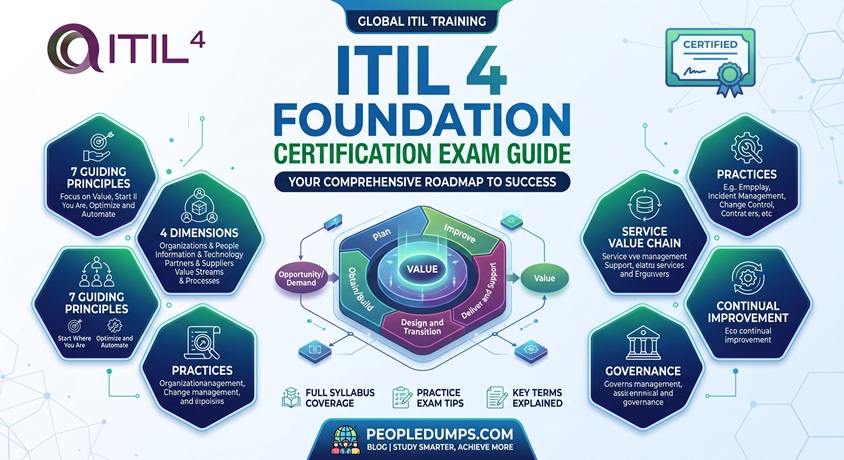
The ITIL 4 Foundation Certification Exam Guide is designed for students and early-career professionals who want to understand the certification, exam format, core ITIL concepts, and effective preparation strategies. If you are beginning a career in IT service management, project management, IT operations, service delivery, or digital transformation, the ITIL 4 Foundation certification provides a practical introduction to how modern organizations create value through technology-enabled services.
ITIL is sometimes misunderstood as a collection of rigid processes that IT departments must follow. In reality, ITIL 4 takes a much broader approach. It connects people, technology, suppliers, workflows, governance, customer experience, and continual improvement into a flexible service management framework.
Rather than asking only whether a particular process has been followed, ITIL 4 encourages organizations to consider a more important question: Are our products and services helping customers and other stakeholders achieve meaningful outcomes?
In this guide, we will look at the ITIL 4 Foundation certification, its value, exam structure, major knowledge areas, practical IT service management concepts, common areas of confusion, and a realistic study strategy for beginners.
What Is ITIL 4 Foundation?
Table of Contents
ToggleITIL 4 Foundation is the introductory certification within the ITIL 4 qualification scheme. It establishes the terminology, principles, concepts, and operating model used in modern IT service management, commonly known as ITSM.
The certification is administered by PeopleCert and is suitable for both technical and non-technical professionals. Candidates do not need to be experienced system administrators, network engineers, service managers, or project managers before studying for the exam.
Instead, the Foundation level is intended to build a common understanding of how services are created, delivered, supported, measured, and improved. Candidates who want a structured starting point can also review the ITIL 4 Foundation course and exam preparation resources while building familiarity with the official framework and terminology.
Key areas covered by ITIL 4 Foundation include:
- Key concepts of service management
- Value and value co-creation
- Utility and warranty
- The seven ITIL guiding principles
- The four dimensions of service management
- The ITIL Service Value System
- The Service Value Chain
- Continual improvement
- ITIL management practices
- Service level management
- Incident and problem management
- Change enablement
- Service request management
- The service desk
For beginners, one of the most valuable aspects of ITIL 4 is that it explains not only what an IT organization does, but also why those activities matter to customers and the business.
Important 2026 Update: ITIL 4 and ITIL Version 5
Candidates preparing for ITIL certification in 2026 should be aware of an important development in the ITIL qualification ecosystem.
PeopleCert has introduced ITIL Foundation (Version 5), representing the next evolution of ITIL. However, the introduction of Version 5 does not mean that ITIL 4 disappeared immediately.
ITIL 4 remains available during the transition period, allowing existing candidates and certification holders to continue their ITIL 4 learning journeys. PeopleCert currently plans to sunset ITIL 4 modules on December 31, 2027.
This means that candidates who are specifically preparing for the ITIL 4 Foundation exam can still pursue the certification. However, anyone who is completely new to ITIL and has not yet purchased training or an exam voucher should also review the newer ITIL Foundation Version 5 pathway before deciding which certification best supports their long-term goals.
PeopleCert also provides an ITIL Foundation Bridge (Version 5) pathway for eligible ITIL 4 Foundation holders who want to update their knowledge to the newer framework.
For current ITIL 4 candidates, the key point is simple: your ITIL 4 knowledge remains useful, but you should understand the transition timeline when planning advanced certifications.
ITIL 4 Foundation Certification Exam Format
Understanding the exam structure is an important part of your ITIL 4 Foundation exam preparation. The examination itself is relatively short, but candidates need a precise understanding of ITIL terminology because several answer choices may appear reasonable at first glance.
| Exam Detail | ITIL 4 Foundation |
|---|---|
| Number of Questions | 40 questions |
| Question Type | Multiple choice |
| Exam Duration | 60 minutes |
| Exam Type | Closed book |
| Passing Score | 65% |
| Questions Required to Pass | 26 out of 40 |
| Certification Provider | PeopleCert |
With 40 questions in 60 minutes, candidates have an average of around 90 seconds per question. For most learners, time is not the biggest challenge.
The more difficult part is identifying the answer that most accurately reflects ITIL guidance rather than selecting an option simply because it matches the way your current organization works.
What Does the ITIL 4 Foundation Exam Cover?
The ITIL 4 Foundation exam is primarily conceptual. Candidates are not expected to configure servers, deploy networks, write automation scripts, troubleshoot databases, or configure an ITSM platform.
Instead, the exam evaluates whether you understand how professional service management works and how different ITIL concepts fit together.
1. Key Concepts of Service Management
The first area to understand is the basic vocabulary of service management. These concepts form the foundation for nearly everything else in the ITIL framework.
Important terms include:
- Service
- Service management
- Value
- Utility
- Warranty
- Outcome
- Output
- Cost
- Risk
- Customer
- User
- Sponsor
- Service offering
- Service relationship
A common mistake is to memorize these definitions independently without understanding how they interact.
For example, suppose an organization implements a new online collaboration platform. The completed platform itself can be considered an output. Better communication and faster collaboration between employees may represent an outcome.
Whether the service creates real value depends on whether those outcomes are useful to customers, users, and other stakeholders.
2. Utility and Warranty
Utility and warranty are two concepts that frequently confuse beginners.
Utility relates to what a service does and whether it is fit for purpose. It addresses whether the service supports the required performance or removes constraints for the customer.
Warranty relates to how well the service performs and whether it is fit for use. Areas such as availability, capacity, security, and continuity may contribute to warranty.
A service may provide excellent functionality but still fail to create value if it is frequently unavailable or unable to support the required number of users.
Therefore, successful service management normally requires an appropriate combination of utility and warranty.
3. The Seven ITIL Guiding Principles
The seven ITIL guiding principles are among the most important concepts in ITIL 4:
- Focus on value
- Start where you are
- Progress iteratively with feedback
- Collaborate and promote visibility
- Think and work holistically
- Keep it simple and practical
- Optimize and automate
These principles should not be treated as seven sequential project phases. They are recommendations that can influence decisions at every level of an organization.
For example, imagine that a company wants to replace its service desk platform.
Start where you are suggests evaluating existing capabilities before discarding everything. Focus on value asks whether the new platform will produce meaningful improvements for users and the organization. Progress iteratively with feedback encourages teams to learn from users instead of implementing a large solution without validation.
Understanding examples such as these is much more effective for exam preparation than simply memorizing the names of the seven principles.
4. The Four Dimensions of Service Management
ITIL 4 encourages organizations to take a balanced and holistic approach to service management through four dimensions:
- Organizations and People
- Information and Technology
- Partners and Suppliers
- Value Streams and Processes
These dimensions help prevent organizations from viewing IT service management as purely a technology problem.
A technically excellent service can still fail if:
- Employees have not received adequate training.
- Roles and responsibilities are unclear.
- A supplier cannot meet service requirements.
- Information is poorly managed.
- Workflows contain unnecessary complexity.
- Communication between teams is ineffective.
For exam purposes, remember that effective service management requires consideration of all four dimensions rather than focusing on only one area.
5. The ITIL Service Value System
The Service Value System (SVS) shows how the various components and activities of an organization work together to facilitate value creation.
The Service Value System includes:
- Guiding principles
- Governance
- Service Value Chain
- Practices
- Continual improvement
At Foundation level, you should understand how these components relate to one another rather than memorizing them as unrelated definitions.
The central idea is that service management works as an interconnected system. A decision made in one part of an organization can affect people, technology, suppliers, customers, costs, risks, and service outcomes elsewhere.
6. The Service Value Chain
The Service Value Chain is an important operating model within the Service Value System.
It contains six activities:
- Plan
- Improve
- Engage
- Design and Transition
- Obtain/Build
- Deliver and Support
One important exam concept is that these activities are not intended to operate as a fixed sequence.
Organizations combine Service Value Chain activities in different ways to form value streams. A value stream represents a series of steps an organization uses to create and deliver products and services to consumers.
This flexible approach allows ITIL 4 to work alongside modern practices such as Agile, DevOps, Lean, cloud computing, product management, and continuous delivery.
Important ITIL 4 Management Practices
ITIL 4 introduced the concept of management practices, replacing the older tendency to describe service management primarily as a set of processes.
A practice includes more than a workflow. It can involve people, competencies, organizational structures, technology, information, suppliers, tools, procedures, and other resources needed to accomplish an objective.
Foundation candidates should be particularly familiar with several important practices.
Incident Management
The purpose of incident management is to minimize the negative impact of incidents by restoring normal service operation as quickly as possible.
An incident is generally associated with an interruption to a service or a reduction in service quality.
For example, if users suddenly cannot access an important business application, restoring access quickly is likely to be the immediate incident management priority.
Problem Management
Problem management focuses on reducing the likelihood and impact of incidents by identifying actual and potential causes and managing workarounds and known errors.
This leads to one of the most important distinctions for Foundation candidates:
An incident is not the same as a problem.
An incident concerns the service disruption that users experience. A problem concerns a cause or potential cause of one or more incidents.
An organization may restore service before it fully understands or permanently eliminates the underlying problem.
Service Desk
The service desk provides a point of communication between the service provider and users.
A modern service desk is not limited to receiving telephone calls. Communication may occur through:
- Phone
- Chat
- Self-service portals
- Mobile applications
- Collaboration platforms
- Automated interfaces
The quality of communication and user experience is therefore an important part of service desk effectiveness.
Service Request Management
Service request management supports agreed, user-initiated service requests in an effective and user-friendly manner.
Common examples may include:
- Requests for information
- Requests for access
- Password-related assistance
- Standard equipment requests
- Approved software requests
- Routine service actions
Service requests are usually predictable and can often be handled through predefined workflows.
Change Enablement
Change enablement aims to maximize the number of successful service and product changes by ensuring that risks are appropriately assessed, changes are authorized, and change schedules are managed effectively.
An important concept is that change enablement is not designed to stop change.
Organizations need change to improve services, respond to customers, fix problems, maintain security, and adopt new technologies. The objective is to enable useful change while managing risk appropriately.
Service Level Management
Service level management establishes clear, business-based targets for service performance and ensures that service delivery is appropriately assessed, monitored, and managed against those targets.
It encourages organizations to discuss service performance in terms that customers and business stakeholders can understand rather than relying only on technical metrics.
Continual Improvement
Continual improvement ensures that products, services, practices, and other organizational activities remain aligned with changing business needs.
Improvement should not be treated as a special activity performed once every several years. ITIL encourages improvement to become part of normal work across the organization.
Why Is the ITIL 4 Foundation Certification Valuable?
The value of ITIL 4 Foundation does not come from memorizing terminology or adding another badge to a résumé.
Its main benefit is that it provides a common language for understanding how technology-enabled services are designed, delivered, supported, measured, governed, and improved.
This knowledge can be useful for professionals working in roles such as:
- IT Service Manager
- IT Project Manager
- Service Desk Analyst
- IT Support Specialist
- IT Operations Specialist
- Business Analyst
- Service Delivery Manager
- Change Management Specialist
- Digital Transformation Specialist
- Product Owner
- Service Owner
- IT Team Leader
- Technology Consultant
Even professionals who do not work directly in ITSM can benefit from understanding how service organizations balance customer requirements, risk, cost, technology, operational stability, and continual improvement.
For learners who intend to sit the exam, a focused ITIL 4 Foundation study guide and preparation resource can help organize revision around the key concepts that candidates are expected to understand.
Is ITIL 4 Foundation Useful for Project Managers?
ITIL 4 Foundation can be particularly useful for project management professionals because project management and service management address different but complementary areas of work.
Projects are temporary initiatives designed to create defined outputs or deliver change. Service management focuses more heavily on the ongoing creation, delivery, support, and improvement of services.
Imagine a project that introduces a new HR management system.
A project manager may focus on:
- Project scope
- Budget
- Schedule
- Stakeholders
- Project risks
- Requirements
- Testing
- Deployment
- Project closure
ITIL encourages the organization to ask additional questions such as:
- Who will support the service after deployment?
- How will incidents be managed?
- How will users request assistance?
- Who owns the service?
- What service levels are expected?
- How will performance be measured?
- How will recurring problems be investigated?
- How will future changes be managed?
- How will suppliers contribute?
- How will customer feedback lead to improvement?
This is why ITIL and project management should not necessarily be viewed as competing approaches. In many organizations, they complement one another.
How Difficult Is the ITIL 4 Foundation Certification Exam?
ITIL 4 Foundation is generally considered accessible to beginners, but that does not mean candidates should underestimate it.
The greatest challenge is usually terminology rather than technical complexity.
Several ITIL concepts appear similar, and examination questions may present more than one answer that initially seems plausible.
Common areas of confusion include:
- Output vs. outcome
- Utility vs. warranty
- Incident vs. problem
- Customer vs. user vs. sponsor
- Service Value Chain vs. value stream
- Practice vs. process
- Service request vs. incident
- Guiding principles vs. Service Value System components
One useful test of your readiness is whether you can explain each pair in your own words without reading a textbook definition.
If you understand why the concepts are different and can apply them to simple scenarios, you are usually much better prepared for the exam than someone who has memorized isolated definitions.
How to Prepare for the ITIL 4 Foundation Certification Exam
A successful preparation strategy should combine conceptual understanding, active recall, comparison of similar terms, and realistic practice questions.
Step 1: Understand the Overall ITIL Structure
Do not begin by memorizing dozens of definitions independently.
First, understand the overall structure:
Service management concepts → Guiding principles → Four dimensions → Service Value System → Service Value Chain → Practices → Continual improvement
Once you understand how these pieces fit together, individual concepts become much easier to remember.
Step 2: Learn Official ITIL Terminology
Workplace terminology does not always match ITIL terminology.
For example, one organization may use the word “problem” for almost any user issue, while ITIL distinguishes clearly between incidents and problems.
When preparing for the exam, use official ITIL definitions as your primary reference.
Step 3: Connect Concepts to Real-World Examples
Realistic examples make abstract terminology easier to remember.
Suppose an employee suddenly cannot access an important Microsoft 365 service.
- The immediate disruption may be handled through incident management.
- A recurring technical cause may require problem management.
- A permanent infrastructure modification may involve change enablement.
- Expected service performance may relate to service level management.
- User communication may involve the service desk.
- Lessons learned may contribute to continual improvement.
If you can connect several ITIL concepts to one practical situation, you are developing understanding rather than simple memorization.
Step 4: Practice Comparing Similar Concepts
Comparison is especially useful for ITIL Foundation preparation.
| Concept A | Concept B | Key Difference |
|---|---|---|
| Incident | Problem | Incident focuses on service disruption; problem focuses on causes or potential causes. |
| Output | Outcome | Output is a deliverable; outcome is a result enabled for a stakeholder. |
| Utility | Warranty | Utility relates to fitness for purpose; warranty relates to fitness for use. |
| User | Customer | A user uses the service; a customer defines requirements and is responsible for service consumption outcomes. |
| Service Value Chain | Value Stream | The Service Value Chain contains core activities; value streams combine activities to create and deliver value. |
Reviewing concepts side by side can significantly reduce mistakes caused by similar terminology.
Step 5: Use Practice Questions Properly
Practice questions are valuable, but only if you use them to improve understanding.
After answering a question incorrectly, do not simply memorize the correct option. Ask yourself:
- Why was my original answer incorrect?
- Which ITIL concept did I misunderstand?
- Why is the correct option more accurate?
- What wording in the question should I have noticed?
- Could I explain the concept without seeing the answer choices?
This turns practice questions into a learning tool rather than a memorization exercise.
Step 6: Take Timed Mock Exams
Once you understand the major topics, complete timed mock exams under conditions similar to the actual examination.
This helps you evaluate:
- Time management
- Knowledge gaps
- Accuracy under pressure
- Terminology recognition
- Readiness for the real exam
PeopleCert also provides an official ITIL 4 Foundation mock exam for candidates who want a practice experience aligned with the official examination environment.
A Simple ITIL 4 Foundation Study Plan for Beginners
Many beginners can prepare effectively with a structured two- to three-week plan. Your exact schedule will depend on your existing IT experience and the amount of time available each day.
| Study Period | Main Focus |
|---|---|
| Days 1–3 | Service management concepts, value, utility, warranty, outcomes, outputs, customers, users, and sponsors |
| Days 4–5 | Seven ITIL guiding principles |
| Days 6–7 | Four dimensions of service management |
| Days 8–10 | Service Value System and Service Value Chain |
| Days 11–14 | Important ITIL management practices |
| Days 15–17 | Practice questions and weak-topic review |
| Days 18–21 | Timed mock exams, terminology review, and final revision |
The number of study hours is less important than the quality of those hours.
Focused study using active recall, concept comparison, practical examples, and practice questions is usually much more effective than repeatedly reading the same material. Candidates who want additional structured revision can use the ITIL 4 Foundation exam study resources alongside official PeopleCert materials to identify topics that need more attention.
Common ITIL 4 Foundation Exam Mistakes
Several study habits can make the exam unnecessarily difficult.
Memorizing Answers Instead of Concepts
Memorizing the answer to a particular practice question does not guarantee that you understand the concept. The real exam may test the same topic using different wording or a different scenario.
Using Workplace Experience as the Only Reference
Your organization may use terminology differently from ITIL. Answer exam questions according to ITIL guidance rather than assuming your company’s current procedure is always the correct answer.
Ignoring Small Differences in Terminology
Words such as output, outcome, incident, problem, customer, and user have specific meanings.
Small terminology differences can completely change the correct answer.
Trying to Memorize Everything at Once
ITIL becomes much easier when you understand its structure first and then add detail gradually.
Build the framework before attempting to memorize every definition.
Ignoring the Guiding Principles
The guiding principles are not just a list to memorize. Candidates should understand the thinking behind each principle and recognize how it can apply to practical situations.
ITIL 4 Foundation Certification Renewal
Candidates should also understand that current PeopleCert policies include certification renewal requirements.
PeopleCert currently uses a three-year renewal cycle for applicable certifications. Certification holders may have several options for keeping their certifications current, including completing additional certifications within the relevant product suite or using Continuous Professional Development activities through eligible PeopleCert membership arrangements.
Certification maintenance policies can change over time, so candidates should always verify current renewal requirements directly with PeopleCert.
What Comes After ITIL 4 Foundation?
ITIL 4 Foundation has traditionally served as the starting point for more advanced ITIL learning paths.
Depending on career goals, professionals may continue into areas involving:
- ITIL management practices
- Service management leadership
- Strategic planning
- Digital and IT strategy
- Service creation and support
- Stakeholder value
- Continual improvement
- Advanced IT service management capabilities
However, candidates planning their next certification in 2026 or later should review the latest PeopleCert qualification structure because the ecosystem is transitioning toward ITIL Version 5.
If you already hold ITIL 4 Foundation, the newer bridge pathway may also provide a more focused route for learning the changes introduced in the latest version.
Is ITIL 4 Foundation Worth It?
Whether ITIL 4 Foundation is worth pursuing depends on what you expect from the certification.
If you expect one entry-level certificate to replace practical IT experience, the answer is no. No Foundation-level certification can substitute for real work experience.
However, ITIL 4 Foundation can be highly useful if your goal is to develop a structured understanding of how professional organizations manage IT and digital services.
The certification is particularly relevant for people working at the intersection of:
- Technology
- Business
- Project management
- Service delivery
- IT operations
- Digital transformation
- Customer experience
- Governance
- Continual improvement
One of the most valuable lessons from ITIL 4 is the habit of thinking beyond an isolated technical task.
Instead of asking only whether a server is working or whether a project has been delivered, ITIL encourages professionals to consider whether services are producing useful outcomes and sustainable value for stakeholders.
Frequently Asked Questions About the ITIL 4 Foundation Exam
How many questions are on the ITIL 4 Foundation exam?
The ITIL 4 Foundation exam contains 40 multiple-choice questions.
How long is the ITIL 4 Foundation exam?
The standard exam duration is 60 minutes.
What score is required to pass ITIL 4 Foundation?
The passing score is 65%. Candidates therefore need at least 26 correct answers out of 40 questions.
Is the ITIL 4 Foundation exam open book?
No. The standard ITIL 4 Foundation examination is a closed-book exam.
Is ITIL 4 Foundation suitable for beginners?
Yes. ITIL 4 Foundation is designed as an introductory certification and does not require candidates to already be experienced IT service managers.
It can be suitable for students, IT professionals, project professionals, support staff, business analysts, consultants, and others who want to understand professional IT service management.
Do I need technical IT skills for ITIL 4 Foundation?
Deep technical skills are not required. The examination focuses primarily on service management concepts, terminology, principles, practices, and relationships rather than hands-on configuration.
Is ITIL 4 still available after the introduction of ITIL Version 5?
Yes. ITIL 4 remains available during the transition period. PeopleCert currently plans to sunset ITIL 4 modules on December 31, 2027.
Can ITIL 4 Foundation holders move to Version 5?
PeopleCert provides an ITIL Foundation Bridge (Version 5) option designed to help eligible ITIL 4 Foundation holders understand the updates introduced in the newer framework.
Is ITIL useful for project managers?
Yes. Project management focuses primarily on temporary initiatives and project delivery, while ITIL provides knowledge related to the ongoing creation, operation, support, and improvement of services. The two disciplines can complement each other effectively.
Final Thoughts on the ITIL 4 Foundation Certification Exam Guide
This ITIL 4 Foundation Certification Exam Guide is intended to give beginners a practical understanding of both the examination and the service management concepts behind it.
The exam is not primarily about memorizing a collection of IT terms. Strong candidates understand how concepts such as value, utility, warranty, guiding principles, the four dimensions, the Service Value System, the Service Value Chain, and management practices work together.
If you are preparing for the certification, focus first on understanding the overall framework. Then learn the official terminology, compare similar concepts, connect theory to realistic service scenarios, and use practice questions to identify weaknesses. You can also review the ITIL 4 Foundation certification preparation page as part of a broader study plan.
Although the ITIL certification ecosystem is evolving toward Version 5, ITIL 4 remains an important body of service management knowledge during the transition period. Candidates should simply consider the current transition timeline when deciding how far they want to continue with the ITIL 4 qualification pathway.
Whether you eventually work as a project manager, service manager, IT operations specialist, business analyst, service desk professional, consultant, or digital transformation specialist, the service-oriented way of thinking taught by ITIL can remain useful well beyond the certification exam itself.
Official and Authoritative ITIL Resources
-
PeopleCert – ITIL 4 Foundation:
Official ITIL 4 Foundation Certification Page -
PeopleCert – ITIL Certification:
Explore ITIL Certifications and Qualification Paths -
PeopleCert – ITIL Frequently Asked Questions:
Official ITIL Certification and Transition FAQ -
PeopleCert – ITIL 4 Foundation Mock Exam:
Official ITIL 4 Foundation Mock Exam -
PeopleCert – ITIL Foundation Version 5:
Official ITIL Foundation Version 5 Page -
PeopleCert – ITIL Foundation Bridge Version 5:
ITIL Foundation Bridge Version 5