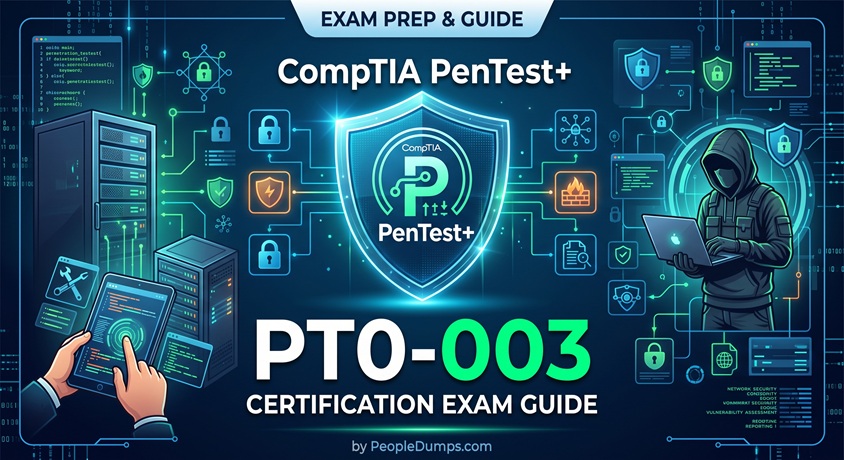
CompTIA PenTest+ PT0-003 is a cybersecurity certification designed for professionals who want to demonstrate practical knowledge of penetration testing, vulnerability discovery, attack techniques, post-exploitation activities, and professional security assessment management. Unlike certifications that focus mainly on defensive security concepts, PenTest+ approaches cybersecurity from the perspective of an authorized penetration tester who must identify weaknesses, validate security risks, communicate findings, and recommend appropriate remediation. Candidates who are actively preparing for the exam can also review our CompTIA PenTest+ PT0-003 certification exam preparation resources while working through the official objectives.
For students and early-career cybersecurity professionals, the certification can serve as an important bridge between foundational security knowledge and more specialized offensive security work. However, PT0-003 is not simply an exam about memorizing hacking tools. Candidates are expected to understand the complete penetration testing lifecycle, including authorization, reconnaissance, vulnerability analysis, exploitation, lateral movement, cleanup, reporting, and communication with stakeholders.
The current PT0-003 objectives also reflect how much penetration testing has changed in recent years. Traditional network and web application testing remains important, but the exam now includes cloud infrastructure, containers, APIs, identity systems, mobile platforms, operational technology, artificial intelligence security, and modern application security testing techniques.
What Is the CompTIA PenTest+ Certification?
Table of Contents
ToggleCompTIA PenTest+ is a vendor-neutral cybersecurity certification focused on identifying and exploiting vulnerabilities within an authorized penetration testing engagement. It sits beyond basic cybersecurity knowledge and requires candidates to think about security from both technical and business perspectives.
A professional penetration test is much more than running a vulnerability scanner against a network. Before testing begins, the tester must understand the scope, rules of engagement, legal restrictions, testing windows, exclusions, escalation procedures, and business objectives. During the technical phases, the tester must collect information, enumerate systems, validate vulnerabilities, select appropriate techniques, document evidence, and remain within the authorized scope.
After testing is complete, findings must be translated into useful information for the organization. A technically impressive attack is of limited value if the tester cannot explain the business impact or provide realistic remediation guidance. This combination of technical and professional skills is one of the defining characteristics of the CompTIA PenTest+ certification.
CompTIA PenTest+ PT0-003 Exam Overview
The CompTIA PenTest+ PT0-003 exam includes both traditional multiple-choice questions and performance-based questions. Performance-based questions, commonly referred to as PBQs, are particularly important because they require candidates to interpret information or work through security scenarios rather than simply recognize a definition.
| Exam Detail | PT0-003 Information |
|---|---|
| Certification | CompTIA PenTest+ |
| Exam Code | PT0-003 |
| Maximum Number of Questions | 90 |
| Question Types | Multiple-choice and performance-based questions |
| Exam Length | 165 minutes |
| Passing Score | 750 |
| Recommended Experience | 3–4 years in a penetration tester job role |
| Main Focus | End-to-end penetration testing and vulnerability assessment |
CompTIA lists three to four years of penetration testing job-role experience as the recommended level of experience. That does not necessarily mean every candidate must have spent several years working under the formal title of penetration tester. Students can still prepare for the exam, but they should have a solid understanding of networking, operating systems, cybersecurity fundamentals, and hands-on security testing before attempting it.
If you are already familiar with these fundamentals and want to organize your preparation around the current exam objectives, our PT0-003 exam preparation page can be used alongside the official CompTIA documentation as an additional study resource.
The certification exam is also accredited by ANSI for compliance with the ISO/IEC 17024 personnel certification standard, which adds another layer of credibility to the certification process.
CompTIA PenTest+ PT0-003 Exam Domains
The current PT0-003 exam objectives are divided into five domains. Understanding these percentages is important when developing a study plan because the domains are not weighted equally.
| Domain | Exam Weight |
|---|---|
| 1.0 Engagement Management | 13% |
| 2.0 Reconnaissance and Enumeration | 21% |
| 3.0 Vulnerability Discovery and Analysis | 17% |
| 4.0 Attacks and Exploits | 35% |
| 5.0 Post-exploitation and Lateral Movement | 14% |
The most heavily weighted domain is Attacks and Exploits at 35%. However, focusing exclusively on exploitation would be a mistake. A professional penetration tester must understand what happens before and after exploitation as well.
Domain 1: Engagement Management – 13%
Engagement Management establishes the professional framework surrounding a penetration test. This domain may initially appear less technical than exploitation, but it represents skills that distinguish authorized penetration testing from uncontrolled hacking activity.
Candidates should understand scope definition, rules of engagement, testing windows, exclusions, escalation procedures, authorization, non-disclosure agreements, statements of work, privacy requirements, and the responsibilities of different parties involved in an assessment.
The domain also covers several recognized security testing frameworks and methodologies, including:
- Penetration Testing Execution Standard (PTES)
- MITRE ATT&CK
- OWASP security testing resources
- OSSTMM
- CREST methodologies
- DREAD, STRIDE, and OCTAVE threat modeling concepts
Reporting is another major part of Engagement Management. Candidates need to understand executive summaries, technical findings, methodologies, attack narratives, risk scoring, remediation recommendations, and the difference between communicating with technical and non-technical stakeholders.
This is important in real-world penetration testing. Finding a vulnerability is only part of the job. A client must understand what the weakness means, how serious it is, what caused it, and what should be done to reduce the risk.
Domain 2: Reconnaissance and Enumeration – 21%
Reconnaissance is the process of learning about a target environment before attempting exploitation. PT0-003 expects candidates to understand both passive and active reconnaissance techniques.
Passive reconnaissance attempts to collect useful information without directly interacting with the target systems whenever possible. Sources can include DNS records, certificate transparency logs, public repositories, search engines, cached pages, social media, job advertisements, and other open-source intelligence.
Active reconnaissance involves direct interaction with systems to identify hosts, ports, services, protocols, operating systems, and other characteristics of the environment.
Important concepts in this domain include:
- Open-source intelligence (OSINT)
- DNS and reverse DNS lookups
- Host discovery
- Service discovery
- Operating system fingerprinting
- TCP and UDP scanning
- Banner grabbing
- Network sniffing
- Directory and share enumeration
- Wireless enumeration
- API key and secrets discovery
- Attack path mapping
- Web crawling
CompTIA also expects candidates to recognize commonly used reconnaissance and enumeration tools. Examples in the official objectives include Nmap, Wireshark, tcpdump, Shodan, Maltego, Recon-ng, SpiderFoot, Amass, theHarvester, WHOIS, dig, Censys, and Aircrack-ng.
Scripting Matters More in PT0-003
A useful change in the current objectives is the emphasis on modifying scripts for reconnaissance and enumeration. Candidates should be comfortable reading basic scripting logic and working with languages such as:
- Python
- PowerShell
- Bash
You do not need to become a professional software developer before taking PenTest+, but you should understand variables, conditionals, loops, functions, libraries, string operations, and basic data manipulation. Modern penetration testers often automate repetitive tasks, so scripting is increasingly part of everyday security testing.
Domain 3: Vulnerability Discovery and Analysis – 17%
Finding an open port does not automatically mean a vulnerability exists, and seeing a scanner alert does not automatically mean that alert is correct. Domain 3 tests whether candidates can move from raw reconnaissance data toward defensible vulnerability findings.
PT0-003 includes several types of security assessment:
- Network vulnerability scanning
- Host-based scanning
- Authenticated and unauthenticated scanning
- Container scanning
- Secrets scanning
- Wireless assessment
- Mobile application scanning
- Industrial control system vulnerability assessment
- Static Application Security Testing (SAST)
- Dynamic Application Security Testing (DAST)
- Interactive Application Security Testing (IAST)
- Software Composition Analysis (SCA)
- Infrastructure as Code security analysis
This domain is especially relevant to modern DevSecOps environments. A penetration tester may now encounter Kubernetes clusters, container images, infrastructure-as-code templates, CI/CD pipelines, APIs, cloud identities, and application dependencies in addition to traditional servers and network devices.
Tools identified in the objectives include Nessus, OpenVAS, Nikto, TruffleHog, BloodHound, Grype, Trivy, and kube-hunter.
Understanding False Positives and False Negatives
One of the most practical concepts in this domain is validating scanner output. Candidates should understand the difference between true positives, false positives, false negatives, and incomplete scans.
Blindly trusting automated scanners is a poor penetration testing practice. A skilled tester should be able to combine scanner results with reconnaissance data, manual validation, system information, vulnerability databases, and additional testing to determine whether a finding represents a genuine security risk.
Domain 4: Attacks and Exploits – 35%
At 35% of the PT0-003 exam, Attacks and Exploits is the largest domain and deserves significant study time. Candidates working through CompTIA PenTest+ PT0-003 study resources should therefore give particular attention to recognizing attack techniques, understanding their prerequisites, and interpreting the results of common penetration testing tools.
Candidates should understand how vulnerabilities are prioritized using information such as CVE identifiers, CVSS scores, CWE classifications, EPSS information, asset value, exposed services, default configurations, software lifecycle status, and defensive controls.
Network Attacks
Network-focused topics include misconfigured services, default credentials, relay attacks, certificate services, multihomed systems, VLAN-related risks, packet crafting, and other common network attack scenarios.
Tools appearing in this area include Metasploit, Nmap, Netcat, Impacket, Wireshark, tcpdump, Responder, and Hydra.
Authentication and Identity Attacks
Identity security has become an increasingly important part of penetration testing. PT0-003 includes concepts involving Kerberos, password attacks, credential reuse, multifactor authentication, OpenID Connect, SAML, and enterprise identity environments.
Candidates should understand the security implications of password spraying, credential stuffing, ticket-based attacks, weak authentication controls, and compromised credentials without reducing these topics to simple tool memorization.
Web Application and API Security
Web applications remain an important part of the CompTIA PenTest+ PT0-003 certification. Candidates should recognize major classes of web vulnerabilities such as:
- SQL injection
- Command injection
- Cross-site scripting (XSS)
- Cross-site request forgery (CSRF)
- Server-side request forgery (SSRF)
- Directory traversal
- Insecure direct object references
- Session hijacking
- File inclusion vulnerabilities
- Insecure deserialization
- API abuse
- JSON Web Token security issues
Relevant tools include Burp Suite, OWASP ZAP, Postman, sqlmap, WPScan, Gobuster, DirBuster, and Wfuzz.
Cloud and Container Security
Cloud security receives meaningful attention in PT0-003. Candidates may encounter scenarios involving identity and access management misconfigurations, exposed storage, overly permissive services, trust relationships, metadata services, container security, workload runtime risks, and supply-chain weaknesses.
The official objectives reference tools such as Prowler, ScoutSuite, Pacu, Docker Bench, kube-hunter, and cloud-native security tools.
This means candidates who have studied only traditional Windows and Linux network penetration testing should spend additional time learning how cloud identity, shared responsibility, containers, and modern infrastructure architectures change the attack surface.
Wireless, Mobile, Social Engineering, OT, and AI
The PT0-003 objectives extend beyond traditional enterprise systems. Candidates should also understand security concepts involving wireless networks, mobile devices, social engineering, operational technology, Internet of Things devices, Bluetooth, RFID, and near-field communication.
One particularly modern addition is artificial intelligence security. The objectives specifically include concepts such as prompt injection and model manipulation. This reflects the growing need for penetration testers to understand security risks associated with AI-enabled applications and large language model systems.
Domain 5: Post-exploitation and Lateral Movement – 14%
Successful exploitation is not always the end of an authorized penetration test. Testers may need to determine what an attacker could achieve after gaining initial access while remaining within the approved rules of engagement.
Domain 5 focuses on persistence, lateral movement, pivoting, credential discovery, staging, exfiltration concepts, and cleanup.
Topics include:
- Persistence mechanisms
- Service and scheduled-task concepts
- Credential discovery
- Pivoting between network segments
- Remote management services
- SMB, RDP, SSH, LDAP, RPC, HTTP, and other enterprise protocols
- Living-off-the-land techniques
- Data staging
- Exfiltration concepts
- Removing tester-created accounts and tools
- Reverting configuration changes
- Preserving required evidence
- Securely destroying sensitive testing data
Cleanup is worth paying attention to. Professional penetration testing should leave the environment in an agreed-upon state after an engagement. Temporary accounts, test infrastructure, persistence mechanisms, tools, and configuration changes should be addressed according to the engagement requirements.
What Makes PT0-003 Different from the Previous PenTest+ Exam?
Candidates should be careful when using older study materials. PT0-003 reorganized the PenTest+ domains and places greater emphasis on the complete penetration testing workflow.
The current version also reflects technologies that are increasingly important in modern enterprise security, including:
- Cloud infrastructure security
- Containers and Kubernetes
- Modern identity systems
- API security
- Infrastructure as Code
- Software supply-chain security
- AI security
- OT and ICS environments
- Mobile application security
- Automation with Python, Bash, and PowerShell
For that reason, study material designed only around older PenTest+ objectives should not be your primary source for PT0-003 preparation. Make sure any PT0-003 certification exam study materials you use are aligned with the current exam code and objectives.
How Valuable Is the CompTIA PenTest+ Certification?
The value of a certification depends heavily on your career goals, existing experience, and the type of cybersecurity work you want to perform. PenTest+ can be particularly useful for people interested in penetration testing, vulnerability assessment, security consulting, offensive security, and technical security assessment roles.
1. It Is Vendor-Neutral
Because CompTIA PenTest+ is not tied to one operating system, cloud platform, firewall vendor, or penetration testing product, the knowledge can be applied across many different environments.
2. It Covers the Entire Engagement
Some learners initially think penetration testing is mainly about exploitation. PT0-003 makes it clear that professional testing also includes authorization, scope management, reconnaissance, vulnerability analysis, communication, remediation, cleanup, and reporting.
3. It Includes Performance-Based Questions
PBQs require candidates to interpret practical security scenarios rather than relying entirely on multiple-choice recognition. This makes hands-on preparation more important.
4. It Can Complement Other Cybersecurity Certifications
Security+ provides a broad cybersecurity foundation, while PenTest+ develops deeper offensive-security and security-assessment knowledge. Professionals interested in both defensive and offensive roles may also combine PenTest+ knowledge with areas such as incident response, threat detection, cloud security, or vulnerability management.
5. It Does Not Replace Real Experience
A certification can validate a defined body of knowledge, but it should not be treated as a substitute for hands-on practice. Building a home lab, working through legal security training environments, writing penetration test reports, reading vulnerability disclosures, and learning how real systems behave will make the certification considerably more useful.
Who Should Consider Taking PT0-003?
The CompTIA PenTest+ PT0-003 exam may be appropriate for:
- Cybersecurity students who already understand networking and security fundamentals
- Network or system administrators moving into cybersecurity
- Security analysts who want to understand offensive techniques
- Vulnerability management professionals
- Junior penetration testers
- Security consultants
- Professionals preparing for red-team or offensive-security roles
For someone completely new to networking and cybersecurity, however, PenTest+ may be unnecessarily difficult as a first certification. Understanding TCP/IP, routing, DNS, HTTP, authentication, Windows, Linux, Active Directory, and basic security concepts makes the technical material much easier to absorb.
Important Tools to Know for the PT0-003 Exam
PT0-003 references many security tools. Candidates do not need to memorize every possible command for every product, but they should understand what category each tool belongs to and why a penetration tester might select one tool instead of another.
| Category | Examples |
|---|---|
| Network Discovery | Nmap, Wireshark, tcpdump |
| OSINT | Shodan, Maltego, Recon-ng, SpiderFoot, theHarvester |
| Vulnerability Scanning | Nessus, OpenVAS, Nikto |
| Web Application Testing | Burp Suite, OWASP ZAP, Postman, WPScan |
| Container and Cloud Assessment | Trivy, Grype, kube-hunter, Prowler, ScoutSuite |
| Credential and Identity Analysis | BloodHound, hashcat, John the Ripper |
| Penetration Testing Frameworks | Metasploit |
| Scripting | Python, Bash, PowerShell |
The better study approach is to understand the problem each tool is designed to solve. If you understand the workflow, remembering the appropriate tool becomes much easier.
How to Prepare for CompTIA PenTest+ PT0-003
Start with the Official Exam Objectives
Download the official PT0-003 objectives before beginning serious preparation. Treat every listed objective as a checklist. If you cannot explain a topic in your own words or recognize how it might appear in a scenario, it probably deserves additional study.
Build Strong Networking Fundamentals
Penetration testing depends heavily on networking knowledge. Make sure you understand TCP and UDP, ports, DNS, routing, VLANs, NAT, firewalls, HTTP/HTTPS, SMB, SSH, LDAP, Kerberos, and common network architectures.
Learn Both Windows and Linux
A penetration tester should be comfortable navigating both operating systems. Practice command-line administration, permissions, services, processes, filesystems, network configuration, and basic scripting.
Create a Legal Practice Lab
Hands-on practice is essential for PBQs and scenario-based questions. Use systems specifically designed for cybersecurity training or an isolated lab environment that you own and are authorized to test.
A useful lab can contain Windows and Linux virtual machines, a web application, a directory service environment, network monitoring tools, and vulnerability scanning software. The objective is not simply to run tools but to understand the workflow from discovery to reporting.
Practice Reading Tool Output
You should be comfortable interpreting information produced by common security tools. PT0-003 questions may test whether you can identify what a scan result means, determine what should happen next, or select an appropriate response based on available evidence.
Learn Basic Python, Bash, and PowerShell
You do not have to build large software projects. Focus on reading and modifying small scripts, understanding loops and conditions, handling input and output, manipulating strings, and recognizing common automation patterns.
Do Not Ignore Reporting
Practice writing short findings containing:
- A clear vulnerability title
- Technical description
- Affected asset
- Evidence
- Risk and business impact
- Recommended remediation
This exercise improves both exam preparation and real-world penetration testing skills.
A Practical PT0-003 Study Strategy
Instead of studying all domains equally, allocate time according to both exam weight and your personal weaknesses. Combining the official objectives with structured PT0-003 exam study and practice resources can also help identify areas that need additional review before exam day.
A reasonable approach could look like this:
- Learn the engagement lifecycle first. Understand what happens before, during, and after a penetration test.
- Build strong reconnaissance skills. Practice converting scattered information into an attack-surface map.
- Learn vulnerability validation. Understand why scanner output must be verified.
- Spend significant time on Domain 4. It represents 35% of the exam.
- Practice cloud, web, identity, and container security. Do not study only traditional network attacks.
- Practice post-exploitation concepts and cleanup. Understand the complete engagement rather than stopping after initial access.
- Review scripts and tool output. Scenario interpretation matters more than memorizing definitions.
- Finish with timed practice. The real exam allows 165 minutes, so time management should become part of your preparation.
Common PT0-003 Study Mistakes
One common mistake is focusing almost entirely on Metasploit or similar offensive tools. PenTest+ evaluates a much wider range of skills.
Other mistakes include:
- Using PT0-002 material without checking it against current PT0-003 objectives
- Memorizing tool names without understanding their purpose
- Ignoring authorization and rules of engagement
- Skipping report writing and remediation
- Studying network attacks while ignoring cloud and application security
- Avoiding scripting because it appears difficult
- Trusting vulnerability scanners without learning validation techniques
- Ignoring Active Directory and modern identity concepts
- Skipping cleanup and restoration procedures
- Preparing only with multiple-choice questions and never practicing scenarios
Is CompTIA PenTest+ PT0-003 Difficult?
For someone with no networking or security experience, PT0-003 can be challenging because it combines many different technologies and expects candidates to apply knowledge in practical scenarios.
For a student who already understands Security+-level concepts, basic Windows and Linux administration, networking, web technologies, and vulnerability management, the exam becomes much more manageable.
The broad scope is often more difficult than any individual topic. You might understand web application vulnerabilities very well but still need additional work on cloud security, Active Directory, scripting, wireless security, engagement management, or post-exploitation.
The best indicator of readiness is not whether you can memorize definitions. You should be able to look at a scenario, identify what stage of the penetration test you are in, interpret the available evidence, and decide what the most appropriate authorized action would be.
Frequently Asked Questions About CompTIA PenTest+ PT0-003
What is the current CompTIA PenTest+ exam code?
The current exam covered in this guide is PT0-003.
How many questions are on the PT0-003 exam?
CompTIA states that the exam contains a maximum of 90 questions.
How long is the PT0-003 exam?
Candidates receive 165 minutes to complete the exam.
What is the passing score for CompTIA PenTest+ PT0-003?
The required passing score is 750.
Does PT0-003 include performance-based questions?
Yes. The exam includes both multiple-choice and performance-based questions.
Which PT0-003 domain carries the most weight?
Domain 4, Attacks and Exploits, represents 35% of the examination and is the largest individual domain.
Do I need programming knowledge for PenTest+?
You do not need to be a professional developer, but PT0-003 expects candidates to understand and modify basic scripts. Python, Bash, and PowerShell are specifically included in the objectives.
Does PT0-003 cover cloud penetration testing?
Yes. Cloud security is explicitly included, covering areas such as identity and access management, exposed resources, trust relationships, containers, workload security, and cloud security assessment tools.
Does PT0-003 include AI security?
Yes. The current objectives include AI-related attack concepts such as prompt injection and model manipulation.
Final Thoughts
CompTIA PenTest+ PT0-003 is a strong option for cybersecurity professionals who want to develop a structured understanding of penetration testing rather than learning isolated offensive techniques.
The exam’s greatest strength is its coverage of the complete security testing lifecycle. Candidates must understand how to define an engagement, gather intelligence, discover vulnerabilities, prioritize findings, evaluate attack paths, assess modern technologies, communicate risk, and restore the environment when testing is complete.
The current PT0-003 objectives are also noticeably modern. Cloud infrastructure, containers, APIs, identity systems, application security, scripting, AI, mobile technology, and operational technology now sit alongside traditional network and host penetration testing.
If you are preparing for the certification, use the official objectives as your master checklist, spend significant time in legal hands-on labs, practice interpreting security tool output, and make sure you can explain why a particular technique is appropriate rather than merely memorizing commands.
For candidates who want additional practice while reviewing each objective, you can also explore the CompTIA PT0-003 PenTest+ certification exam course and use it as a supplement to official documentation, hands-on labs, and other trusted cybersecurity learning resources.
Passing the exam is an important milestone, but the longer-term goal should be developing the judgment required to perform security testing safely, legally, systematically, and in a way that actually helps organizations reduce risk.