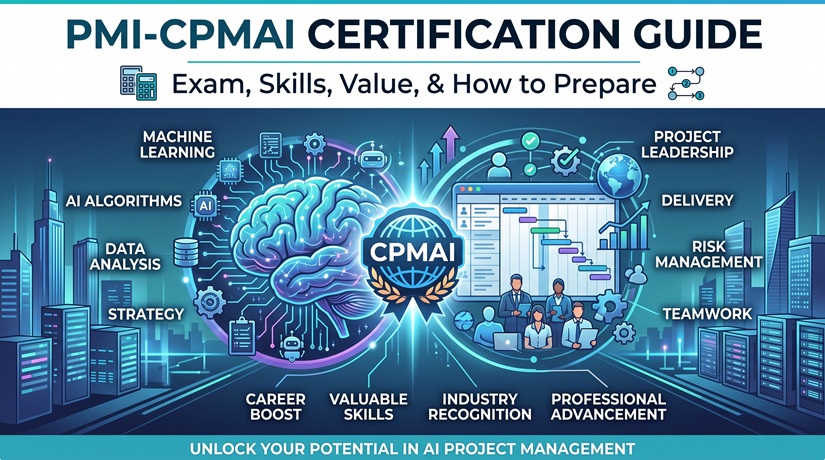
PMI Certified Professional in Managing AI (PMI-CPMAI) is a certification for people who need to manage artificial intelligence projects without turning into full-time machine learning engineers. It sits at an interesting intersection: project management, data, AI governance, model development, business value, and operational delivery.
If I had to describe the certification in one sentence, I would call it a vendor-neutral operating model for taking an AI idea from business problem to production system.
That distinction matters. Many AI courses teach a tool, a cloud platform, prompt engineering, or model development. PMI-CPMAI is aimed at a different problem: how do you organize the people, data, decisions, risks, and technical work required to deliver an AI initiative that actually survives outside a demo?
This guide explains the exam, the CPMAI methodology, the technical topics you should understand, the certification’s practical value, and a study approach that makes sense for students and early-career technology professionals.
What Is PMI-CPMAI?
Table of Contents
TogglePMI-CPMAI stands for PMI Certified Professional in Managing AI. The certification is built around the CPMAI methodology, which originated as Cognitive Project Management in AI. PMI acquired Cognilytica, the organization behind the methodology, in 2024 and subsequently expanded the certification under the PMI brand.
The easiest way to understand PMI-CPMAI is to compare it with two other categories of learning.
A traditional project management certification teaches broad delivery disciplines: scope, stakeholders, risk, planning, teams, governance, and value. A technical AI course teaches how models, data pipelines, or AI platforms work. PMI-CPMAI tries to connect those two worlds.
It asks questions such as:
- Is AI actually the right solution to the business problem?
- Do we have enough usable and legally appropriate data?
- What kind of AI pattern best matches the use case?
- How do we define success before model development starts?
- How should model quality, bias, explainability, privacy, and security be evaluated?
- What happens when a model reaches production and begins to drift?
- Who owns the system after the project team hands it over?
That is why I would not describe PMI-CPMAI as an “AI coding certification.” It is better described as an AI delivery and governance certification with enough technical depth to manage technical work intelligently.
PMI-CPMAI Exam Overview
As of the current PMI exam content outline, the exam is relatively straightforward to understand, although the scenario-based thinking can be more demanding than the headline numbers suggest.
| Item | Current PMI-CPMAI Requirement |
|---|---|
| Experience requirement | No prior project management, technical, or AI experience is required |
| Required training | Completion of the official PMI-CPMAI Exam Prep Course is required before scheduling the exam |
| Official course duration | 21 hours |
| Exam questions | 120 total questions |
| Scored questions | 100 scored questions |
| Pretest questions | 20 unscored questions, mixed into the exam |
| Exam time | 160 minutes |
| Scheduled breaks | None |
| Delivery | Pearson VUE test center or online proctored exam |
| Eligibility period | One year from purchase to obtain the certification |
| Retakes | Up to three total attempts within the one-year eligibility period; additional attempts require an exam fee |
| Certification maintenance | 30 PDUs every three years |
One detail is easy to miss: the official Exam Prep Course is not merely recommended; PMI states that completing it is required to schedule and take the certification exam.
PMI also uses regional and membership-based pricing, so there is no single price that is safe to hard-code into a long-lived article. Check the official certification page before purchasing, especially if you are a PMI member or buying from outside the United States.
The certification and exam are available in multiple languages, including English, Simplified Chinese, Traditional Chinese, Japanese, Korean, German, French, Arabic, Brazilian Portuguese, and Spanish (LATAM). Availability can change, so verify the language selector on the PMI page when booking.
PMI-CPMAI Exam Domains and Weightings
The current examination content outline divides the exam into five domains. Two areas dominate the blueprint: business needs and solutions and data needs. Together they account for more than half of the exam.
| Exam Domain | Weight | What It Means in Practice |
|---|---|---|
| Support Responsible and Trustworthy AI Efforts | 15% | Privacy, security, transparency, explainability, bias, regulation, accountability, and auditability |
| Identify Business Needs and Solutions | 26% | Problem definition, feasibility, scope, ROI, risk, success criteria, architecture, adoption, and resources |
| Identify Data Needs | 26% | Data requirements, sources, ownership, quality, privacy, access, infrastructure, lineage, and readiness |
| Manage AI Model Development and Evaluation | 16% | Algorithm selection, model training, QA/QC, data preparation, validation, and deployment readiness |
| Operationalize AI Solution | 17% | Deployment, monitoring, model governance, drift, metrics, transition, incident response, and continuity |
This weighting tells you something important about the philosophy of the certification: PMI-CPMAI does not assume that the hardest part of AI is choosing an algorithm. In real projects, a technically excellent model can still fail because the wrong problem was selected, the data is unsuitable, users do not adopt the solution, compliance was ignored, or nobody planned for production monitoring.
The Six Phases of the CPMAI Methodology
The certification is built around a six-phase AI project lifecycle. The phases are presented in sequence, but they are intentionally iterative. AI teams often have to move backward when new data, model behavior, or business constraints appear.
1. Business Understanding
The project starts by defining the business problem, desired outcomes, constraints, stakeholders, success criteria, and the reason AI is being considered at all.
A surprisingly mature question at this stage is: Would ordinary software, workflow automation, or analytics solve the problem more cheaply and reliably? Not every problem deserves an AI solution.
2. Data Understanding
The team identifies available data, ownership, accessibility, quality, representativeness, privacy obligations, and gaps. This is where a project can discover that a promising idea is not yet feasible.
3. Data Preparation
Raw data is turned into model-ready data through cleaning, labeling, normalization, deduplication, transformation, feature work, augmentation, or other preparation activities.
For beginners, this is a useful lesson: the model is often the most visible part of an AI system, but the quality of the data pipeline frequently determines whether the model is useful.
4. Model Development
The team selects a suitable model or algorithmic approach, trains the model, tunes parameters, tracks experiments, and compares alternatives against defined objectives.
5. Model Evaluation
The model is assessed against both technical and business criteria. Accuracy alone is not enough. Depending on the use case, the team may need to consider precision, recall, false positives, robustness, fairness, interpretability, explainability, security, latency, cost, and other constraints.
6. Model Operationalization
The solution moves into production. The work now includes deployment, integration, monitoring, governance, change control, retraining plans, drift detection, rollback procedures, incident response, user adoption, and transition to operations.
This final phase is where many classroom AI projects stop and real enterprise AI work begins.
How Technical Is PMI-CPMAI?
PMI-CPMAI is technical enough that you should understand how AI systems are developed, but it is not designed as a mathematics-heavy machine learning engineering exam.
You should be comfortable discussing the following concepts at a project-management level:
AI and Machine Learning Foundations
- Supervised, unsupervised, and reinforcement learning
- Training, validation, and test data
- Model selection and model complexity
- Hyperparameter tuning
- Cross-validation
- Overfitting and generalization
- Model performance metrics
- Generative AI and large-model use cases at a conceptual level
Data Engineering and Governance
- Data quality, completeness, consistency, and freshness
- Data lineage and provenance
- Access control and data ownership
- Personally identifiable information (PII)
- Data licensing and usage rights
- Exploratory data analysis
- Sampling and representativeness
- Bias in data and labels
Responsible and Trustworthy AI
- Privacy and security controls
- Bias detection and mitigation
- Explainability and interpretability
- Transparency and documentation
- Audit trails and accountability
- Regulatory and policy monitoring
- Human oversight and escalation paths
MLOps and Production Operations
- Model versioning and configuration management
- Experiment tracking
- Deployment planning
- Monitoring and alerting
- Model drift and data drift
- Retraining triggers
- Rollback and contingency planning
- Knowledge transfer to production support teams
The exam content outline even expects candidates to understand trade-offs between model performance, complexity, and interpretability. That is a good example of the expected depth: you may not be asked to derive an algorithm, but you should understand why choosing the most accurate model is not always the best business decision.
The Seven Patterns of AI: A Useful Mental Model
PMI’s CPMAI material also uses a taxonomy called the Seven Patterns of AI. These patterns help teams classify what the AI system is trying to do before they choose technology.
- Hyperpersonalization
- Conversational and human interaction
- Recognition
- Pattern and anomaly detection
- Predictive analytics and decision support
- Goal-driven systems
- Autonomous systems
For a beginner, the value of this model is practical. A fraud-detection system, a customer-support chatbot, and a warehouse robot may all be called “AI,” but they have very different data, evaluation, safety, infrastructure, and governance requirements.
Why AI Projects Are Different from Traditional Software Projects
This is one of the most important ideas behind PMI-CPMAI.
Traditional software is usually built around explicit rules written by developers. AI systems introduce a different source of uncertainty: behavior is learned from data, and model performance can change when data or real-world conditions change.
That creates several management problems that conventional project plans can underestimate.
Data Can Kill the Project Before Development Starts
You can have budget, engineers, executive support, and a clear business objective—and still discover that the data is inaccessible, biased, legally restricted, incomplete, or too sparse for the proposed model.
Model Development Is Experimental
An AI team may not know in advance which approach will meet the required performance threshold. Iteration is normal, which makes rigid one-pass planning unrealistic.
“Accurate” Does Not Automatically Mean “Useful”
A model can perform well on a test dataset and still fail the business. It may be too slow, too expensive, too difficult to explain, unfair to a user group, fragile in production, or impossible to integrate into the existing workflow.
Production Is Not the End
Models need monitoring because data distributions and user behavior change. A model that was acceptable six months ago can degrade without anyone changing the source code.
This is where PMI-CPMAI overlaps conceptually with broader frameworks such as the NIST AI Risk Management Framework and management standards such as ISO/IEC 42001: trustworthy AI requires ongoing governance, not a one-time approval meeting.
Is PMI-CPMAI Worth It?
The answer depends heavily on what job you want.
PMI-CPMAI has the strongest value for people who need to coordinate AI work across business and technical teams. It gives project managers, product managers, business analysts, consultants, transformation leads, and technical coordinators a structured vocabulary for discussing data, models, risk, governance, and deployment.
Its biggest advantage is not that it teaches one trendy tool. In fact, the certification is deliberately vendor-neutral. That makes the knowledge more durable when cloud products, model names, and AI platforms change.
Where the Certification Has Real Value
- Structure: It provides a repeatable lifecycle for AI initiatives instead of treating AI work as ad hoc experimentation.
- Cross-functional communication: It helps non-data-scientists ask better questions of data scientists, engineers, security teams, legal teams, and executives.
- Governance awareness: Responsible AI is part of the project lifecycle rather than an afterthought.
- Production mindset: Deployment, drift, model governance, transition, and contingency planning receive explicit attention.
- PMI brand recognition: PMI is already well known in project and program management, which may make the credential easier for hiring managers to place than a little-known private certificate.
Where You Should Keep Expectations Realistic
PMI-CPMAI will not make you a machine learning engineer, data scientist, or MLOps engineer by itself. It does not replace hands-on skill in Python, SQL, statistics, cloud architecture, model development, data engineering, or production ML tooling.
If your goal is to build neural networks, optimize inference, write feature pipelines, fine-tune models, or operate large-scale ML infrastructure, you need additional technical study.
In that case, PMI-CPMAI works better as a complement to engineering skills than as a substitute for them.
PMI-CPMAI vs. PMP: They Solve Different Problems
| Area | PMI-CPMAI | PMP |
|---|---|---|
| Primary focus | Managing AI and data-driven initiatives | Broad project management across industries |
| AI/data depth | High relative to general PM certifications | Not the main focus |
| Governance topics | Bias, explainability, data privacy, model governance, drift | General project governance and risk |
| Experience requirement | No prior experience required | Professional experience requirements apply |
| Best fit | AI project/product roles and AI transformation work | General project leadership |
For an experienced project manager, PMI-CPMAI can add an AI-specific layer to existing PM skills. For a student, it can provide a structured introduction to how enterprise AI projects are actually managed.
Who Should Take PMI-CPMAI?
I would consider it a good fit for:
- Project managers moving into AI, data, automation, or digital transformation
- Product managers responsible for AI-enabled products
- Business analysts working between business teams and technical teams
- Consultants who need a structured AI delivery methodology
- Data or technology professionals who are moving into leadership roles
- Students who already understand basic IT concepts and want a serious introduction to AI project delivery
- Professionals involved in AI governance, risk, compliance, or responsible AI programs
It is probably not the first certification I would choose if your only goal is a deeply technical machine learning role. In that case, you will get more immediate value from statistics, Python, SQL, data structures, cloud platforms, model development, and hands-on projects.
How Difficult Is the PMI-CPMAI Exam?
The exam should be approachable for beginners because PMI does not require previous project management or AI experience. But “no experience required” should not be confused with “no preparation required.”
The challenge is mostly conceptual and situational. You need to understand what should happen next in an AI project and why.
For example, imagine a customer-churn model performs well in development, but evaluation shows poor results for a newly launched customer segment. A weak answer might be “train a larger model.” A stronger project-management response is to investigate whether the data adequately represents the new segment, revisit data requirements, assess bias and performance thresholds, and then decide whether more data, different features, or a modeling change is needed.
That style of thinking is more important than memorizing a dictionary of AI terms.
A Practical PMI-CPMAI Study Plan
Because the official 21-hour course is mandatory, your preparation should use it as the backbone rather than treating it as a checkbox. For supplemental review, you can also use our PMI-CPMAI study materials to reinforce the terminology, lifecycle concepts, and scenario-based decision making covered in the exam blueprint.
Step 1: Read the Exam Content Outline Before You Study
Download the current PMI-CPMAI Examination Content Outline (ECO). Read the domain percentages first, then scan the tasks and enablers. The ECO tells you what the exam is actually designed to test.
Step 2: Build a Five-Domain Notebook
Create five sections matching the exam blueprint. As you complete the official course, place each concept under the corresponding domain.
This prevents the common problem of finishing a long course with many notes but no sense of priority.
Step 3: Learn the Six-Phase Lifecycle Until You Can Explain It Without Notes
You should be able to describe how an AI initiative moves from business understanding to data work, model work, evaluation, and operationalization—and explain why teams sometimes iterate backward.
Step 4: Strengthen the Technical Vocabulary
If you are new to AI, spend extra time on data quality, supervised versus unsupervised learning, model evaluation, overfitting, bias, explainability, model drift, versioning, and monitoring.
You do not need to become a mathematician, but technical terms should not slow you down during a timed exam.
Step 5: Practice Scenario Questions
Ask yourself three questions when reviewing a scenario:
- Which phase or exam domain is this testing?
- What information is missing before the team can safely move forward?
- What action best protects business value, data quality, trustworthiness, and operational success?
Once you understand the official methodology, additional PMI-CPMAI practice questions can be useful for testing whether you can apply those concepts under exam-style time pressure rather than simply recognize definitions.
Step 6: Use the Official Practice Exam if You Want Exam-Style Repetition
PMI offers an official PMI-CPMAI Practice Exam aligned with the examination content outline. PMI states that it can be taken multiple times and includes explanations and performance summaries. For many learners, this is more useful than collecting large quantities of unofficial questions of unknown quality.
A Reasonable Four-to-Six-Week Schedule
- Week 1: Exam blueprint, business understanding, AI patterns, feasibility, ROI, and risk
- Week 2: Data understanding, data governance, privacy, quality, access, and data preparation
- Week 3: Model development, training, validation, evaluation metrics, bias, and explainability
- Week 4: Operationalization, MLOps concepts, drift, monitoring, governance, incident response, and handover
- Week 5: Mixed scenario practice and weak-area review
- Week 6: Practice exam, time management, and final revision
If you already have project management and data experience, you may move faster. If AI terminology is completely new, give yourself more time rather than trying to memorize the course in a weekend.
Exam-Day Strategy
With 120 questions in 160 minutes, you have an average of roughly 80 seconds per question. Because there are no scheduled breaks, pacing matters.
- Do not spend several minutes fighting one ambiguous scenario.
- Look for the answer that follows a disciplined AI lifecycle rather than jumping straight to a technical fix.
- Be suspicious of answers that deploy before data quality, evaluation, security, privacy, or success criteria are addressed.
- Remember that business value and technical performance are both required.
- For governance questions, prefer traceability, documentation, accountability, monitoring, and defined decision rights over informal workarounds.
- For data problems, first verify whether the data is sufficient, representative, legal to use, and fit for the business objective.
If you take the exam online, complete Pearson VUE’s system checks and room requirements ahead of time. If you prefer fewer environmental variables, PMI’s exam content outline explicitly describes in-person testing as the recommended option.
How PMI-CPMAI Fits into a Technical Career
For students and junior technologists, PMI-CPMAI is most useful when it is part of a larger skill stack.
A strong early-career combination might look like this:
- Technical foundation: Python, SQL, statistics, APIs, cloud basics
- AI foundation: machine learning concepts, model evaluation, generative AI basics
- Delivery foundation: Agile, stakeholder communication, requirements, risk, change management
- Governance foundation: privacy, security, fairness, explainability, AI risk management
- Project evidence: at least one portfolio project that moves from problem statement to data, model, evaluation, and deployment plan
The certification can organize these pieces, but your portfolio and ability to discuss real trade-offs will still matter in interviews.
Responsible AI: Where to Go Beyond the Exam
One reason PMI-CPMAI is more relevant than a purely tool-focused AI credential is its treatment of trustworthy AI. Still, serious practitioners should read beyond the exam materials.
The NIST AI Risk Management Framework (AI RMF) is a useful companion because it provides a broader risk-management framework for trustworthy AI systems. ISO/IEC 42001 is also worth understanding because it defines requirements for an organizational AI management system.
If you work in regulated industries, public-sector systems, critical infrastructure, financial services, healthcare, hiring, or other high-impact areas, these governance topics become operational requirements rather than theoretical exam content.
Frequently Asked Questions About PMI-CPMAI
Do I need PMP before taking PMI-CPMAI?
No. PMI states that PMI-CPMAI does not require prior project management, technical, or AI experience or another certification.
Is the PMI-CPMAI Exam Prep Course mandatory?
Yes. According to the current examination content outline, completing the PMI-CPMAI Exam Prep Course is required before you can schedule and take the exam.
How many questions are on the PMI-CPMAI exam?
The exam contains 120 questions. PMI identifies 100 as scored questions and 20 as unscored pretest questions.
How long is the PMI-CPMAI exam?
You receive 160 minutes. The current exam content outline states that there are no scheduled breaks.
Can I take PMI-CPMAI online?
Yes. PMI uses Pearson VUE and supports both test-center delivery and online proctoring.
Does PMI-CPMAI teach programming?
It covers AI and machine learning concepts needed to manage AI work, but it is not a programming certification. You should study coding, data analysis, and ML engineering separately if those are part of your career goal.
Is PMI-CPMAI useful for students?
It can be, especially for students interested in project management, product management, business analysis, AI governance, consulting, or technology leadership. Students aiming for engineering roles should pair it with hands-on technical projects.
How do I maintain the certification?
PMI currently requires 30 professional development units (PDUs) every three years to maintain PMI-CPMAI.
Final Thoughts
PMI-CPMAI is interesting because it focuses on a gap that becomes obvious once AI leaves the lab: organizations do not only need people who can build models. They also need people who can decide which problems are worth solving, secure the right data, coordinate technical and business teams, manage AI risk, define acceptance criteria, and keep models useful after deployment.
For an early-career learner, the certification can provide a surprisingly complete map of the AI project lifecycle. For an experienced project professional, it can provide the AI-specific vocabulary and governance model that traditional project management training often lacks.
Just keep the credential in perspective. The strongest profile is not “certified but theoretical.” It is someone who can connect the methodology to real data, real systems, real stakeholders, and real trade-offs.
Official and Authoritative References
Use the sources below to verify exam details and expand your study beyond this article. Exam policies can change, so the PMI pages should always take priority over older blogs, videos, or third-party question banks.
- PMI — PMI Certified Professional in Managing AI (PMI-CPMAI) Certification
- PMI — PMI-CPMAI Examination Content Outline and Specifications
- PMI — Six Phases to Run a Successful AI Project
- PMI — Understanding the Seven Patterns of AI
- PMI — Official PMI-CPMAI Practice Exam
- PMI — Free Introduction to PMI-CPMAI
- Pearson VUE — PMI Exam Delivery
- NIST — AI Risk Management Framework
- ISO — ISO/IEC 42001 Artificial Intelligence Management System
- IBM — CRISP-DM Overview