
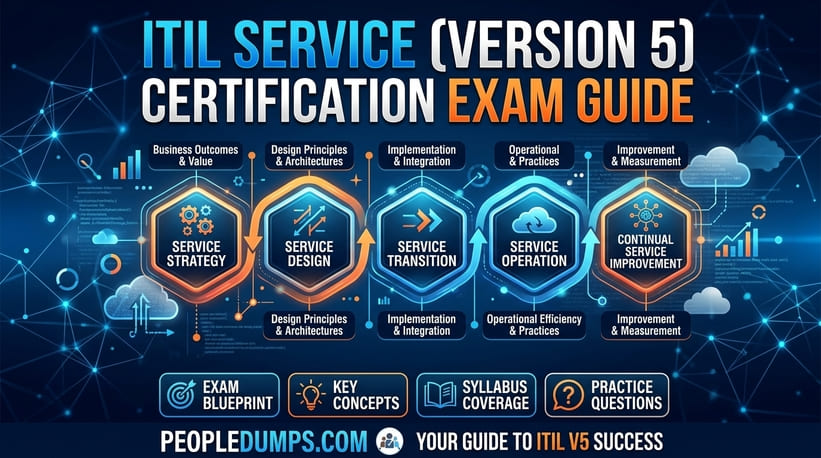
Digital services are now at the center of how most organizations communicate with customers, support employees, deliver products, and generate business value. As technology environments become more distributed, automated, AI-enabled, and dependent on third-party platforms, organizations need service management professionals who understand more than traditional IT operations.
This is where ITIL Service (Version 5) becomes particularly relevant.
The ITIL Service (Version 5) certification is designed for professionals who want to develop a deeper understanding of how digital services are designed, operated, delivered, supported, measured, and continually improved. Rather than looking at service management as a collection of isolated processes, the module takes a lifecycle-oriented view of service delivery and focuses on creating reliable outcomes for customers and other stakeholders.
For students and professionals building a career in IT service management, IT operations, project management, service delivery, or digital transformation, the certification can provide a structured way to understand how modern services work from beginning to end.
What Is ITIL Service (Version 5)?
Table of Contents
ToggleITIL Service (Version 5) is an advanced module within the current ITIL certification framework managed by PeopleCert. It focuses specifically on the management and delivery of digital services throughout their lifecycle.
The module develops the knowledge required to manage service relationships, operational performance, service levels, reliability, resilience, customer outcomes, and continual improvement.
One of the important ideas behind ITIL Service is that a service should not simply be considered a technical system. A digital service typically involves a combination of people, technology, suppliers, processes, information, agreements, support structures, and customer interactions.
For example, an online banking service is much more than the application customers see on their phones. Delivering that service successfully may require:
- Cloud infrastructure and networking
- Application development and maintenance
- Identity and security controls
- Monitoring and event management
- Incident and problem management
- Service desk capabilities
- External suppliers
- Service level agreements
- Business continuity planning
- Customer support
- Continual improvement
ITIL Service provides a structured way of understanding how these elements work together to create a service that is useful, dependable, resilient, and valuable.
ITIL Service (Version 5) Exam Overview
Candidates planning to take the ITIL Service Version 5 exam should first become familiar with the official exam structure and certification requirements.
According to the current PeopleCert examination information, the exam uses the following format:
| Exam Detail | ITIL Service (Version 5) |
|---|---|
| Exam Provider | PeopleCert |
| Number of Questions | 40 |
| Question Type | Multiple choice |
| Exam Duration | 90 minutes |
| Exam Format | Open book |
| Passing Score | 70% |
| Certification Area | Digital Service Management / IT Service Management |
The examination is available in multiple languages. Candidates should always verify the latest language availability, examination rules, and permitted reference materials on the official PeopleCert website before scheduling the exam.
Although the examination is open book, candidates should not assume that this makes the test easy. An open-book examination rewards familiarity with the concepts and the ability to apply them quickly. Candidates who spend too much time searching the official material for every answer may struggle to complete the examination efficiently.
ITIL Service Version 5 Certification Requirements
ITIL Service is not intended to replace foundation-level ITIL training. It builds on knowledge candidates are expected to have already developed.
PeopleCert currently identifies eligible ITIL certifications that can satisfy the prerequisite requirements for this advanced module. Candidates should review the official PeopleCert requirements before purchasing or scheduling an exam because certification policies can change.
Candidates must also complete the applicable accredited training requirement through an Accredited Training Organization or ITIL Official eLearning.
This is an important distinction from some entry-level certifications where independent self-study alone may be enough to satisfy certification requirements.
What Does ITIL Service (Version 5) Teach?
The ITIL Service certification covers a broad range of ideas related to modern digital service management. The goal is not simply to teach candidates how to respond to incidents or operate a service desk. Instead, it develops an understanding of how services contribute to organizational value throughout their lifecycle.
1. Digital Products and Services
One of the foundations of the course is understanding the relationship between digital products and digital services.
A product may provide capabilities, while a service allows those capabilities to generate value for consumers. In practice, the distinction is important because successful digital organizations need both product thinking and service thinking.
A team may successfully release a technically impressive product, for example, but customers may still have a poor experience if availability is unreliable, support is ineffective, service levels are unclear, or operational issues are not managed properly.
ITIL Service therefore encourages professionals to think beyond technical functionality and consider the complete service environment.
2. Service Value Co-Creation
Modern ITIL emphasizes that organizations do not simply manufacture value and hand it to customers. Value is often co-created through interactions between service providers, customers, users, suppliers, partners, and other stakeholders.
Consider a cloud collaboration platform. The provider delivers infrastructure, applications, security controls, support, and continuous improvements. However, the actual business value depends on how customers configure the platform, how employees use it, how administrators govern it, and how well the service supports real business objectives.
Understanding this relationship helps service managers avoid measuring success only through technical outputs.
3. Experience-Led Service Quality
Technical metrics remain important, but they do not tell the complete story about service quality.
A system can theoretically meet its availability target while users remain frustrated by poor performance, confusing workflows, slow support, or repeated interruptions.
ITIL Service introduces an experience-oriented perspective that encourages professionals to consider how users and customers actually perceive the service.
This may involve looking beyond infrastructure measurements and considering factors such as:
- User satisfaction
- Accessibility
- Ease of use
- Support quality
- Service responsiveness
- Communication during incidents
- Reliability from the customer’s perspective
This is particularly important in modern service management because customer experience and technical service performance increasingly overlap.
4. Service Level Management
Service level management remains one of the central disciplines in professional service management.
Service levels help establish clear expectations between service providers and customers. Depending on the organization, measurements may include:
- Availability
- Response time
- Resolution time
- Transaction performance
- Recovery objectives
- Customer satisfaction
- Service capacity
However, an effective service level is not simply a number written into an SLA.
Good service level management requires teams to understand which measurements actually represent customer value. A technically convenient metric may be easy for an IT department to measure while providing very little insight into whether the customer is receiving the desired outcome.
5. Service Operations
Service operations are where digital services must perform under real-world conditions.
This includes monitoring services, responding to failures, processing user requests, restoring services, maintaining configuration information, managing infrastructure and applications, and coordinating support teams.
Professionals studying ITIL Service Version 5 should therefore be comfortable with operational topics including:
- Incident management
- Problem management
- Service request management
- Monitoring and event management
- Service configuration management
- IT asset management
- Release management
- Deployment management
The important point is understanding how these capabilities interact rather than treating each one as an isolated process.
6. Incident and Problem Management
Incident management and problem management are closely related, but they serve different purposes.
Incident management concentrates on restoring normal service operation as quickly as practical after disruption.
Problem management focuses more deeply on identifying and managing the causes of incidents, reducing the probability or impact of recurrence.
For example, restarting a failed application server may restore a service and resolve an incident. Investigating why that server repeatedly fails and removing the underlying cause is more closely associated with problem management.
Effective organizations need both capabilities.
7. Monitoring and Event Management
Modern digital environments generate enormous amounts of operational data. Servers, applications, APIs, networks, containers, cloud platforms, databases, and security tools continuously produce metrics, logs, alerts, and events.
Monitoring and event management helps organizations detect significant changes and determine when action is required.
The challenge is no longer simply collecting information. The challenge is identifying which information matters.
Modern service management increasingly uses automation, analytics, observability platforms, machine learning, and AIOps technologies to identify abnormal behavior and support faster operational decision-making.
8. Resilience and Service Continuity
Digital services must be capable of continuing or recovering when something goes wrong.
Failures can originate from many sources:
- Hardware failure
- Software defects
- Cloud service outages
- Cybersecurity incidents
- Network problems
- Human error
- Supplier failures
- Natural disasters
- Unexpected demand
ITIL Service encourages professionals to think about resilience as a property of the complete service rather than a single technical component.
Having redundant servers, for example, does not necessarily create a resilient service if authentication depends on a single unavailable identity provider.
9. Continual Improvement
A service is rarely finished.
Business requirements change, technology evolves, customers develop new expectations, suppliers introduce new capabilities, and new risks appear. For that reason, continual improvement remains an essential part of service management.
Improvement activities may involve:
- Reducing incident volumes
- Improving customer satisfaction
- Increasing availability
- Automating repetitive work
- Removing bottlenecks
- Improving security
- Reducing operating costs
- Improving recovery time
- Optimizing service workflows
The strongest improvement initiatives connect operational changes to measurable organizational outcomes.
The ITIL Product and Service Lifecycle
A particularly useful aspect of ITIL Version 5 is its stronger lifecycle perspective.
The lifecycle describes activities through which products and services move as organizations understand needs, create capabilities, introduce them into operation, deliver value, and provide ongoing support.
The lifecycle activities include:
- Discover – understand needs, opportunities, constraints, and the environment.
- Design – determine how the product or service should work and deliver value.
- Acquire – obtain required technology, services, suppliers, resources, and capabilities.
- Build – create or configure the components required for the product or service.
- Transition – move new or changed capabilities into the live environment safely.
- Operate – maintain the technical environment and ensure reliable operation.
- Deliver – enable customers and users to receive value from the service.
- Support – help users, resolve issues, fulfil requests, and maintain effective service relationships.
These activities provide a practical way to think about digital services from beginning to end.
For exam preparation, students should avoid memorizing these concepts only as definitions. Instead, consider how decisions made during one lifecycle activity affect later activities.
A poorly designed monitoring strategy, for example, can create major difficulties during operation and support. Similarly, failing to involve operational teams during transition may increase incidents after a release.
How ITIL Service Differs from ITIL Foundation
Students sometimes assume that ITIL Service is simply a more difficult version of the ITIL Foundation exam. That is not quite accurate.
ITIL Foundation (Version 5) provides the broad conceptual foundation needed to understand modern digital product and service management.
ITIL Service goes deeper into the service side of that environment.
| Area | ITIL Foundation (Version 5) | ITIL Service (Version 5) |
|---|---|---|
| Level | Foundation | Advanced / Specialist |
| Main Purpose | Understand core ITIL concepts | Develop deeper service management capability |
| Service Operations | Introduction | More detailed application |
| Service Lifecycle | Foundation understanding | Service-focused application |
| Service Levels | Core concepts | Greater operational focus |
| Resilience | General understanding | Major service consideration |
| Target Audience | Beginners and experienced professionals | Professionals developing service management expertise |
ITIL Service vs ITIL Product
Another useful distinction is between ITIL Service (Version 5) and ITIL Product (Version 5).
ITIL Product concentrates more heavily on managing digital products as integrated value streams, connecting product capabilities, services, lifecycle decisions, and organizational outcomes.
ITIL Service approaches the environment from the service perspective, with greater emphasis on areas such as:
- Service delivery
- Service operations
- Service relationships
- Service levels
- Operational reliability
- Service resilience
- Support
- Continual improvement
The two perspectives are complementary.
A modern SaaS platform, for instance, is simultaneously a digital product and a digital service. Product professionals may concentrate on capabilities, roadmap, market requirements, and product value, while service professionals ensure that customers can reliably consume those capabilities in production.
Why Is the ITIL Service Certification Valuable?
The value of any certification depends on how it fits your career goals, but ITIL Service addresses a set of capabilities that remain important across many industries.
Organizations increasingly operate through digital services, whether they are technology companies, banks, healthcare providers, government organizations, manufacturers, retailers, universities, or consulting firms.
Those services need to be monitored, supported, measured, improved, and protected against disruption.
The certification can therefore be relevant to professionals working in roles such as:
- IT Service Manager
- Service Delivery Manager
- IT Operations Manager
- Service Desk Manager
- Incident Manager
- Problem Manager
- Service Level Manager
- Support Manager
- ITSM Consultant
- Technical Support Lead
- Digital Transformation Professional
- Platform Operations Professional
- Cloud Operations Professional
- Project Manager
- Program Manager
For project managers, ITIL Service can be particularly useful because projects often introduce new or changed services into an operational environment.
A project may successfully meet scope, budget, and schedule targets while still causing problems after launch if operational support, monitoring, service levels, continuity, or incident response have not been adequately considered.
Understanding service management helps project professionals think beyond project delivery and consider what happens after a solution enters production.
ITIL Service and Modern Cloud Environments
ITIL should not be viewed as a framework designed only for traditional on-premises data centers.
The principles of service management become arguably more important in cloud-native environments because modern services often depend on a complex chain of internal and external components.
A customer-facing application might rely on:
- Amazon Web Services, Microsoft Azure, or Google Cloud
- Kubernetes
- Software-as-a-Service platforms
- External APIs
- Content delivery networks
- Managed databases
- Identity providers
- Payment platforms
- Third-party monitoring systems
Even when individual components are outsourced, the organization remains responsible for the overall experience delivered to customers.
This makes supplier management, observability, resilience, service levels, escalation procedures, and operational coordination increasingly important.
ITIL Service and DevOps
ITIL and DevOps are sometimes presented as competing approaches, but this is an unnecessarily narrow interpretation.
DevOps emphasizes collaboration, automation, rapid feedback, continuous delivery, and removing barriers between software development and operations.
Service management focuses on creating reliable services and measurable value for stakeholders.
In a mature organization, these approaches can reinforce each other.
- CI/CD pipelines can accelerate deployment while service management defines appropriate controls.
- Observability supports both DevOps feedback loops and monitoring and event management.
- Automated testing can reduce deployment-related incidents.
- Incident reviews can feed learning back into development teams.
- Infrastructure as code can improve repeatability and configuration consistency.
The objective should not be maximum process or maximum speed. The objective is sustainable value delivery at an appropriate level of risk.
ITIL Service and Artificial Intelligence
Artificial intelligence is changing service management rapidly.
AI-enabled tools can already assist with tasks including:
- Ticket classification
- Knowledge article recommendations
- Service desk virtual assistants
- Incident correlation
- Anomaly detection
- Predictive monitoring
- Root-cause analysis
- Operational summarization
- Automated remediation
However, AI does not eliminate the need for service management.
Organizations still need to decide what should be automated, how outcomes should be measured, what risks are acceptable, when human intervention is necessary, and how automation affects the customer experience.
This makes the combination of service management knowledge and modern technical capabilities increasingly valuable.
How Difficult Is the ITIL Service Version 5 Exam?
For candidates with practical IT service management experience, many concepts will feel familiar. However, the exam requires more than general workplace knowledge.
The main challenge is likely to be distinguishing between several reasonable-looking answers and identifying the option that best reflects ITIL guidance.
Scenario-based questions may describe an organization, a service management problem, or a decision that needs to be made. Candidates must identify which principle, lifecycle activity, practice, or approach is most appropriate.
This means effective ITIL Service exam preparation should combine:
- Conceptual understanding
- Knowledge of ITIL terminology
- Scenario analysis
- Practice questions
- Familiarity with the official publication
How to Prepare for the ITIL Service Exam
Candidates who want to prepare for the ITIL Service exam effectively should combine official learning materials with structured review and scenario-based practice.
Start with the Official Learning Materials
The official ITIL Service eBook and Learning Resource Kit should form the foundation of your preparation.
Instead of immediately memorizing definitions, read each topic with a simple question in mind: What problem is this concept designed to solve?
Understanding the purpose behind a concept makes it much easier to apply that concept to an examination scenario.
Understand Relationships Between Concepts
One of the biggest mistakes candidates make is studying every topic separately.
Real services do not operate this way.
Monitoring can identify an event. The event may trigger an incident. Repeated incidents may lead to problem investigation. A permanent resolution may require a change, release, or deployment. The improvement can then be measured against service performance targets.
Understanding these relationships is much more valuable than memorizing isolated terminology.
Create Your Own Service Scenarios
Choose a familiar digital service such as online banking, Microsoft 365, an e-commerce website, or a university student portal.
Ask yourself:
- Who are the customers?
- Who are the users?
- What value does the service provide?
- What service levels matter?
- What happens when the service fails?
- How would incidents be detected?
- What suppliers are involved?
- How could the service be improved?
This exercise turns abstract ITIL terminology into something concrete.
Practice Scenario-Based Questions
Practice questions are useful when they are used to understand the reasoning behind an answer rather than simply memorize it.
After answering a question, determine:
- Why the correct answer is correct
- Why the other answers are less appropriate
- Which ITIL concept the question is testing
- What wording in the scenario provides the key clue
A structured ITIL Service Version 5 study resource can also help candidates organize their revision around the major topics they are expected to understand.
Prepare for the Open-Book Format
Because the ITIL Service examination is open book, become familiar with the structure of the permitted official material.
You should know approximately where major subjects are located before the exam begins.
Do not plan to search for every answer. The reference material is most useful for confirming details when you already understand the underlying topic.
Use a Two-Pass Exam Strategy
A practical approach is to answer straightforward questions during the first pass and mark more complicated questions for review.
This reduces the risk of spending too much time on a difficult scenario early in the exam.
During the second pass, return to the marked questions and use the remaining time to evaluate them more carefully or consult permitted reference material.
Common Exam Preparation Mistakes
Candidates preparing for ITIL Service should avoid several common mistakes.
Memorizing Without Understanding
Definitions are important, but application matters more. If you cannot explain how a concept works in a realistic service environment, you may struggle with scenario questions.
Relying Too Much on Work Experience
Your organization may use terminology or procedures differently from ITIL. During the examination, answer according to ITIL guidance rather than simply selecting what your current employer happens to do.
Depending Too Much on the Open Book
Reference material is not a replacement for preparation. Constantly searching during the exam can consume valuable time.
Ignoring Customer Outcomes
Technical teams naturally concentrate on systems, infrastructure, and processes. ITIL repeatedly brings the discussion back to value and outcomes.
Studying Practices in Isolation
Modern service management is interconnected. Develop an understanding of how lifecycle activities, management practices, stakeholders, technology, and value creation interact.
Who Should Take ITIL Service (Version 5)?
This certification is particularly suitable for professionals who want to develop stronger skills in operational service management.
Potential candidates include:
- IT service management professionals
- Service delivery managers
- IT operations professionals
- Service desk and support professionals
- Incident and problem managers
- Cloud operations professionals
- Infrastructure professionals
- IT consultants
- Project and program managers
- Digital transformation professionals
- Students planning a career in ITSM
It may be especially useful for someone who understands basic ITIL concepts but wants to progress from theoretical knowledge into more practical service delivery and operational management.
Is ITIL Service Worth It for Project Managers?
For project managers working with technology projects, the answer can often be yes.
Project management and service management address different but overlapping concerns.
A project has a defined objective and usually has a temporary structure. A service may need to operate continuously for many years after the project that created it has finished.
A project manager who understands service management is better positioned to ask important transition questions:
- Who will support the service?
- What monitoring is required?
- What are the service level targets?
- How will incidents be escalated?
- Are operational teams ready?
- Is documentation complete?
- Are suppliers prepared?
- What continuity arrangements exist?
These questions help reduce the common gap between successful project delivery and successful operational adoption.
Certification Renewal
PeopleCert currently operates a certification renewal model for ITIL certifications.
ITIL certifications are generally subject to PeopleCert’s current renewal requirements. Certification holders should consult the latest official policy to understand the available renewal routes and applicable timelines.
Because certification policies may change, candidates and certification holders should always consult the current PeopleCert renewal policy rather than relying on older ITIL renewal information found elsewhere online.
Career Value of ITIL Service Version 5
A certification alone does not automatically qualify someone to become a senior Service Manager or IT Operations Manager. Practical experience, communication skills, technical understanding, leadership ability, and business knowledge remain essential.
However, the ITIL Service certification can provide a recognized framework for demonstrating that you understand how digital services should be operated and improved.
The knowledge is particularly relevant in organizations that rely heavily on:
- Enterprise IT services
- Cloud computing
- Managed services
- Software-as-a-Service
- Shared service centers
- Outsourcing
- Digital platforms
- DevOps and platform engineering
The real professional value comes from being able to apply ITIL ideas to real business and technology problems rather than simply adding another certification badge to a résumé.
Final Thoughts
ITIL Service (Version 5) represents a modern approach to one of the oldest challenges in technology management: how do you turn technology into a dependable service that consistently creates value?
The answer requires much more than keeping servers online.
Modern service professionals need to understand customer expectations, service levels, operations, incidents, problems, monitoring, resilience, suppliers, lifecycle decisions, experience, and continual improvement. They must also understand how these areas interact within increasingly complex cloud, automation, and AI-enabled environments.
For beginners, ITIL Service provides an opportunity to move beyond basic ITIL terminology and develop a more practical understanding of digital service management. For experienced IT professionals, it provides a structured framework for connecting operational experience with broader business value.
If you are currently preparing for the certification, you can also review the ITIL Service Version 5 course and exam preparation resources to reinforce important concepts and organize your study plan.
Most importantly, candidates should approach the certification as more than an exam. Understanding how to create reliable, resilient, customer-centered services is a capability that can remain useful long after the certification test has been completed.
Frequently Asked Questions About ITIL Service (Version 5)
What is ITIL Service (Version 5)?
ITIL Service (Version 5) is an ITIL certification module focused on delivering, managing, supporting, and continually improving digital services throughout their lifecycle. It covers topics including service operations, service levels, resilience, service relationships, customer outcomes, and continual improvement.
How many questions are on the ITIL Service Version 5 exam?
The ITIL Service (Version 5) exam currently contains 40 multiple-choice questions.
How long is the ITIL Service exam?
Candidates currently receive 90 minutes to complete the examination.
What is the ITIL Service Version 5 passing score?
The current minimum passing score is 70%.
Is the ITIL Service Version 5 exam open book?
Yes. The current ITIL Service (Version 5) examination is an open-book exam. Candidates should review the latest PeopleCert examination rules to confirm which materials are permitted.
Do I need an ITIL prerequisite before taking ITIL Service?
Yes. Candidates must satisfy PeopleCert’s current prerequisite requirements before taking the module. Because accepted prerequisites can be updated, candidates should verify the latest eligibility requirements directly with PeopleCert before registering.
Is official training mandatory?
PeopleCert requires the applicable accredited training for this module. Candidates should verify the latest training and examination eligibility rules when booking their certification.
Is ITIL Service useful for project managers?
Yes, particularly for project managers involved with technology implementation, cloud migration, digital transformation, and service transition. ITIL Service helps project professionals understand how systems will be operated and supported after project delivery.
Is ITIL Service useful for cloud and DevOps professionals?
Yes. Modern cloud and DevOps environments still require reliable service delivery, incident response, monitoring, resilience, service level management, customer support, and continual improvement. ITIL provides a management framework that can complement technical and DevOps capabilities.
Official and Authoritative Resources
Before booking the ITIL Service exam, candidates should verify current examination policies and certification requirements through official or authoritative sources.
- PeopleCert – ITIL Service (Version 5)
PeopleCert ITIL Service (Version 5)
- PeopleCert – ITIL Certifications
PeopleCert ITIL Certification Portfolio
- PeopleCert – ITIL Frequently Asked Questions
PeopleCert ITIL FAQ





