
Modern IT organizations release changes more frequently than ever. A software update that once happened every few months may now be deployed several times a day, while infrastructure can be created, changed, and removed automatically through cloud platforms and infrastructure-as-code tools.
This speed creates an important question: how do organizations move new or changed components into the environments where they are needed without creating unnecessary risk or disruption?
This is exactly where ITIL 4 Practitioner: Deployment Management comes in.
The ITIL 4 Practitioner: Deployment Management certification from PeopleCert focuses on the practical management of moving hardware, software, documentation, processes, configuration items, and other service components into live, test, staging, and other environments.
Although the exam itself is relatively short, the subject is highly relevant to modern IT operations. Deployment Management sits at the intersection of traditional IT service management, project delivery, DevOps, cloud operations, release engineering, configuration management, and automation.
This guide explains what the certification covers, how the exam works, the technologies and practices you should understand, how Deployment Management differs from Release Management and Change Enablement, and how to prepare effectively for the PeopleCert examination.
What Is ITIL 4 Practitioner: Deployment Management?
Table of Contents
ToggleITIL 4 Practitioner: Deployment Management is one of the practice-based ITIL 4 certification modules offered by PeopleCert.
The purpose of Deployment Management is to manage the movement of new or changed components into different environments. These components may include:
- Application software
- Operating system components
- Infrastructure
- Cloud resources
- Hardware
- Configuration files
- Databases and database changes
- Documentation
- Processes and procedures
- Other components required to deliver an IT service
Deployment does not necessarily mean moving something directly into production. A component may first be deployed into a development, integration, testing, staging, pre-production, disaster recovery, or training environment.
This distinction is important because Deployment Management is concerned with the controlled movement of service components, not simply with announcing that a new feature is available to users.
ITIL 4 Deployment Management Exam Overview
According to the current PeopleCert certification information, the ITIL 4 Practitioner: Deployment Management exam has the following format:
| Exam Item | Details |
|---|---|
| Certification | ITIL 4 Practitioner: Deployment Management |
| Certification Body | PeopleCert |
| Number of Questions | 20 questions |
| Question Type | Multiple choice |
| Exam Duration | 30 minutes |
| Pass Mark | 65% |
| Minimum Correct Answers | 13 out of 20 |
| Open or Closed Book | Closed book |
| Exam Language | English currently listed by PeopleCert |
| Delivery | PeopleCert examination environment |
Because there are only 20 questions, every question matters. Getting just a few additional questions wrong can significantly affect the final score.
At the same time, candidates should not mistake the short exam for an exam based entirely on memorization. ITIL practice exams increasingly expect learners to understand why a particular activity, role, metric, technology, or process contributes to an effective management practice.
Prerequisites for the Certification
PeopleCert currently lists qualifying ITIL certifications such as ITIL 4 Foundation, qualifying ITIL v3 certifications, or the ITIL 4 Managing Professional certificate as prerequisites for this module.
Candidates also need to complete the required training through an Accredited Training Organization (ATO) or through ITIL Official eLearning. PeopleCert states that examination results are not released without the required proof of training completion.
For most students and entry-level professionals, the usual path is therefore:
- Earn ITIL 4 Foundation.
- Study the official Deployment Management learning materials.
- Complete an approved course or PeopleCert official eLearning.
- Practice scenario-based questions.
- Take the PeopleCert Deployment Management examination.
What Does Deployment Management Actually Do?
A useful way to understand Deployment Management is to imagine that a development team has completed version 3.2 of a customer portal.
The new version contains application code, database changes, configuration files, and updated infrastructure definitions.
Those components may need to move through several environments:
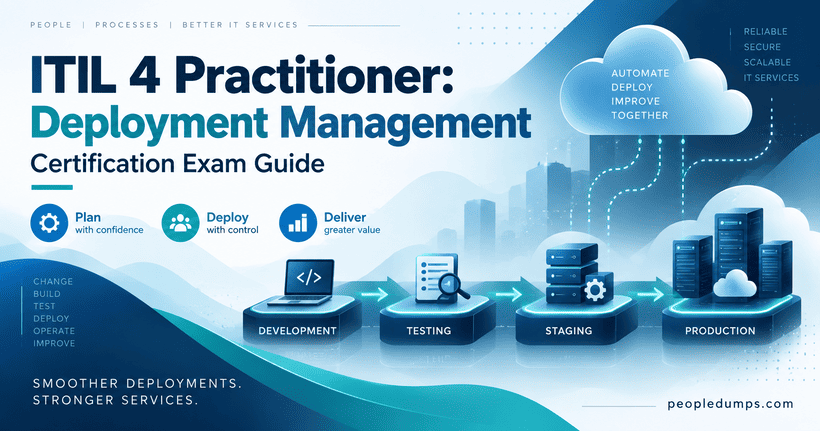
Development → Integration → Testing → Staging → Production
Deployment Management helps ensure that this movement is performed in a controlled, repeatable, observable, and appropriate way.
Depending on the organization, Deployment Management activities may involve:
- Preparing deployment packages
- Checking deployment prerequisites
- Scheduling deployment activities
- Deploying components into target environments
- Validating whether deployment completed correctly
- Automating deployment pipelines
- Monitoring deployment results
- Recording deployment information
- Supporting rollback or remediation activities
- Coordinating with Change Enablement and Release Management
- Maintaining appropriate configuration information
- Improving deployment reliability and speed
Deployment Management vs. Release Management
One of the most important distinctions for the ITIL Deployment Management certification exam is the relationship between Deployment Management and Release Management.
Students often treat these terms as interchangeable, but ITIL distinguishes them.
Deployment Management
Deployment Management focuses on moving components into environments.
For example, version 5.0 of an application may be technically deployed to production servers on Saturday night.
Release Management
Release Management is concerned with making new and changed services and features available for use.
The application might therefore be deployed on Saturday but not released to customers until Monday morning.
This separation is very common in modern software environments.
A feature can be deployed into production but hidden behind a feature flag. The technical deployment has already happened, but the business release can occur later when the feature flag is enabled.
Remember this simple distinction:
Deployment moves components. Release makes functionality or services available for use.
This is one of the most useful conceptual distinctions to understand before taking the exam.
Deployment Management vs. Change Enablement
Deployment Management also works closely with Change Enablement.
Change Enablement focuses on maximizing successful changes by ensuring that risks are properly assessed, changes are authorized appropriately, and change schedules are managed effectively.
Deployment Management performs or coordinates the actual movement of components.
Consider a production database upgrade.
Change Enablement may determine whether the proposed change has an acceptable level of risk and whether the change is authorized.
Deployment Management then handles the controlled deployment of the approved database changes into the production environment.
The two practices support one another, but they solve different management problems.
Deployment Management and Service Configuration Management
Deployment activities can change the configuration of an IT service significantly.
After deploying a new server, application version, network component, container image, or database release, organizations may need to update information about their configuration items and relationships.
This is where Service Configuration Management becomes important.
For example, imagine that an application changes from:
Application Server Version 4.7
to:
Application Server Version 4.8
The deployment pipeline may complete successfully, but the organization also needs reliable information about what is actually running in the production environment.
In mature environments, automation can connect deployment pipelines with configuration management systems so that configuration records remain synchronized with the actual infrastructure.
Deployment Management and IT Asset Management
IT Asset Management and Deployment Management can also interact.
If new physical servers, network devices, laptops, or licensed software are being deployed, the organization may need to maintain:
- Asset ownership information
- License information
- Hardware lifecycle information
- Financial records
- Warranty information
- Contractual information
Deployment Management should therefore not be viewed as an isolated technical activity. ITIL encourages organizations to understand how different management practices work together as part of broader value streams.
Deployment Approaches You Should Understand
The best deployment approach depends on technical architecture, risk, service criticality, customer expectations, automation maturity, and the ability to recover from failure.
Several deployment models are particularly useful to understand when preparing for the ITIL 4 Deployment Management exam.
1. Big-Bang Deployment
In a big-bang deployment, a new version is deployed to the entire target environment within a relatively short period.
This approach can be simple to understand but may create significant risk because a deployment problem can affect a large percentage of users simultaneously.
2. Phased Deployment
A phased deployment introduces the change gradually.
For example, an organization could deploy a new desktop application to:
- 10% of employees first
- 25% after successful validation
- 50% during the next phase
- 100% after confidence has been established
This approach can reduce risk and provide opportunities to identify problems before the entire user population is affected.
3. Continuous Deployment
Continuous deployment is closely associated with DevOps and highly automated software delivery environments.
When changes successfully pass the required automated checks, they can progress automatically through the delivery pipeline and potentially into production.
This requires strong capabilities in areas such as:
- Automated testing
- Version control
- Infrastructure as Code
- Pipeline automation
- Monitoring
- Security automation
- Rollback and recovery
4. Pull Deployment
In a pull model, the target system retrieves the required deployment package rather than having the package pushed centrally to the target.
This technique is common in modern configuration management, endpoint management, container, and cloud-native environments.
Why DevOps Matters to Deployment Management
ITIL 4 and DevOps are sometimes incorrectly described as competing approaches.
In reality, they address many complementary problems.
DevOps emphasizes collaboration, automation, rapid feedback, small changes, and reliable software delivery. ITIL 4 provides management practices that help organizations integrate these technical capabilities with governance, value creation, service management, measurement, suppliers, risks, and customer expectations.
Deployment Management is one of the areas where this relationship is easiest to see.
A traditional deployment might involve:
- A developer manually creates a package.
- An operations engineer copies the package to a server.
- A database administrator executes scripts manually.
- Another administrator changes configuration files.
- The team performs manual validation.
A modern automated deployment pipeline might instead perform:
- Source code commit
- Automated build
- Unit testing
- Security scanning
- Artifact creation
- Integration testing
- Deployment to staging
- Automated validation
- Authorization when required
- Production deployment
- Post-deployment monitoring
The ITIL principle is not that every organization must automate everything. The goal is to use appropriate practices, technology, controls, and automation to create value while managing risk.
CI/CD and Deployment Management
If you work in software development or cloud operations, understanding CI/CD will make Deployment Management much easier to understand.
Continuous Integration
Continuous Integration involves developers frequently integrating changes into a shared source code repository, supported by automated builds and testing.
Continuous Delivery
Continuous Delivery keeps software in a state where it can be released reliably and frequently.
Continuous Deployment
Continuous Deployment goes further by allowing changes that meet defined criteria to be deployed automatically into production.
From an ITIL perspective, CI/CD pipelines can provide important automation for Deployment Management, but automation alone does not guarantee effective deployment management.
An organization must still consider:
- Deployment policies
- Risk
- Governance
- Responsibilities
- Measurement
- Recovery
- Security
- Supplier dependencies
- Service impact
- Continual improvement
Infrastructure as Code and Modern Deployment
Infrastructure as Code, often abbreviated as IaC, has transformed infrastructure deployment.
Instead of manually creating servers, networks, cloud resources, and security policies, teams describe infrastructure using machine-readable definitions.
Technologies commonly associated with this approach include tools such as Terraform, Ansible, Kubernetes manifests, cloud templates, and platform-specific automation technologies.
The major advantage is repeatability.
If infrastructure deployment instructions are stored in version control, reviewed, tested, and executed through automated pipelines, organizations can reduce many errors caused by inconsistent manual configuration.
From a Deployment Management perspective, Infrastructure as Code can contribute to:
- Repeatable deployments
- Faster environment creation
- Better traceability
- Improved standardization
- Easier recovery
- Reduced configuration drift
Deployment Pipelines and Automation
Automation is a major capability for modern Deployment Management.
However, the purpose of automation should not simply be to make deployment faster.
Good deployment automation should make deployment more reliable, repeatable, measurable, auditable, and recoverable.
A mature deployment pipeline may automatically collect information such as:
- Deployment start and finish time
- Application version
- Deployment environment
- Deployment success or failure
- Test results
- Security scan results
- Configuration changes
- Rollback information
- Approvals
- Responsible team
This information can later support troubleshooting, auditing, continual improvement, problem management, and service configuration management.
Deployment Success Factors and Metrics
A good Deployment Management practice should not be measured only by the number of deployments completed.
More deployments are not automatically better deployments.
Useful measurements may include:
- Deployment success rate
- Deployment failure rate
- Percentage of deployments requiring rollback
- Deployment duration
- Lead time
- Deployment frequency
- Number of deployment-related incidents
- Time required to recover from failed deployments
- Percentage of deployment activities automated
- Customer or user impact caused by deployments
Metrics should help the organization make better decisions rather than become targets that encourage undesirable behavior.
For example, a team should not attempt to maximize deployment frequency if doing so causes a sharp increase in production failures.
The objective is to improve the organization’s ability to deploy changes effectively while supporting service value.
Rollback and Recovery
A professional deployment process assumes that deployments can fail.
No amount of testing can guarantee that every production deployment will succeed.
Teams therefore need to consider recovery before deployment begins.
Possible strategies include:
- Restoring a previous software version
- Reverting infrastructure configuration
- Restoring database backups
- Switching traffic to a previous environment
- Disabling a feature flag
- Rolling forward with an emergency correction
The correct approach depends on the architecture and the nature of the change.
For example, rolling back application code may be easy, while rolling back a database schema modification can be significantly more complicated.
Blue-Green and Canary Deployments
Students interested in DevOps should also become familiar with modern deployment techniques even when the ITIL exam is primarily focused on management principles rather than specific products.
Blue-Green Deployment
Two environments are maintained:
- Blue: the currently active production environment
- Green: the environment containing the new version
After the green environment has been validated, production traffic can be switched from blue to green.
This approach can make rollback relatively fast because traffic may be redirected to the previous environment if required.
Canary Deployment
A new version is initially exposed to a small subset of users or traffic.
If monitoring indicates acceptable performance and reliability, the deployment is gradually expanded.
This technique limits the impact of unexpected defects.
The Human Side of Deployment Management
Deployment Management is not only about automation tools and scripts.
Large deployments often require coordination across multiple teams, including:
- Development
- Operations
- Information security
- Database administration
- Network engineering
- Service desk
- Change management
- Release management
- Product owners
- Project managers
- Suppliers
A technically successful deployment can still create business problems if stakeholders are not prepared.
Imagine deploying a completely redesigned customer service application at 9:00 Monday morning without informing the service desk or providing updated support documentation.
The software might work perfectly, but the deployment would still create unnecessary operational risk.
This is why ITIL consistently considers people, processes, technology, partners, information, and value streams rather than treating IT management as a purely technical problem.
How Deployment Management Supports Project Management
For students studying project management, Deployment Management provides a useful bridge between project delivery and operational service management.
A project may successfully develop a new application, but project completion does not automatically mean that the application can be safely introduced into production.
The transition from project delivery into operational use may involve:
- Deployment planning
- Change authorization
- Operational readiness
- Testing
- Support preparation
- Knowledge transfer
- Configuration updates
- Risk management
- Monitoring
- Post-deployment validation
Project managers who understand Deployment Management are therefore better prepared to work with operations and service management teams during implementation.
Is the ITIL 4 Deployment Management Certification Worth It?
The value of the ITIL 4 Deployment Management certification depends on your career direction.
It is particularly relevant for professionals working in or moving toward:
- IT Service Management
- DevOps
- Cloud Operations
- Application Support
- Release Engineering
- Change Management
- Service Transition
- Infrastructure Operations
- Platform Engineering
- IT Project Management
- Service Delivery Management
The certification is not intended to turn someone into a Kubernetes engineer, cloud architect, or DevOps engineer by itself.
Its value is different.
It demonstrates that you understand how deployment capabilities should be organized and managed within a broader service management system.
This is particularly useful for professionals who need to connect technical teams with business processes, governance, service management, and organizational objectives.
Relationship with ITIL 4 Specialist: Plan, Implement and Control
Deployment Management is also part of the broader ITIL 4 Specialist: Plan, Implement and Control area.
PeopleCert groups five closely related practices within this combined module:
- Change Enablement
- Deployment Management
- Release Management
- Service Configuration Management
- IT Asset Management
The relationship between these practices makes practical sense.
Consider deploying a major new business application:
- Change Enablement helps manage change risk and authorization.
- Release Management manages making new functionality available.
- Deployment Management moves components into the required environments.
- Service Configuration Management helps maintain reliable information about service configurations.
- IT Asset Management manages relevant assets throughout their lifecycle.
Studying these practices together can provide a much clearer understanding of how ITIL works in real organizations.
Who Should Take the Deployment Management Exam?
The ITIL 4 Practitioner Deployment Management exam can be useful for several groups.
Students
If you already understand ITIL Foundation concepts and want to explore how IT services are actually changed and deployed, this module offers a practical next step.
Junior IT Professionals
Service desk analysts, system administrators, application support engineers, and junior cloud engineers can benefit from understanding what happens beyond their individual technical tasks.
Project Managers
Project professionals responsible for technology implementations frequently need to coordinate deployment, change, release, testing, support, and operational readiness activities.
DevOps and Operations Professionals
For technically experienced professionals, the certification can provide a management framework for understanding how deployment pipelines contribute to organizational service value.
ITSM Professionals
Professionals working with Incident Management, Problem Management, Change Enablement, Release Management, Service Configuration Management, or Continual Improvement will find significant overlap with Deployment Management.
How Difficult Is the ITIL 4 Deployment Management Exam?
The exam should be manageable for candidates who understand ITIL 4 Foundation and carefully study the official practice guidance.
The biggest challenge is usually not the number of questions. It is distinguishing concepts that appear similar.
For example:
- Deployment Management versus Release Management
- Deployment Management versus Change Enablement
- Outputs versus outcomes
- Activities versus practice success factors
- Metrics versus objectives
- Technology capability versus management responsibility
Do not prepare by memorizing isolated sentences without understanding their context.
Instead, ask:
- What problem is this practice trying to solve?
- Who needs the information?
- What value does the activity create?
- Which other ITIL practice should be involved?
- What could go wrong?
- How could the activity be measured?
- Where could automation improve the practice?
Recommended Exam Preparation Strategy
Step 1: Review ITIL 4 Foundation Concepts
Make sure you still understand the basic ITIL vocabulary, including:
- Value
- Service
- Utility and warranty
- Service relationships
- Guiding principles
- Service Value System
- Service Value Chain
- Four Dimensions of Service Management
- Continual improvement
Step 2: Learn the Purpose of Deployment Management
You should be able to explain the purpose of the practice in your own words rather than simply memorizing a definition.
Step 3: Understand the Related Practices
Spend extra time comparing Deployment Management with:
- Change Enablement
- Release Management
- Service Configuration Management
- IT Asset Management
- Monitoring and Event Management
- Incident Management
- Information Security Management
Step 4: Understand Modern Deployment Technology
You do not need to become a DevOps engineer to pass the ITIL exam, but understanding the following concepts makes many questions easier:
- CI/CD
- Version control
- Automated testing
- Infrastructure as Code
- Containers
- Deployment pipelines
- Feature flags
- Rollback
- Blue-green deployment
- Canary deployment
Step 5: Study Metrics and Practice Success
Understand why organizations measure deployment performance and how measurements can support better decisions.
Step 6: Practice Scenario Questions
When answering ITIL Deployment Management exam questions, first identify what the scenario is really testing.
Look for words associated with:
- Moving components → Deployment Management
- Making features available → Release Management
- Assessing or authorizing change → Change Enablement
- Configuration information → Service Configuration Management
- Asset lifecycle or financial value → IT Asset Management
Step 7: Practice Under Time Pressure
Thirty minutes for 20 questions gives an average of approximately 90 seconds per question.
That is normally enough time, but only if you avoid spending several minutes debating one difficult question.
A practical approach is:
- Answer questions you know confidently.
- Mark uncertain questions for review when the examination interface permits.
- Eliminate obviously incorrect answers.
- Return to difficult questions with the remaining time.
Common Exam Mistakes
Mistake 1: Treating Deployment and Release as the Same Thing
This is probably the most important conceptual error to avoid.
Mistake 2: Thinking Deployment Management Is Only Technical
The practice also involves people, information, processes, partners, metrics, governance, and continual improvement.
Mistake 3: Assuming Automation Eliminates Management
Automation changes how work is performed. It does not eliminate the need to manage risk, responsibilities, measurement, security, and value.
Mistake 4: Memorizing Answers Instead of Concepts
If a question changes the scenario slightly, memorized answers can quickly become unreliable.
Mistake 5: Ignoring Other ITIL Practices
Deployment Management almost never operates completely independently.
A Simple Real-World Deployment Example
Suppose a university is introducing a new student registration portal.
The development team finishes version 1.0 and creates a deployment package.
The organization might proceed as follows:
- The application is deployed into a test environment.
- Automated and manual tests confirm that the application works correctly.
- The application is deployed into staging.
- Operational teams validate monitoring, backup, security, and support requirements.
- The production change receives the appropriate authorization.
- The application is deployed into production.
- Deployment validation confirms that the required components are operating.
- Configuration information is updated.
- The service is released to students.
- Monitoring identifies any unexpected behavior.
This example demonstrates why Deployment Management should be understood as part of a wider value stream rather than as a single installation task.
Career Value of the Certification
An ITIL certification should not be evaluated only by whether it immediately produces a salary increase.
The greater value comes from building a structured understanding of IT management.
A professional who understands Deployment Management can participate more effectively in discussions such as:
- Why are production deployments failing?
- Why are deployments taking several hours?
- Which deployment activities should be automated?
- How should deployment risks be controlled?
- What information should be recorded?
- Should we use phased deployment?
- How should rollback work?
- How do deployment and release differ?
- How do we reduce deployment-related incidents?
- How do DevOps pipelines fit into IT service management?
That knowledge is useful well beyond the examination itself.
Maintaining Your ITIL Certification
PeopleCert certifications are subject to its current certification renewal policy. PeopleCert currently describes ITIL certifications as having a three-year renewal cycle and provides mechanisms for keeping certifications current, including continuing certification activity within the same product suite and qualifying Continuing Professional Development activities.
Because certification policies can change, always review the latest PeopleCert requirements rather than relying solely on older training material or forum posts.
Frequently Asked Questions
How many questions are on the ITIL 4 Practitioner: Deployment Management exam?
The current PeopleCert exam contains 20 multiple-choice questions.
How long is the Deployment Management exam?
The standard examination duration currently listed by PeopleCert is 30 minutes.
What score is required to pass?
The pass mark is 65%, which means candidates need at least 13 correct answers out of 20.
Is the exam open book?
No. PeopleCert currently lists the ITIL 4 Practitioner: Deployment Management examination as closed book.
Is ITIL 4 Foundation required?
ITIL 4 Foundation is the most common prerequisite for new ITIL candidates. PeopleCert also recognizes certain other qualifying ITIL credentials according to its current certification requirements.
What is the difference between deployment and release?
Deployment is primarily concerned with moving service components into an environment. Release Management focuses on making new or changed services and features available for use.
Is Deployment Management useful for DevOps professionals?
Yes. The practice has strong connections with CI/CD pipelines, deployment automation, Infrastructure as Code, continuous delivery, configuration management, monitoring, and modern software delivery.
Is this certification useful for project managers?
Yes, particularly for technology project managers. Understanding deployment helps project managers coordinate the transition from development and project delivery into live operational environments.
Should I learn specific tools such as Jenkins, Kubernetes, Terraform, or Ansible for the exam?
You do not need to become an expert in a specific product simply to understand ITIL Deployment Management. However, familiarity with CI/CD, Infrastructure as Code, deployment automation, cloud platforms, and modern DevOps practices provides valuable practical context.
Final Thoughts
The ITIL 4 Practitioner: Deployment Management certification may look like a small specialist qualification, but the subject sits at the heart of modern IT delivery.
Every organization that develops software, operates cloud infrastructure, updates business applications, manages endpoints, or changes production systems needs some form of deployment capability.
The technology has changed dramatically over the years. Manual installations have evolved into automated pipelines, containers, Infrastructure as Code, feature flags, blue-green environments, and continuous deployment.
The management challenge, however, remains familiar: move the right components to the right environment, at the right time, with an appropriate level of control, reliability, visibility, and risk.
If you are preparing for the exam, focus less on memorizing isolated definitions and more on understanding the relationships between Deployment Management, Change Enablement, Release Management, Service Configuration Management, IT Asset Management, DevOps, and continual improvement.
For structured preparation, review the ITIL 4 Practitioner: Deployment Management exam preparation resources and combine practice questions with a solid understanding of the official ITIL concepts.
That approach will not only improve your chances of passing the exam. It will also make the certification much more useful when you encounter real deployment problems in an IT organization.
Official and Authoritative References
-
PeopleCert – ITIL 4 Practitioner: Deployment Management
PeopleCert Official Deployment Management Certification Page -
PeopleCert – ITIL Certifications
PeopleCert ITIL Certification Portfolio -
PeopleCert – ITIL 4 Management Practices
Explore ITIL 4 Management Practices -
PeopleCert – ITIL 4 Specialist: Plan, Implement and Control
Plan, Implement and Control Certification -
PeopleCert – Certification Renewal and CPD
PeopleCert Certification Renewal Information
Note: Exam formats, prerequisites, available languages, prices, training requirements, and certification renewal policies may be updated by PeopleCert. Candidates should always verify the latest information on the official PeopleCert website before purchasing or scheduling an examination.





