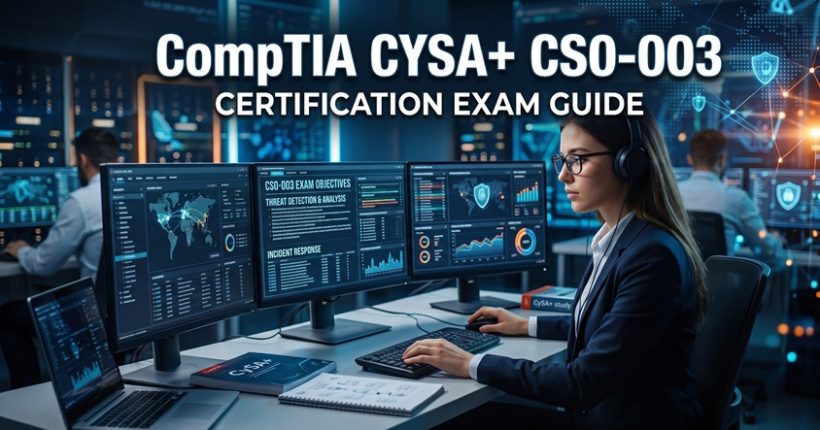
If Security+ teaches you the language of cybersecurity, CompTIA Cybersecurity Analyst (CySA+) asks whether you can use that language while an incident is unfolding.
The current CySA+ V4 exam, CS0-004, is built around the work performed by defensive security teams: reviewing logs, investigating suspicious behavior, prioritizing vulnerabilities, responding to incidents, improving security operations, and explaining technical risk to people who may never open a SIEM console.
That distinction matters. CySA+ is not mainly a test of memorizing definitions. You still need solid theory, but the harder questions tend to ask what an analyst should notice, what evidence matters, what should happen next, or which action reduces risk without creating a larger operational problem.
For students and early-career professionals, that makes CySA+ an interesting certification. It sits beyond entry-level security knowledge, yet its subject matter is close enough to real SOC work that studying for it can also give you a useful roadmap for building practical defensive skills.
CompTIA CySA+ CS0-004 Exam at a Glance
Table of Contents
Toggle| Exam Item | CS0-004 Details |
|---|---|
| Certification | CompTIA Cybersecurity Analyst (CySA+) V4 |
| Exam Code | CS0-004 |
| Launch Date | June 23, 2026 |
| Number of Questions | Maximum of 85 |
| Question Types | Multiple-choice and performance-based questions (PBQs) |
| Exam Time | 165 minutes |
| Passing Score | 750 on a scale of 100–900 |
| Recommended Experience | Approximately four years of hands-on experience in a SOC analyst or vulnerability analyst role |
The experience recommendation can look intimidating if you are a student. It is better to read it as a signal about the level of judgment the exam expects, not as a rule that prevents you from studying earlier. A student who has strong networking fundamentals, Security+-level knowledge, several home labs, and repeated practice analyzing real logs may be much better prepared than someone who has spent years in IT without doing security analysis.
One practical warning: CS0-004 is the current CySA+ V4 exam. If a course, book, practice test, or video series is built for CS0-003, do not assume it maps perfectly to the current blueprint. Much of the core security knowledge still transfers, but V4 changes the weighting and gives more explicit attention to AI-assisted security operations, identity and cloud activity, automation, modern vulnerability prioritization, and business-focused reporting.
CS0-004 Exam Domains and Weighting
| Domain | Weight | What It Means in Practice |
|---|---|---|
| 1.0 Security Operations | 34% | Detection, log and telemetry analysis, threat intelligence, hunting, architecture, security tools, automation, AI-related security operations |
| 2.0 Vulnerability Management | 26% | Scanning, validating findings, prioritizing risk, remediation, controls, and risk-based vulnerability decisions |
| 3.0 Incident Response and Management | 24% | Investigation, containment, eradication, recovery, evidence, response processes, and post-incident improvement |
| 4.0 Reporting and Communication | 16% | Metrics, incident reporting, vulnerability reporting, stakeholder communication, escalation, and translating technical findings into business impact |
The weighting tells you something important about the identity of the certification. Nearly one-third of the exam is Security Operations, but the remaining domains make it clear that a good analyst is not simply a person who can recognize malware. Analysts also need to understand exposure, decide what to fix first, manage incidents methodically, and communicate well enough that other teams can act.
What Skills Does CySA+ CS0-004 Actually Validate?
1. Reading Security Telemetry Instead of Just Naming Security Tools
A beginner often learns tools as a vocabulary list: SIEM, EDR, IDS, IPS, packet analyzer, vulnerability scanner. CySA+ pushes you one step further. The question becomes: What evidence would this tool show, and what can you infer from it?
For example, a suspicious login by itself may not prove much. A better investigation might correlate an unusual authentication event with a new endpoint process, DNS requests to an unfamiliar domain, a burst of outbound traffic, and a privilege change. None of those signals exists in isolation in a real SOC, and the exam increasingly rewards that kind of correlation mindset.
Useful technologies to practice with include Windows Event Viewer, Sysmon, Wireshark, Zeek, a SIEM platform such as Splunk or Wazuh, and endpoint telemetry from EDR-style tools. You do not need to become an expert administrator of every product. You do need to become comfortable looking at timestamps, source and destination addresses, process trees, authentication events, commands, hashes, network connections, and alert context.
2. Threat Hunting and MITRE ATT&CK Thinking
CySA+ expects more than reactive alert handling. Threat hunting starts with a hypothesis or a behavior worth looking for, then uses available telemetry to determine whether that behavior is present.
MITRE ATT&CK is especially useful because it gives defenders a common language for adversary tactics and techniques. Instead of saying, “The attacker did something suspicious with PowerShell,” an analyst can think in terms of execution behavior, credential access, persistence, defense evasion, lateral movement, and other observable techniques.
This is a valuable shift for beginners: indicators such as IP addresses and file hashes can change quickly, but adversary behavior is often more reusable for detection engineering and hunting.
3. Vulnerability Management Based on Risk, Not Panic
One of the easiest mistakes in vulnerability management is to treat every high CVSS score as an emergency. Real environments are messier.
Suppose two vulnerabilities both have serious technical severity. One affects an isolated lab system with no sensitive data. The other affects an internet-facing identity server, has public exploitation activity, and sits in the authentication path for hundreds of users. A competent analyst should not treat those two findings as equivalent.
CS0-004 reflects modern risk-based prioritization. You should understand how several inputs work together:
- CVSS helps describe technical severity.
- EPSS estimates the probability that a published vulnerability will be exploited in the wild.
- CISA KEV identifies vulnerabilities known to have been exploited.
- Asset criticality tells you how important the affected system is to the organization.
- Exposure tells you whether the vulnerable service is reachable and by whom.
- Compensating controls may reduce risk while a permanent fix is being tested or scheduled.
The important skill is prioritization. A vulnerability program exists to reduce organizational risk, not to produce the largest possible spreadsheet of red cells.
4. Incident Response as a Controlled Process
During an incident, technical skill matters, but sequence matters too. An analyst who immediately deletes suspicious files may destroy evidence. An analyst who isolates the wrong system may interrupt a critical business service. An analyst who waits too long for certainty may give an attacker more time to move laterally.
Study incident response as a repeatable process: preparation, detection and analysis, containment, eradication, recovery, and post-incident improvement. Also understand evidence handling, documentation, escalation, root-cause analysis, lessons learned, and the trade-offs between short-term containment and business continuity.
This is one reason hands-on labs are important for CySA+. Reading an incident response flowchart is useful; working through a scenario where you have incomplete evidence is much closer to the thinking the exam wants.
5. AI and Automation in Modern Security Operations
One of the most notable changes in CySA+ V4 is the explicit treatment of AI in security operations. CompTIA’s 2026 V4 announcement highlights AI-assisted log analysis, automation, and security risks such as hallucinations and data exposure.
For an analyst, the right mental model is not “AI replaces investigation.” It is “AI can accelerate parts of investigation, but its output still needs validation.” An AI system may summarize a large volume of alerts or help draft a report, but analysts still need to confirm the evidence, protect sensitive data, understand model limitations, and recognize attacks against AI-enabled workflows.
Automation has a similar role. SOAR playbooks and scripts can enrich alerts, open tickets, query reputation sources, disable accounts, or trigger containment actions. The value comes from consistency and speed. The risk comes from automating a bad decision at machine speed.
6. Reporting: The Skill Technical People Often Underestimate
A cybersecurity analyst can be technically correct and still fail operationally if nobody understands the recommendation.
Imagine telling a business owner: “CVE severity is critical and the host has suspicious outbound connections.” That may be accurate, but the person making a remediation decision also needs to know the affected service, likelihood of exploitation, possible impact, current containment status, recommended action, urgency, and operational trade-offs.
That is why Reporting and Communication deserves serious study even though it has the smallest domain percentage. Learn the difference between a technical incident note, an executive summary, a vulnerability remediation report, a dashboard metric, and an escalation message. Good security communication is concise, evidence-based, and written for a specific audience.
How Valuable Is the CompTIA CySA+ Certification?
CySA+ has value because it occupies a useful middle ground in the certification market. It is vendor-neutral, defensive in orientation, and more operational than a broad foundational certification.
For someone targeting blue-team work, it can support several career directions:
- Security Operations Center (SOC) Analyst
- Cybersecurity Analyst
- Incident Response Analyst
- Vulnerability Management Analyst
- Threat Intelligence or Threat Hunting roles at the junior-to-intermediate level
- Security-focused system or network administration
However, a certification should not be treated as a replacement for experience. Passing CySA+ proves that you met an exam standard; it does not prove that you have investigated a production ransomware incident at 3 a.m. Employers know the difference.
The strongest way to use the certification is to pair it with evidence of practice: a small home lab, sanitized investigation write-ups, detection rules, packet-analysis exercises, SIEM dashboards, vulnerability-prioritization exercises, or a GitHub repository containing scripts and defensive tooling notes. That combination tells a much stronger story than a certification badge alone.
CySA+ vs. Security+, PenTest+, and SecurityX
| Certification | Main Focus | Best Fit |
|---|---|---|
| CompTIA Security+ | Core cybersecurity concepts and baseline security skills | Students, IT professionals moving into security, entry-level security candidates |
| CompTIA CySA+ | Defensive analysis, detection, vulnerability management, incident response, reporting | Aspiring or working SOC analysts and blue-team professionals |
| CompTIA PenTest+ | Offensive security, penetration testing, vulnerability exploitation and reporting | People pursuing penetration testing or offensive security |
| CompTIA SecurityX | Advanced enterprise security architecture, engineering, governance, and complex security decisions | Experienced security professionals moving into advanced technical roles |
If your goal is SOC or defensive security work, Security+ followed by CySA+ is a logical progression. If you are more interested in offensive testing, PenTest+ may fit better. Learning some offensive concepts is still valuable for a defender, but CySA+ is primarily about detecting, investigating, prioritizing, and responding.
How Difficult Is the CS0-004 Exam?
CySA+ is usually difficult for a different reason than a memorization-heavy exam. Many questions contain several answers that sound technically reasonable. The task is to choose the one that best fits the evidence, the stage of the incident, the business requirement, or the security objective.
Expect to be tested on questions such as:
- Which log entry is the strongest indicator of malicious activity?
- What should the analyst do next after confirming a compromise?
- Which vulnerability should be remediated first?
- Which data source would best validate a hypothesis?
- Which containment action reduces risk with the least operational impact?
- Which metric or report is appropriate for a technical team versus management?
The wording “best,” “most likely,” “first,” and “next” matters. Those questions test prioritization and process, not just factual recall.
Performance-Based Questions: Why Hands-On Practice Matters
Performance-based questions are one of the reasons you should not prepare for CySA+ using flashcards alone. A PBQ may require you to inspect information, connect several clues, classify activity, choose response actions, or work through a simulated security task.
A useful exam strategy is to avoid getting trapped in one complicated PBQ at the beginning. If the interface allows you to flag and return to it, collect the easier points first and come back with enough time to think. More importantly, prepare before exam day by doing small investigations where the answer is not already explained in the lab title.
A Practical CS0-004 Study Plan for Students and Junior Analysts
Phase 1: Fix the Foundations
Before diving into advanced threat hunting, make sure you are comfortable with TCP/IP, common ports and protocols, DNS, HTTP/S, authentication, Windows and Linux basics, access control, encryption concepts, network segmentation, and Security+-level security terminology.
If you cannot look at a packet capture or authentication log and explain what the normal traffic should look like, detecting abnormal behavior will be much harder.
Phase 2: Build a Small Security Operations Lab
You do not need an enterprise SOC in your bedroom. A few virtual machines can teach a lot. Generate normal and suspicious activity, collect logs, and practice answering simple questions:
- Which user logged in?
- From which source?
- What process started next?
- Which network connection followed?
- Does the timeline make sense?
- What additional evidence would confirm the conclusion?
Practice with Wireshark, Sysmon, Windows logs, Linux logs, Zeek, and a SIEM platform. The goal is not to memorize an interface. The goal is to learn how evidence is represented.
Phase 3: Practice Vulnerability Prioritization
Take a list of vulnerabilities and rank them using more than CVSS. Add asset importance, internet exposure, EPSS, KEV status, available patches, exploit maturity, and compensating controls. Then write two sentences explaining why your top item deserves priority.
That exercise combines technical analysis and reporting, which is exactly the kind of cross-domain thinking that makes CySA+ easier.
Phase 4: Run Incident Scenarios
Create short scenarios around phishing, credential theft, suspicious PowerShell, web exploitation, ransomware, cloud account abuse, or unusual outbound traffic. For each scenario, document:
- What triggered the investigation?
- What evidence should be collected?
- What hypothesis are you testing?
- What containment action is appropriate?
- What would eradication and recovery look like?
- What should be reported afterward?
Phase 5: Use Practice Exams as Diagnostics
A practice test is most useful when it tells you why you were wrong. Track missed questions by domain and by mistake type. Did you lack knowledge? Misread “first” versus “best”? Ignore business impact? Choose a technically possible answer instead of the operationally correct one?
When you move into exam-focused review, make sure your CS0-004 exam preparation is aligned with the current V4 objectives rather than an older CySA+ blueprint. Use practice material to identify weak domains, then return to the underlying concepts, logs, tools, and workflows until you understand why an answer is correct.
Do not chase a giant number of practice questions at the expense of understanding. Repeatedly memorizing answer banks creates false confidence and does very little for your ability to handle PBQs or unfamiliar scenarios.
Common Mistakes When Preparing for CySA+ CS0-004
- Studying only definitions: CySA+ rewards interpretation and decision-making.
- Ignoring networking: Security analysis without network fundamentals becomes guesswork.
- Using outdated CS0-003 material as the main source: V4 has different emphasis and updated objectives.
- Memorizing CVSS scores without learning prioritization: Severity is only one part of vulnerability risk.
- Skipping reporting: Communication is an exam domain and a real job requirement.
- Over-focusing on tools: Products change. Analytical concepts transfer.
- Avoiding labs until the end: Practical work should run alongside theory from the beginning.
Is CySA+ CS0-004 Good for Beginners?
It depends on what “beginner” means.
If you are new to IT and still learning IP addressing, operating systems, and basic security terminology, CySA+ is probably too early. Security+ or equivalent foundational study will give you a better starting point.
If you are a computer science, networking, or cybersecurity student who already understands basic networking and security and you are willing to build a lab, CySA+ can be a productive next target. You may not have four years of professional SOC experience, but you can still train the analytical habits the exam is designed to measure.
A good readiness test is simple: when you see a suspicious event, can you explain what additional evidence you would collect and why? If your first instinct is only to search for the definition of the alert name, keep building fundamentals. If you naturally start thinking about context, telemetry, timeline, impact, and response options, you are moving toward the CySA+ mindset.
Frequently Asked Questions
Does CS0-004 include artificial intelligence topics?
Yes. CySA+ V4 explicitly expands coverage of AI in security operations, including practical uses such as analysis and automation as well as risks such as inaccurate output, sensitive-data exposure, and attacks against AI-enabled workflows.
Do I need to know programming for CySA+?
You do not need to be a software developer, but basic scripting literacy is valuable. Be comfortable reading simple command-line output, scripts, structured data such as JSON, and automation logic. Analysts often need to understand what a script is doing even when they did not write it.
Is CySA+ an offensive or defensive certification?
Primarily defensive. You need to understand attacker techniques because defenders must recognize them, but the exam focuses on detection, analysis, vulnerability management, incident response, and communication rather than penetration testing as the main job function.
Is CySA+ enough to get a SOC analyst job?
No certification can guarantee a job. CySA+ can strengthen your resume and provide a structured learning path, but labs, internships, troubleshooting ability, communication, networking knowledge, and evidence of practical work remain important.
Should I take Security+ before CySA+?
You do not need to think of certifications as a mandatory ladder, but Security+-level knowledge is an excellent foundation for CySA+. If core networking, access control, cryptography, common attacks, and security architecture are still unfamiliar, strengthen those areas first.
Final Thoughts
The best way to understand the CompTIA CySA+ CS0-004 certification exam is to stop thinking of it as a collection of cybersecurity facts. It is an analyst exam.
You are expected to look at evidence, separate signal from noise, decide what matters first, act without losing control of the incident, and explain the result clearly. The V4 update makes that even more obvious by adding stronger emphasis on AI-assisted operations, automation, identity and cloud activity, modern vulnerability prioritization, and business-oriented reporting.
For students and junior professionals, the certification is most valuable when the study process changes how you work. If preparing for CySA+ teaches you to read logs more carefully, question alert context, rank vulnerabilities by real risk, document investigations, and communicate findings clearly, then the benefit goes well beyond passing CS0-004.
External References and Authoritative Resources
- CompTIA CySA+ V4 Official Certification Page — official exam and certification information.
- CompTIA CySA+ V4 Launch Announcement — CompTIA’s June 23, 2026 announcement describing the updated focus on AI, automation, modern infrastructure, vulnerability prioritization, threat detection, and reporting.
- MITRE ATT&CK — adversary tactics and techniques used for threat-informed defense, detection, and threat hunting.
- NIST SP 800-61 Rev. 3 — current NIST incident response recommendations aligned with the Cybersecurity Framework 2.0.
- CISA Known Exploited Vulnerabilities (KEV) Catalog — authoritative catalog of vulnerabilities known to be exploited in the wild.
- FIRST Exploit Prediction Scoring System (EPSS) — probability-focused data for vulnerability prioritization.
- FIRST Common Vulnerability Scoring System (CVSS) — technical vulnerability severity scoring resources.