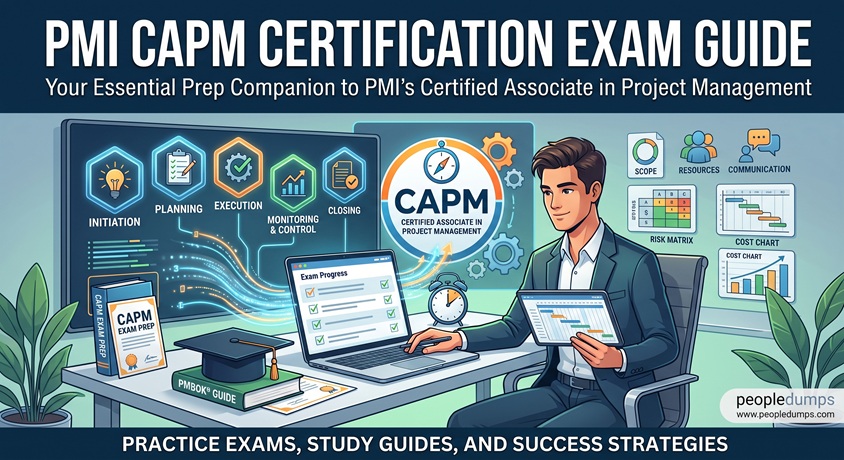
If you are interested in project management but do not yet have the experience required for an advanced certification, the Certified Associate in Project Management (CAPM)® is one of the most practical places to start.
Offered by the Project Management Institute (PMI), the CAPM certification is designed around the knowledge and skills expected from entry-level and associate-level project professionals. More importantly, the modern CAPM exam is no longer simply a test of project management terminology. It covers predictive project management, Agile approaches, business analysis, stakeholder communication, project controls, requirements, and the practical decisions project team members face in real working environments.
This CAPM Certification Exam Guide explains what the certification is, who should consider it, the current exam structure, the four CAPM exam domains, important project management techniques, preparation strategies, and the career value of becoming CAPM certified.
If you are already planning your study schedule, you can also explore these CAPM certification exam preparation resources alongside the official PMI exam objectives to strengthen your understanding of the topics covered on the test.
Updated for 2026. Exam policies can change, so candidates should always confirm final requirements with PMI before scheduling an exam.
What Is the CAPM Certification?
Table of Contents
ToggleCAPM stands for Certified Associate in Project Management. It is a professional project management certification offered by the Project Management Institute (PMI).
The certification is aimed primarily at people who want to demonstrate that they understand the foundations of professional project management but have not yet accumulated extensive project leadership experience.
This makes CAPM especially relevant to:
- University and college students interested in project management
- Recent graduates entering project-based industries
- Project coordinators and project administrators
- Junior project managers
- PMO analysts and support staff
- Business analysts working with project teams
- Technical professionals who regularly participate in projects
- Professionals planning to pursue PMP® certification later in their careers
One important difference between CAPM and many technology certifications is that PMI does not require candidates to have years of professional project management experience before applying. That makes CAPM particularly accessible to students and early-career professionals.
CAPM Exam Quick Facts
| Item | CAPM Exam Information |
|---|---|
| Certification | Certified Associate in Project Management (CAPM)® |
| Certification Body | Project Management Institute (PMI) |
| Experience Required | No professional project management experience required |
| Education Requirement | Secondary degree or global equivalent |
| Project Management Education | At least 23 hours completed before the exam |
| Number of Questions | 150 |
| Scored Questions | 135 |
| Unscored Pretest Questions | 15 |
| Exam Duration | 180 minutes |
| Exam Delivery | Pearson VUE testing center or secure online testing |
| Certification Maintenance | 15 PDUs during each three-year certification cycle |
Candidates should always check PMI’s official certification information before applying because fees, testing policies, available languages, and administrative requirements can change over time.
CAPM Certification Requirements
The eligibility requirements are one reason CAPM works well as an entry-level project management certification.
To qualify for the CAPM exam, candidates currently need:
- A secondary degree, such as a high school diploma, GED, or global equivalent
- At least 23 hours of project management education completed before taking the examination
The key point is that professional project management experience is not required.
The 23 hours of project management education can be particularly useful for beginners because it provides a structured introduction to the terminology, processes, tools, and decision-making frameworks used throughout the profession.
However, candidates should not treat those 23 hours as the entire preparation process. Meeting the application requirement and being ready to answer 150 CAPM exam questions are two different things.
Understanding the CAPM Exam Format
The CAPM exam contains 150 questions and provides candidates with 180 minutes to complete them.
Of those 150 questions, 135 are scored and 15 are unscored pretest questions. Candidates are not told which questions are unscored, so every question should be approached as if it contributes to the final result.
The exam is also more interactive than candidates sometimes expect. Depending on the exam form and delivery method, candidates may encounter:
- Traditional multiple-choice questions
- Drag-and-drop or matching questions
- Hot spot questions
- Scenario-based questions
- Comic-strip-based scenarios
- Animation-based questions in supported testing environments
There is a 10-minute break after the first 75 questions once that section has been reviewed. After beginning the break, candidates cannot return to questions from the completed section.
This makes time management part of the exam strategy rather than something to think about only on exam day.
CAPM Exam Domains and Their Weightings
The CAPM examination is organized around four major domains. Understanding their weightings is important because it helps candidates allocate study time intelligently.
| CAPM Exam Domain | Exam Weight |
|---|---|
| Project Management Fundamentals and Core Concepts | 36% |
| Predictive, Plan-Based Methodologies | 17% |
| Agile Frameworks/Methodologies | 20% |
| Business Analysis Frameworks | 27% |
These percentages immediately reveal something important about modern CAPM preparation: studying traditional project management processes alone is not enough.
Agile and business analysis together account for nearly half of the examination. Candidates who concentrate almost entirely on predictive project management may leave large knowledge gaps.
A balanced preparation plan should therefore combine the official exam objectives with structured CAPM exam study resources that cover all four domains rather than concentrating on only one part of the syllabus.
Domain 1: Project Management Fundamentals and Core Concepts – 36%
This is the largest CAPM exam domain and provides the conceptual foundation for everything else.
You should be comfortable distinguishing between projects, programs, portfolios, and operational work. You also need to understand how projects move through different life cycles and why one project may require a predictive approach while another works better with an adaptive or hybrid approach.
Important concepts include:
- Project, program, portfolio, and operations
- Predictive and adaptive project approaches
- Project life cycles
- Project planning
- Scope, schedule, cost, quality, resources, and risk
- Risks, issues, assumptions, and constraints
- Risk registers and stakeholder registers
- Project roles and responsibilities
- Project sponsors and project managers
- Leadership versus management
- Emotional intelligence
- Communication and stakeholder engagement
- Project closure and transition
- PMI ethics and professional conduct
For beginners, this domain is not difficult because of mathematics. The challenge is learning to distinguish concepts that initially sound similar.
For example, a risk is an uncertain event that may affect the project in the future, while an issue is something that has already happened or currently requires attention. CAPM questions may place these concepts inside a scenario rather than simply asking for a definition.
Domain 2: Predictive, Plan-Based Methodologies – 17%
Predictive project management is what many beginners initially imagine when they hear the term project management: define the work, create a plan, build a schedule, establish a budget, execute the project, monitor performance, and manage changes against the baseline.
Although this domain represents 17% of the exam, it contains several important techniques that every project professional should understand.
Work Breakdown Structure
A Work Breakdown Structure (WBS) decomposes project scope into smaller and more manageable components. Candidates should understand the relationship among deliverables, work packages, activities, and the project scope.
Critical Path Method
The Critical Path Method (CPM) helps determine the sequence of activities that controls the earliest possible project completion date.
You should understand concepts such as:
- Activity dependencies
- Early start and early finish
- Late start and late finish
- Float or slack
- Critical activities
You do not need to become a scheduling specialist, but you should be able to interpret a simple project network and understand why a delay on the critical path can affect the completion date.
Cost and Schedule Performance
CAPM candidates should also understand basic project performance measurements.
Two useful formulas are:
Schedule Variance (SV) = Earned Value (EV) − Planned Value (PV)
Cost Variance (CV) = Earned Value (EV) − Actual Cost (AC)
A negative schedule variance generally indicates that work is behind the planned position, while a negative cost variance indicates unfavorable cost performance.
The objective should not be to memorize formulas in isolation. Understand what the numbers mean for the project.
Domain 3: Agile Frameworks and Methodologies – 20%
Agile is now an essential part of CAPM preparation.
The exam expects candidates to understand when an adaptive approach is appropriate, how iterations are planned, how work is prioritized, and how Agile teams control and communicate work differently from traditional predictive projects.
Important concepts can include:
- Adaptive versus predictive approaches
- Iterative and incremental delivery
- Scrum
- Kanban
- Extreme Programming (XP)
- Scaled Agile concepts
- Product backlogs
- Iteration planning
- Prioritization
- Adaptive project tracking
- Continuous feedback
One of the most important skills here is knowing when Agile makes sense.
If requirements are expected to evolve and frequent customer feedback is valuable, an adaptive approach may be appropriate. If the scope is highly stable, regulated, and predictable, a plan-driven approach may provide better control.
CAPM questions frequently reward understanding of context rather than blindly selecting Agile or predictive methods as universally superior.
Domain 4: Business Analysis Frameworks – 27%
Business analysis represents 27% of the CAPM exam, making it the second-largest domain.
This surprises some candidates, especially those who use older CAPM preparation materials.
Modern project teams do more than manage schedules and budgets. They must understand what stakeholders actually need, convert those needs into requirements, confirm acceptance criteria, and help ensure that the final product creates value.
Important business analysis topics include:
- Business analyst roles and responsibilities
- Stakeholder identification
- Internal and external stakeholders
- Requirements elicitation
- Stakeholder interviews
- Surveys and workshops
- User stories
- Use cases
- Requirements traceability matrices
- Product backlogs
- Acceptance criteria
- Product roadmaps
- Release planning
- Requirements validation
A strong way to prepare for this domain is to study requirements as part of a workflow rather than as isolated definitions:
Identify stakeholders → understand needs → elicit requirements → analyze and prioritize requirements → document them → trace them → validate delivery.
Once that sequence makes sense, many business analysis questions become easier to reason through.
Is the CAPM Exam Difficult?
CAPM is an entry-level certification, but entry-level does not mean effortless.
The main challenge is breadth. Candidates need to move between traditional project planning, Agile delivery, leadership concepts, stakeholder communication, business analysis, risk management, scheduling, and project controls.
Another challenge is the style of the questions.
Knowing that a risk register records identified risks is useful. Being given a scenario and deciding whether the project team should update the risk register, issue log, stakeholder register, backlog, or another artifact requires a deeper level of understanding.
For this reason, memorization alone is rarely the best CAPM exam preparation strategy.
Is CAPM Certification Worth It?
For the right candidate, yes—but its value should be understood realistically.
A CAPM certification does not automatically turn someone with no experience into a senior project manager. What it does is provide independent evidence that the candidate understands a recognized project management framework and has invested time in developing professional project skills.
That can be valuable when applying for positions such as:
- Project Coordinator
- Project Administrator
- Junior Project Manager
- Assistant Project Manager
- Project Analyst
- PMO Analyst
- Project Support Specialist
It can also benefit people who are not pursuing a dedicated project manager title. Engineers, developers, analysts, consultants, operations staff, and other technical specialists frequently work inside projects and benefit from understanding scope, dependencies, risks, stakeholders, schedules, and delivery methods.
CAPM vs PMP: What Is the Difference?
CAPM and PMP are both PMI credentials, but they are designed for professionals at very different stages of their careers.
| Area | CAPM | PMP |
|---|---|---|
| Career Level | Entry or associate level | Experienced project professional |
| Project Experience | Not required | Professional project leadership experience required |
| Primary Goal | Validate foundational project management knowledge | Validate project leadership capability and experience |
| Best For | Students, graduates, coordinators, junior professionals | Experienced project managers and project leaders |
If you already have substantial project leadership experience, PMP may be the more appropriate objective.
If you are still developing that experience, CAPM provides a structured foundation and can help you learn the language and logic of professional project management before moving toward more advanced credentials.
What Should You Study for the CAPM Exam?
A common preparation mistake is treating the CAPM exam as a test based on a single book.
PMI’s Exam Content Outline makes it clear that the examination covers concepts drawn from multiple areas of modern project practice. The PMBOK® Guide remains important, but candidates should also understand predictive processes, Agile practices, and business analysis.
A practical CAPM study structure is:
- Start with the CAPM Exam Content Outline. Understand exactly what PMI expects you to know.
- Build your project management foundation. Learn life cycles, roles, planning, scope, risk, schedule, cost, stakeholders, and communication.
- Study predictive project management. Focus on WBS, scheduling, critical path, controls, variance, and project documentation.
- Learn Agile concepts. Understand Scrum, Kanban, iterative delivery, backlogs, prioritization, and adaptive planning.
- Give business analysis serious attention. It represents 27% of the exam.
- Practice scenario-based questions. Learn why an answer is correct rather than simply memorizing it.
- Take timed practice exams. Develop the ability to answer questions consistently while managing the three-hour exam window.
Once you have completed the first pass through the exam objectives, using additional Certified Associate in Project Management (CAPM) study materials can help you identify topics that still need review and become more comfortable with exam-style questions.
A Practical 8-Week CAPM Study Plan
The right study duration depends on your background, but beginners may find an eight-week structure easier to manage than trying to absorb everything immediately before the exam.
Week 1: Understand the Exam and Project Fundamentals
Read the CAPM Exam Content Outline and study projects, programs, portfolios, operations, project life cycles, stakeholders, risks, issues, assumptions, and constraints.
Week 2: Planning and Project Roles
Study scope, schedule, cost, quality, resources, communication, risk, project managers, sponsors, team responsibilities, leadership, and emotional intelligence.
Week 3: Predictive Project Management
Focus on the WBS, network diagrams, dependencies, critical path, project controls, change, schedule variance, and cost variance.
Week 4: Agile Fundamentals
Study adaptive delivery, Scrum, Kanban, iterations, backlogs, prioritization, Agile roles, and the differences between predictive and adaptive approaches.
Week 5: Business Analysis
Spend a full study week on stakeholders, requirements elicitation, user stories, use cases, traceability, acceptance criteria, roadmaps, and requirements validation.
Week 6: Integrated Scenario Practice
Begin mixing all four domains. This forces you to determine which framework applies rather than answering questions from a predictable chapter.
Week 7: Timed Practice Exams
Complete longer practice sessions under realistic time constraints. Track weak areas instead of focusing only on your total score.
Week 8: Final Review
Review incorrect answers, formulas, Agile terminology, business analysis techniques, project artifacts, and the topics you still confuse. Avoid attempting to relearn the entire curriculum during the final few days.
How to Use CAPM Practice Questions Effectively
Practice questions are most useful when they expose weaknesses in your reasoning.
For every question you answer incorrectly, ask:
- Which CAPM domain does this question belong to?
- Which concept did I misunderstand?
- Why is the correct answer better than the alternatives?
- Did I miss a keyword or condition in the scenario?
- Was I applying a predictive principle to an Agile situation, or the reverse?
This method turns question practice into actual learning.
Simply completing a large number of questions without reviewing the reasoning behind the answers can create false confidence. A better approach is to combine concept review with carefully selected CAPM practice and exam preparation resources and then revisit every weak topic you identify.
CAPM Exam Time Management
You have 180 minutes for 150 questions. That gives you an average of roughly 72 seconds per question.
That does not mean every question must be completed in exactly 72 seconds. Some definition-based questions may take only a few seconds, while scenario questions, calculations, or interactive questions may require considerably more time.
A practical strategy is to avoid spending several minutes fighting with a single difficult question while easier questions remain unanswered.
Use the review function appropriately, pay attention to the first 75-question section, and remember that once you begin the scheduled break you cannot return to that completed section.
CAPM Exam Preparation Mistakes to Avoid
1. Studying Only the PMBOK Guide
The current exam includes substantial Agile and business analysis content. PMBOK knowledge is valuable, but it should not be your only preparation resource.
2. Ignoring Business Analysis
At 27% of the examination, business analysis deserves nearly as much attention as the fundamentals domain.
3. Memorizing Without Understanding
Knowing a definition is different from recognizing when a concept should be applied inside a project scenario.
4. Avoiding Practice Questions Until the End
Questions should be used throughout your study plan. They are one of the fastest ways to identify misunderstandings.
5. Memorizing Every Formula Without Understanding the Meaning
You should know relevant calculations, but also understand what a positive or negative result tells a project manager.
6. Assuming CAPM Is Easy Because Experience Is Not Required
The lack of an experience prerequisite makes the certification accessible. It does not reduce the breadth of knowledge that candidates are expected to demonstrate.
How to Maintain Your CAPM Certification
Passing the examination is not the end of the certification process.
CAPM holders currently need to earn 15 Professional Development Units (PDUs) during each three-year certification cycle.
PMI divides professional development into areas associated with its Talent Triangle, including Ways of Working, Power Skills, and Business Acumen.
This continuing education requirement is useful because project management does not stand still. Agile practices, digital collaboration, data-driven decision-making, AI-assisted project work, and changing business environments continue to influence how projects are planned and delivered.
Frequently Asked Questions About the CAPM Certification
What does CAPM stand for?
CAPM stands for Certified Associate in Project Management, a professional certification offered by the Project Management Institute.
Do I need project management experience for CAPM?
No. The CAPM certification does not currently require professional project management experience. Candidates must meet PMI’s educational eligibility requirements, including the required project management education.
How many questions are on the CAPM exam?
The CAPM examination contains 150 questions. Of these, 135 are scored and 15 are unscored pretest questions.
How long is the CAPM exam?
Candidates receive 180 minutes to complete the CAPM exam.
What is the CAPM passing score?
PMI does not publish a simple fixed percentage such as 70% as the universal CAPM passing mark. Candidates should therefore be cautious about websites that claim a specific unofficial percentage is guaranteed to represent the current passing score.
Can I take the CAPM exam online?
Yes. PMI currently provides both Pearson VUE testing-center delivery and secure online testing options, subject to applicable scheduling and testing policies.
Can I retake the CAPM exam if I fail?
Under current PMI policy, candidates may attempt the examination up to three times within their one-year eligibility period. Retake fees and additional policies may apply.
Is CAPM useful before PMP?
Yes. CAPM can be a logical first step for someone who wants to build formal project management knowledge before accumulating the experience needed for PMP certification.
Is CAPM useful for students?
CAPM can be particularly useful for students and recent graduates because it does not require several years of project management experience. It can help demonstrate familiarity with professional project terminology, Agile and predictive methods, business analysis, and project team practices.
How long should I study for CAPM?
There is no single study duration that works for everyone. Someone already working in projects may need less preparation than a student encountering project management for the first time. A structured six- to eight-week plan is a reasonable starting point for many beginners, provided that it includes regular practice questions and review.
Final Thoughts: Should You Earn the CAPM Certification?
The CAPM certification makes the most sense when you view it as a foundation rather than a finish line.
It teaches the vocabulary of professional project management, but the real value comes from understanding how scope, schedule, cost, risk, stakeholders, Agile delivery, requirements, and business objectives fit together.
For students, recent graduates, project coordinators, technical professionals, and aspiring project managers, CAPM can provide a structured path into the profession without requiring years of prior project leadership experience.
The modern CAPM exam also reflects how project work has changed. Predictive project planning remains important, but project professionals increasingly need to move between traditional planning, Agile delivery, stakeholder collaboration, and business analysis.
That broader skill set is what makes preparing for the CAPM worthwhile even beyond the certification itself.
If you are preparing for the exam, start with PMI’s official CAPM Exam Content Outline, organize your study plan around the four exam domains, and supplement your learning with reliable CAPM exam preparation and practice materials. Focus on understanding why an answer is correct rather than simply memorizing terminology.
CAPM is an entry-level certification, but the knowledge behind it can become the foundation for a much longer career in project management.
Official References and Further Reading
For candidates preparing for the PMI Certified Associate in Project Management (CAPM) exam, the following official PMI and authoritative project management resources provide additional information about exam requirements, project management fundamentals, predictive methodologies, Agile frameworks, business analysis, and professional project management practices.
- PMI Certified Associate in Project Management (CAPM) – Official Certification Page
– PMI’s official CAPM certification page covering eligibility requirements, exam information, certification benefits, application procedures, and the path to earning the CAPM credential. - CAPM Exam Content Outline (ECO)
– The official PMI examination blueprint describing the domains, tasks, knowledge areas, question structure, and skills assessed on the current CAPM examination. - PMI CAPM Exam Preparation Resources
– PMI’s official exam preparation portal providing access to the CAPM Exam Content Outline, Certification Handbook, official certification guide, sample questions, and other preparation resources. - PMI CAPM Official Exam Reference List
– PMI’s official reference list identifying publications and resources used when developing CAPM exam content across project management fundamentals, predictive approaches, Agile methodologies, and business analysis. - PMI Certification Handbook and Certification Resources
– Official PMI resources covering certification applications, examination policies, scheduling, eligibility, maintaining certifications, and other important candidate requirements. - A Guide to the Project Management Body of Knowledge (PMBOK® Guide)
– PMI’s flagship project management standard and an important resource for understanding project management principles, performance domains, value delivery, governance, scope, schedule, stakeholders, resources, risk, and modern project delivery practices. - PMI Agile Practice Guide
– An official PMI resource covering Agile principles, adaptive delivery, Lean thinking, Kanban, team collaboration, value delivery, and the selection of predictive, Agile, and hybrid approaches. - The PMI Guide to Business Analysis
– PMI’s authoritative resource for business analysis concepts, including requirements management, stakeholder engagement, needs assessment, solution evaluation, and the role of business analysis in successful project delivery.